From Silmarillion:
Among the tales of sorrow and ruin that come down to us from the darkness of those days, there are yet some in which amid weeping there is joy and under the shadow of death, light that endures. And of these histories most fair still in the ears of elves is the tale of Beren and Luthien. Of their lives was made the Lay of Leithian, Release from Bondage, which is the longest save one of the songs concerning the world of old.
Beren, son of Barahir renowned in wars against Morgoth, was of Mankind, and desired Luthien Tinuviel the fairest ever among both the children of Illuvatar to walk the earth. And she had a far greater lineage--her mother was none other than Melian the maia and her father, Elu Thingol, the Elven Lord of Doriath. When Beren asked Thingol for Luthien's hand, Thingol was enraged at this insolence, but Melian counselled him to forgo his wrath. He then said:
"I see the ring [of Barahir, an heirloom], son of Barahir, and I preceive that you are proud, and deem yourself mighty. But a father's deeds, even had his services rendered to me, avail not to win the daughter of Thingol and Melian. See now! I too desire a treasure that is withheld. For rock and steel and fires of Morgoth keep the jewel away that I would possess against all the powers of elf kingdoms.Yet I hear you say that bonds such as these do not daunt you. Go your way therefore! Bring to me in your hand, a Silmaril from Morgoth's crown; and then if she will, Luthien may set her hand in yours. Then you shall have my jewel; and though the fate of Arda lie within the Silmarils, yet you shall hold me generous."
Thus he wrought the doom of Doriath, and was ensnared within the curse of Mandos.
But Beren laughed. "For little price", he said, "do Elven-kings sell their daughters: for gems, and things made by craft. But if this be your will, Thingol, I will perform it. And when me meet again, my hand shall hold a Silmaril from the Iron Crown; for you have not looked the last upon Beren son of Barahir".
Forth went Beren from the halls of Thingol, and at length came to the King of Nargothrond, Finrod Felagund, the fairest of the house of Finwe. With ten other companions, they set out on a wondrously impossible quest to wrest a Simlaril from the Iron Crown of Morgoth. By the arts of Finrod, they passed unnoticed till they ventured into a pass guarded by a Tower, built in the past, by Finrod himself. Incidentally, it was named as Minas Tirith when it was built, but it fell into Morgoth's hands and was remaned as Tol-in-Gaurhoth. But that tower was now held by the most fell of all the servants of Morgoth-- Sauron, who of old was named Gorthaur, and he was now aware of them:
Thus befell the contest of Sauron and Felagund which is renowned. For Felagund strove with Sauron in songs of Power, and the power of the King was very great; but Sauron had the mastery, as is told in the Lay of Leithian:
He chanted a song of wizadry,
Of piercing, opening, of treachery,
Revealing, uncovering, betraying.
Then suddenFelagund there swaying,
Sang in answer a song of staying,
Resisting, battling against power,
Of secrets kept, strength like a Tower,
And trust unbroken, freedom, escape;
Of changing and, of shifting shape,
Of snares eluded, of broken traps,
The prison opening, the chain that snaps.
Backwards and forwards swayed their song.
Reeling and foundering, as ever more strong
The chanting swelled, Felagund fought
And all the magic and might he brought
Of Elvenesse into his words.
Softly in the gloom they heard the birds
Singing afar in Nargothrond,
The sighing of the sea beyond,
Beyond the western world, on sand,
On sand of pearls in Elvenland.
Then the gloom gathered; darkness glowing
In Valinor, the red blood flowing
Beside the sea where the Noldor slew
The Foamriders, and stealing drew
Their white ships and their white sails
From Lamplit havens. The wind wails,
The wolf howls. The ravens flee.
The ice mutters in the mouths of the Sea.
The captives sad in Angband mourn,
Thunder rumbles, the fires burn--
And Finrod fell before the throne.
Thus was Felagund imprisoned in dark pits of Tol-in-Gaurhoth along with Beren and the companions . The latter part of the tale has much to say on sacrifice, courage, and victory. The first union of Elf and Man was that of Luthien and Beren. Of this union sprang the lines of both Elves and Men. Both Elrond and Aragorn are from this same root.
Monday, March 27, 2006


Wednesday, March 22, 2006
A silly lil American song
A silly lil American song
My girlfriend’s boyfriend is from Alabama!
O Boy! He’s such a panorama!
A frets about and mucks about,
Really makes a lot of melodrama!
Once muh girl went to see the south side,
She had a great time in the farms wide,
He saw her there, and made the dare,
She fell for his long and huge….. homa!
Muh girlfriend’s boyfriend is a great countryman
Eveready for war, and he is a nascar-man!
An ardent fan, of dubyaman,
His neck has a reddish red chroma!
And now muh girlfriend don’t love me no more,
She says that I am a huge huge bore,
She likes him and he likes her,
O why don’t I die of melanoma!
--Kedar.
My girlfriend’s boyfriend is from Alabama!
O Boy! He’s such a panorama!
A frets about and mucks about,
Really makes a lot of melodrama!
Once muh girl went to see the south side,
She had a great time in the farms wide,
He saw her there, and made the dare,
She fell for his long and huge….. homa!
Muh girlfriend’s boyfriend is a great countryman
Eveready for war, and he is a nascar-man!
An ardent fan, of dubyaman,
His neck has a reddish red chroma!
And now muh girlfriend don’t love me no more,
She says that I am a huge huge bore,
She likes him and he likes her,
O why don’t I die of melanoma!
--Kedar.
Saturday, March 11, 2006
Manikarnika
I was searching for Manikarnika on the net and found this:
http://www.beezone.com/edwardo/PeterM/ManikarnikaGhat/latest.htm
http://www.beezone.com/edwardo/PeterM/ManikarnikaGhat/latest.htm
Tuesday, March 07, 2006
Been there, done that?
After the War of Wrath in the middle earth, the Evil in the north was utterly destroyed and there was established a lasting Elven kingdom in Eregion near Khazad-Dum in the misty mountains. There was great friendship between the Elves and Dwarves at that time, and it is said:
"In Eregion, the craftsmen of Gwaith-i-Mirdain, the people of the Jewel-smiths, surpassed in cunning all that have ever been wrought, save only Feanor himself; and indeed greatest in skill among them was Celebrimbor, son of Curufin [son of Feanor]..."
In that time, there came one who called himself 'Annatar', giver of gifts who was of fair and wise hue. Though he was not received elsewhere, he was gladly welcomed in Eregion. The legend says:
"and for a while, they had much profit from his friendship and they learnt many things, for his knowledge was great. In those days, the smiths of Ost-in-Edhil [city of the Elves] surpassed all that they had contrived before; and they took thought and made Rings of Power."
But he guided their labours and he was aware of all that they did. The Elves made many rings, but he made the One Ring to rule them all, for He was none other than Sauron himself, and he ever desired to presuade Elves to his service. When the war of wrath was fought between Morgoth and the rest of the Valar, Morgoth's castle at Thangorodrim was utterly destroyed, Morgoth himself captured, and his most of his servants were either killed or captured. But Sauron eluded them and could not be captured. And he resolved to make himself the Lord of the Middle Earth, thinking that the Valar have forgotten the Middle Earth.
Much is now known to all about the power of the One Ring. But it is said:
"But the Elves were not so lightly to be caught. As soon as Sauron set the One Ring upon his finger, they were aware of him; and they knew him, and perceived that he would be master of them, and of all they wrought. Then in anger and fear they took off their rings. But he, finding that he was betrayed and that they Elves were not deceived, was filled with wrath; and he came against them with open war..."
Of that war, much evil and grief came to pass.
-------------------------------------------------------------------------------------------------------
At this very moment in the international politics, I fear there is one more Annatar at large, deceiving countries with his guile and submitting them to his will, where guile works not. And we are glad to have him as a friend, and are making deals with him. I only hope we Indians dont not have to flee for cover once his deception is revealed to the world.
"In Eregion, the craftsmen of Gwaith-i-Mirdain, the people of the Jewel-smiths, surpassed in cunning all that have ever been wrought, save only Feanor himself; and indeed greatest in skill among them was Celebrimbor, son of Curufin [son of Feanor]..."
In that time, there came one who called himself 'Annatar', giver of gifts who was of fair and wise hue. Though he was not received elsewhere, he was gladly welcomed in Eregion. The legend says:
"and for a while, they had much profit from his friendship and they learnt many things, for his knowledge was great. In those days, the smiths of Ost-in-Edhil [city of the Elves] surpassed all that they had contrived before; and they took thought and made Rings of Power."
But he guided their labours and he was aware of all that they did. The Elves made many rings, but he made the One Ring to rule them all, for He was none other than Sauron himself, and he ever desired to presuade Elves to his service. When the war of wrath was fought between Morgoth and the rest of the Valar, Morgoth's castle at Thangorodrim was utterly destroyed, Morgoth himself captured, and his most of his servants were either killed or captured. But Sauron eluded them and could not be captured. And he resolved to make himself the Lord of the Middle Earth, thinking that the Valar have forgotten the Middle Earth.
Much is now known to all about the power of the One Ring. But it is said:
"But the Elves were not so lightly to be caught. As soon as Sauron set the One Ring upon his finger, they were aware of him; and they knew him, and perceived that he would be master of them, and of all they wrought. Then in anger and fear they took off their rings. But he, finding that he was betrayed and that they Elves were not deceived, was filled with wrath; and he came against them with open war..."
Of that war, much evil and grief came to pass.
-------------------------------------------------------------------------------------------------------
At this very moment in the international politics, I fear there is one more Annatar at large, deceiving countries with his guile and submitting them to his will, where guile works not. And we are glad to have him as a friend, and are making deals with him. I only hope we Indians dont not have to flee for cover once his deception is revealed to the world.
Thursday, March 02, 2006
This and that
The other day, I was watching TV (I moved to my friend's house) late night. I was racing towards Star World to watch whatever was left of Seinfeld with all the speed my fingers could provide, when suddenly I had to apply the air-brake-- at an unlikely stop-- DD-8 Saptagiri.
They were showing a documentary on Amaraavathi. The head priest with his immaculate diction was explaining that panchaaraamaas are five aaraamaas such as Daakshaaraamam, etc., and that Amaraavathi is actually Amaraaraamam, and so on. After that, when I was about to press on the accelerator again, I had to drop the idea ..This time, a lalitha geetham. A truly wonderful Keeravaani duet. I dont remember the names of the 2 singers, but I guess I havent seen the last of them, that is, if I am able to keep track of DD8 at that hour everyday.
An then, to top it all, at 11:30 in the night, of the programmes on all the channels, Aanando-Brahma!!! The jaw dropped--half an hour of great humour, of stupendous acting (even "ok" acting skills are a rare commodity these days), and of those good old characters we grew up watching on television-- before there was something called cableTV, before there were instruments called cell phones, before there was a field called IT....
What I would not give to watch, just once, "pandhula pempakam" on vyavasaayadaarula kaaryakramam... that would have been a perfect birthday gift, though I am more than happy with what I got.
They were showing a documentary on Amaraavathi. The head priest with his immaculate diction was explaining that panchaaraamaas are five aaraamaas such as Daakshaaraamam, etc., and that Amaraavathi is actually Amaraaraamam, and so on. After that, when I was about to press on the accelerator again, I had to drop the idea ..This time, a lalitha geetham. A truly wonderful Keeravaani duet. I dont remember the names of the 2 singers, but I guess I havent seen the last of them, that is, if I am able to keep track of DD8 at that hour everyday.
An then, to top it all, at 11:30 in the night, of the programmes on all the channels, Aanando-Brahma!!! The jaw dropped--half an hour of great humour, of stupendous acting (even "ok" acting skills are a rare commodity these days), and of those good old characters we grew up watching on television-- before there was something called cableTV, before there were instruments called cell phones, before there was a field called IT....
What I would not give to watch, just once, "pandhula pempakam" on vyavasaayadaarula kaaryakramam... that would have been a perfect birthday gift, though I am more than happy with what I got.
Tuesday, February 28, 2006
Sunday Outing
"You dont know Kannada?" He asked suddenly In English.
I fought hard to restrain from showing any signs of amazement. Only a smile and a sideways shake of head.
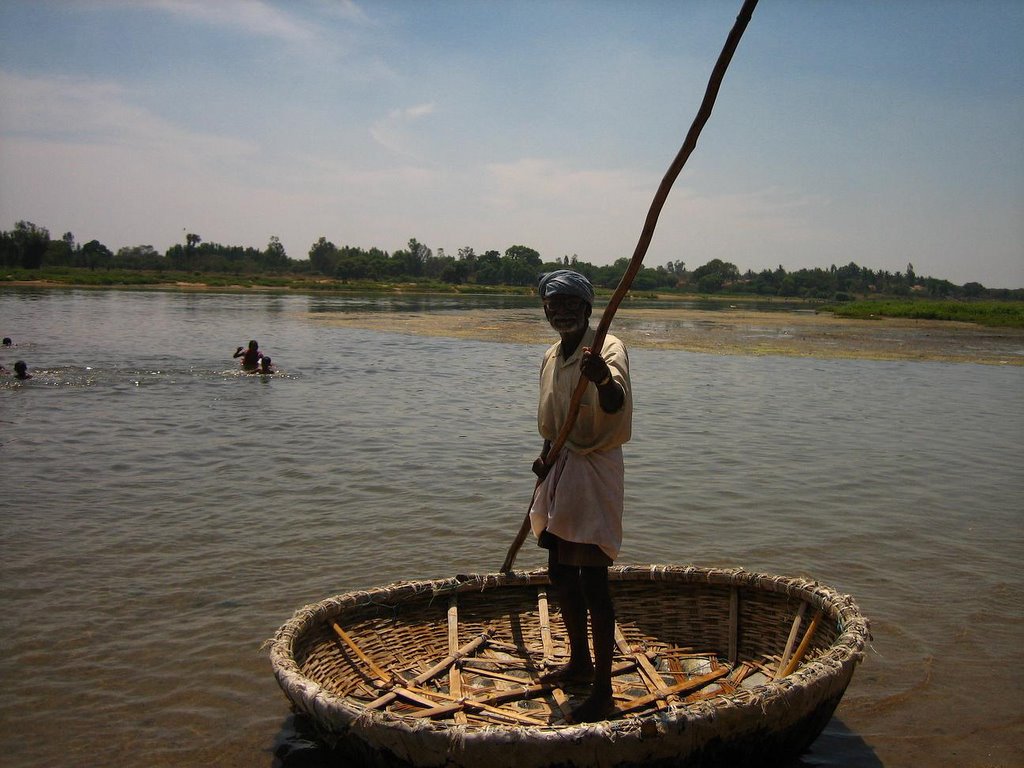
"Ok. Send this picture to my address". He removed his wallet and showed his address:
D.Mahadevayya (Community Health Guide/ Boat Man)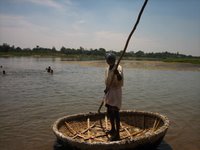
s/o. Devarasanayaka
Kaliyur, Narasipur Taluk
Mysore Dist.
I guess everybody here knows English, given the fact its a tourist spot. The place is Talakadu, about 140 Km. from bangalore. We had just taken a ride in his "theppa" (a disc shaped boat) across to the opposite bank of Kavery and back. I also made him pose for a photograph.
The plan was to go to a place called "Shivanasamudra", a place with scenic beauty and some water falls on saturday Feb 25th 2006 so that I can attend a concert on Sunday eve (Shivaratri). But the trip got deferred to Sunday. We started off in a qualis, and after having our breakfast at a town called "Bididhi", famous for its huge idli called "thatte idli", we reached there after nearly 3 hours, not to mention the absence of a tar-road. Yet it was surreal sight watching people on top of private busses going to almost unreachable place of the same country of which Bangalore was once a part.

While travelling, I happened to see a hill to my left and a temple gopuram appeared on top of it. The driver informed us that its a nice Shiva temple. We took a detour and he parked near the base of the hill. On top of this hill called Somashaila presides Lord Mallikarjuna. Seemingly very old architecture, we had a nice bit of climb, given the fact that "Bangaloreans" tire easily.
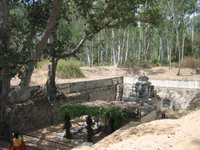 After that, we went to the Kavery river bank, and driver made it a point to repeat that all this water goes to Tamil Nadu. Perhaps he was expecting some comment from us... Anyway, we found a lot more sand than we were expecting. One can see how Kavery's course changed over the millenia. Someone told us about a few ancient recently discovered monuments and temples here. No time was lost-- up we went to the other side of the undulating land with sand top. The first monument we sighted was the Pataleshwara temple.
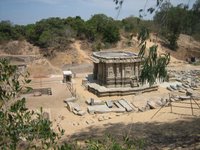 Further on, we came across a huge circular valley with a very ancient construction amidst. A guide was heard telling some interested telugu people that this was one of the pancha Narayanas established by Ramanuja. This was recently discovered and was in a bad shape before they dis-assembled it and put it back. A bigger temple also exists here, still in the dis-assembled state. Efforts are on to number the stone-blocks used and arrange them back.
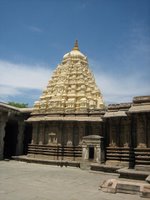
Very close by is the Vaidyeshwara temple. If the other two were old, this must be much older. With that amazing architecture in sight and no one to stop us from capturing it on camera, we cut loose with our weapons. The statue of the deity had an imposing and commanding presence, given the rather large and relatively dark hall, giving it an hoary appeal.
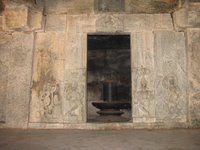
One of the places in that temple that caught my attention was the five lingas in the rooms at the back of the temple. The Linga shown here is the centre most and most imposing one. It reminds me of Egyptian Architecture. And inside lives, verily, Pharaoh of the Worlds! From here on, we went to the Kavery bank. After Swimming (I cant, so I didnt), Theppa rides and water melons , we came back here for lunch. There is a very small mess just in front of the temple declaring that it is a "brahmin tiffin and mess". What more to be needed from life?? We had our fill there alright!
All said and done, this was my best Shivaratri ever when I visited three Temples of Shiva-- one on top of a hill, one below ground and one on level ground. Lord of the Three Worlds! Icing on the cake: I cannot forget the coincidence that the boat man's name was Mahadevayya, who helped us cross the river (of our life?) on that holy day. Alas! A symbolist's predicament! Looking too much into everything!
Then we went to the water falls about an hour from there( which might need another post...)
Kedar.
I fought hard to restrain from showing any signs of amazement. Only a smile and a sideways shake of head.
"Ok. Send this picture to my address". He removed his wallet and showed his address:
D.Mahadevayya (Community Health Guide/ Boat Man)
s/o. Devarasanayaka
Kaliyur, Narasipur Taluk
Mysore Dist.
I guess everybody here knows English, given the fact its a tourist spot. The place is Talakadu, about 140 Km. from bangalore. We had just taken a ride in his "theppa" (a disc shaped boat) across to the opposite bank of Kavery and back. I also made him pose for a photograph.
The plan was to go to a place called "Shivanasamudra", a place with scenic beauty and some water falls on saturday Feb 25th 2006 so that I can attend a concert on Sunday eve (Shivaratri). But the trip got deferred to Sunday. We started off in a qualis, and after having our breakfast at a town called "Bididhi", famous for its huge idli called "thatte idli", we reached there after nearly 3 hours, not to mention the absence of a tar-road. Yet it was surreal sight watching people on top of private busses going to almost unreachable place of the same country of which Bangalore was once a part.
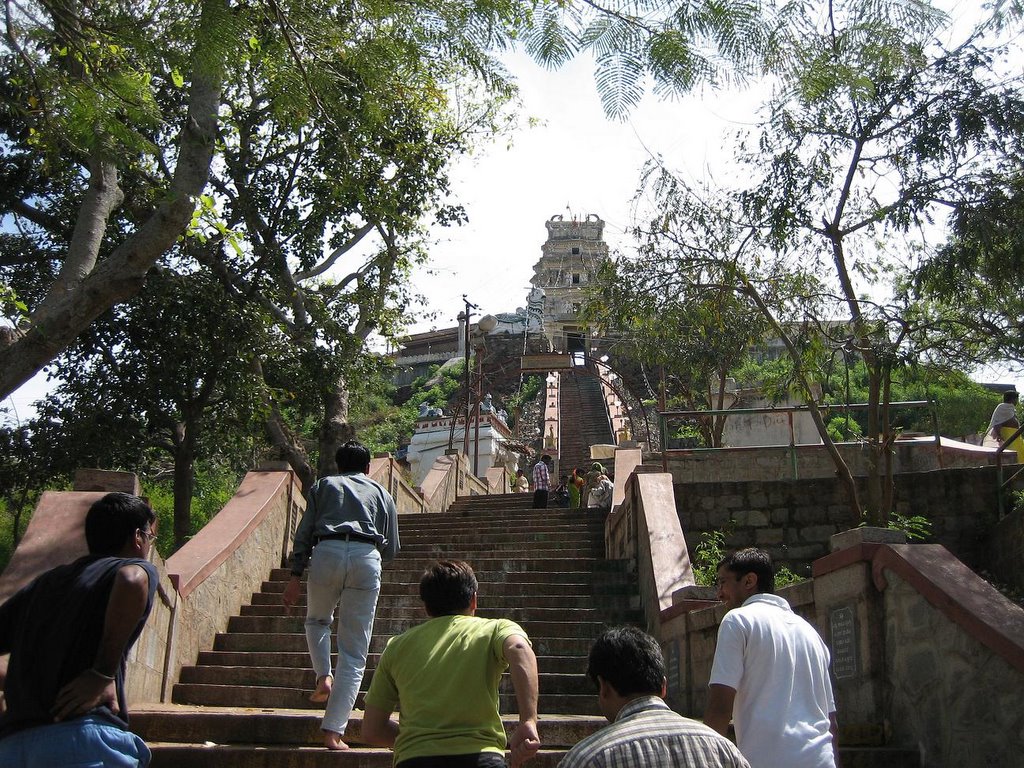
While travelling, I happened to see a hill to my left and a temple gopuram appeared on top of it. The driver informed us that its a nice Shiva temple. We took a detour and he parked near the base of the hill. On top of this hill called Somashaila presides Lord Mallikarjuna. Seemingly very old architecture, we had a nice bit of climb, given the fact that "Bangaloreans" tire easily.
 After that, we went to the Kavery river bank, and driver made it a point to repeat that all this water goes to Tamil Nadu. Perhaps he was expecting some comment from us... Anyway, we found a lot more sand than we were expecting. One can see how Kavery's course changed over the millenia. Someone told us about a few ancient recently discovered monuments and temples here. No time was lost-- up we went to the other side of the undulating land with sand top. The first monument we sighted was the Pataleshwara temple.
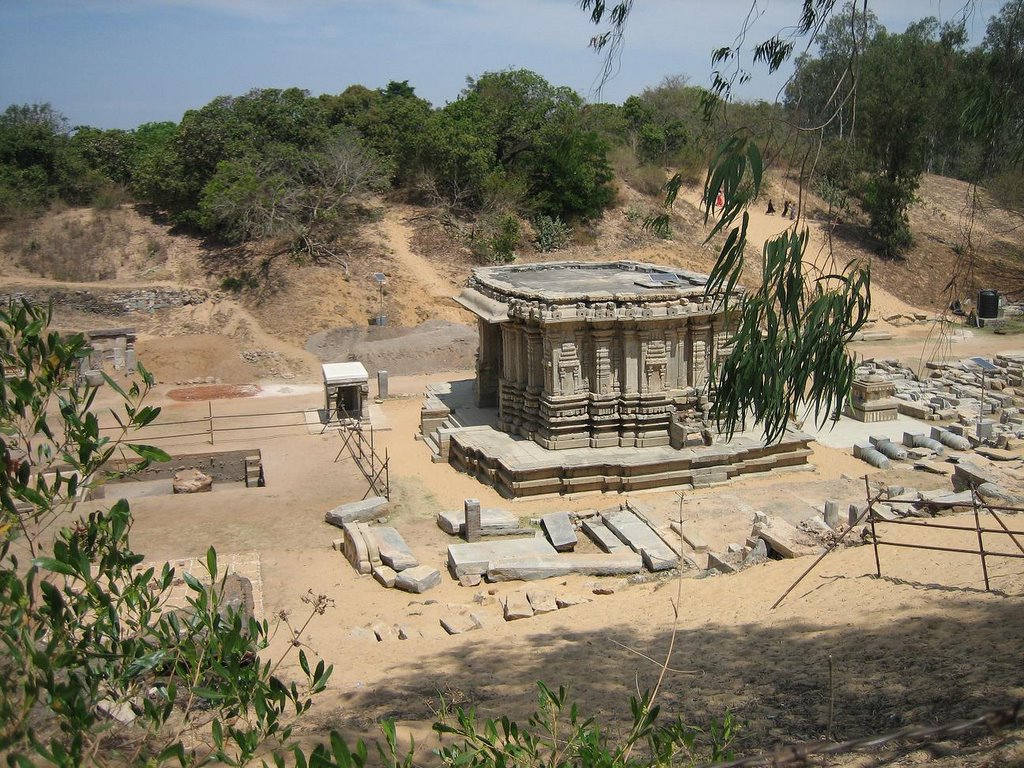 Further on, we came across a huge circular valley with a very ancient construction amidst. A guide was heard telling some interested telugu people that this was one of the pancha Narayanas established by Ramanuja. This was recently discovered and was in a bad shape before they dis-assembled it and put it back. A bigger temple also exists here, still in the dis-assembled state. Efforts are on to number the stone-blocks used and arrange them back.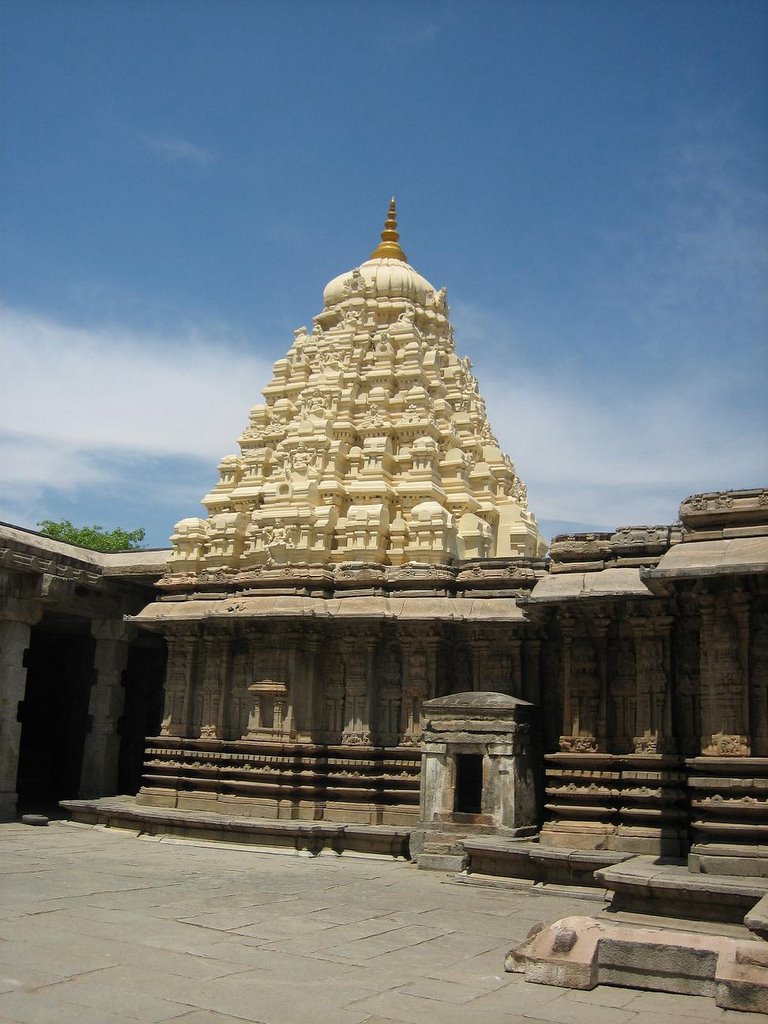
Very close by is the Vaidyeshwara temple. If the other two were old, this must be much older. With that amazing architecture in sight and no one to stop us from capturing it on camera, we cut loose with our weapons. The statue of the deity had an imposing and commanding presence, given the rather large and relatively dark hall, giving it an hoary appeal.
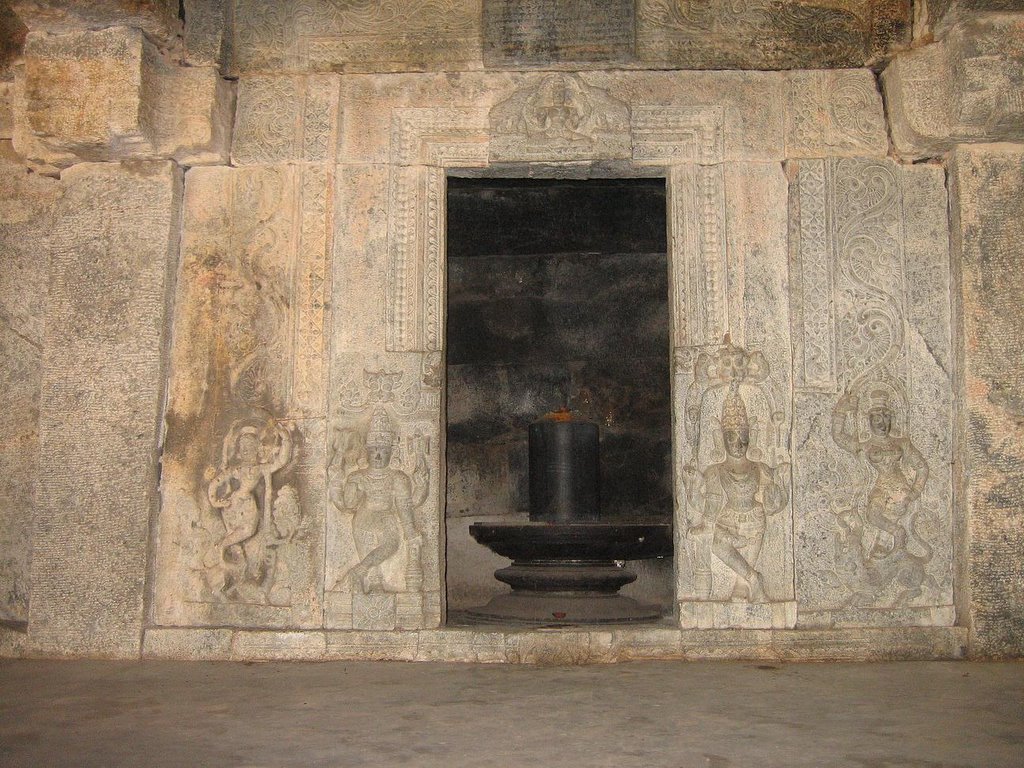
One of the places in that temple that caught my attention was the five lingas in the rooms at the back of the temple. The Linga shown here is the centre most and most imposing one. It reminds me of Egyptian Architecture. And inside lives, verily, Pharaoh of the Worlds! From here on, we went to the Kavery bank. After Swimming (I cant, so I didnt), Theppa rides and water melons , we came back here for lunch. There is a very small mess just in front of the temple declaring that it is a "brahmin tiffin and mess". What more to be needed from life?? We had our fill there alright!
All said and done, this was my best Shivaratri ever when I visited three Temples of Shiva-- one on top of a hill, one below ground and one on level ground. Lord of the Three Worlds! Icing on the cake: I cannot forget the coincidence that the boat man's name was Mahadevayya, who helped us cross the river (of our life?) on that holy day. Alas! A symbolist's predicament! Looking too much into everything!
Then we went to the water falls about an hour from there( which might need another post...)
Kedar.
Saturday, February 25, 2006
Thought process
I: O look! See the amount of cement being spent in the city. I bet, in a few years, we will run out of cement reserves.
Me: Stupid ass! Long before the reserves run out, cement will become so costly that only a few will be able to afford it.
Myself: Idiots! Long before that happens, there will be no land to build on, in the first place!!
Me: Stupid ass! Long before the reserves run out, cement will become so costly that only a few will be able to afford it.
Myself: Idiots! Long before that happens, there will be no land to build on, in the first place!!
Wednesday, February 22, 2006
A plea to save natural habitat
Long ago, I had a minor revelation about bangalore. Now, lets look at a different scene.
Magrath Road is supposed to be a posh locality. It is home to a couple of very high-class hotels in the hub of the city--in close proximity of Brigade Road, Residency Road and MG Road (every city has one, if you dont know the rule). Other than the everlasting road construction work and narrow one-way street, a very curious phenomenon is the presence of a pack of a species called "Stray dogs".
My own meditations on the presence of this species in this area told me that this is not very surprising-- a one-way street (did I mention "narrow"?) with a dead-end has very low traffic. If that street has a restaurant, then naturally it will have a lot of trash. This is a perfect place for dogs. If someone asks me what is Magrath Road most useful for, my answer will be-- to breed Stray dogs.
The only problem is a species called "Homo sapiens". What if someday, the road opens to free-flowing traffic? Or what if the authorities decide to clean-up the road? Or what if some American guy (a species very close to Indian guy, but is higher up the heirarchical ladder of economy-chain-- while he makes or breaks the economy of the world, his Indian counterpart can only get chained) finally decides to take action against stray-dogs, given the fact that there is a heavy interspecies competetion between the species of American guy and Stray dog, both competing for the same resources.
Given the jeopardy Stray dog is in, will someone not come to the aid of this mute being?
Magrath Road is supposed to be a posh locality. It is home to a couple of very high-class hotels in the hub of the city--in close proximity of Brigade Road, Residency Road and MG Road (every city has one, if you dont know the rule). Other than the everlasting road construction work and narrow one-way street, a very curious phenomenon is the presence of a pack of a species called "Stray dogs".
My own meditations on the presence of this species in this area told me that this is not very surprising-- a one-way street (did I mention "narrow"?) with a dead-end has very low traffic. If that street has a restaurant, then naturally it will have a lot of trash. This is a perfect place for dogs. If someone asks me what is Magrath Road most useful for, my answer will be-- to breed Stray dogs.
The only problem is a species called "Homo sapiens". What if someday, the road opens to free-flowing traffic? Or what if the authorities decide to clean-up the road? Or what if some American guy (a species very close to Indian guy, but is higher up the heirarchical ladder of economy-chain-- while he makes or breaks the economy of the world, his Indian counterpart can only get chained) finally decides to take action against stray-dogs, given the fact that there is a heavy interspecies competetion between the species of American guy and Stray dog, both competing for the same resources.
Given the jeopardy Stray dog is in, will someone not come to the aid of this mute being?
Monday, January 23, 2006
Identify the following compound
This is a test of your "hyderabadiness" (of course, N.A. if you are either not from Hyd or you dont claim to be from there!).
Identify the following compound "XXX":
"A panacea for several ailments which can be used both internally and externally.
DIRECTIONS FOR USE
Internal use:
COUGH COLD AND CORYZA Rub 4 drops of XXX on the neck, nose and also chest twice a day, morning and evening. It will also help if 4 drops are added to betel leaves or tea or coffee and consumed.
THROAT TROUBLE: Such as Tonsilitis, Hard Breathing and difficulty in swallowing--Add 2 drops of XXX in two to three glasses of boiling water and inhale vapour through mouth. Also paint the inside throat with swab dipped in XXX mixed with 1 oz. water
STOMACH TROUBLES: (Indigestion, Constipation, Flatulence, Loud Eructations, Bilious Retching and Loose Motions) Take 8 drops of XXX mixed with 1 oz. of water.
DYSENTERY Mix 8 drops of XXX with 10 grammes of butter or 50 grammes of curd and take twice, morning and evening on empty stomach till motions stop. Diet with barley water.
MALARIA: Fever followed by shivering-- Mix 8 drops of XXX with 1 oz. of water and take three times a day.
CHOLERA: Mix 8 drops of XXX with plain or soda water and take every 15 minutes till relief. During treatment take only Ganji or sabudana.
BREATHING TROUBLE OF CHILDREN: Mix 2 drops of XXX with mother's milk and feed the child. Also rub the chest of the child with 6 drops and foment with warm cloth. Repeat till relief. The above dosage is for children below 3 years.
External use:
HEADACHE: Rub on the forehead, 6 drops of XXX. If necessary repeat after two hours.
TOOTHACHE: Apply cotton swab soaked in XXX to the affected part ofthe gum every two hours till pain subsides.
EAR TROUBLE: Wash the affected ear with warm water and put 4 drops of XXX mixed with LUKEWARM coconut oil and plug with cotton.
PAINS: In any part of the body viz. Hands, feet, Back, Knees, etc.-- Rub on the affected part and foment with warm cloth. If the pain is chronic, mix XXX with equal quantity of kerosene oil and rub slowly twice a day morning and evening, foment with warm cloth and bandage.
SCORPION STING: Rub 4 drops of XXX on the part stung and apply heat from embers. Repeat till relief.
NOTE: XXX can be used during pregnancy also.
Identify the following compound "XXX":
"A panacea for several ailments which can be used both internally and externally.
DIRECTIONS FOR USE
Internal use:
COUGH COLD AND CORYZA Rub 4 drops of XXX on the neck, nose and also chest twice a day, morning and evening. It will also help if 4 drops are added to betel leaves or tea or coffee and consumed.
THROAT TROUBLE: Such as Tonsilitis, Hard Breathing and difficulty in swallowing--Add 2 drops of XXX in two to three glasses of boiling water and inhale vapour through mouth. Also paint the inside throat with swab dipped in XXX mixed with 1 oz. water
STOMACH TROUBLES: (Indigestion, Constipation, Flatulence, Loud Eructations, Bilious Retching and Loose Motions) Take 8 drops of XXX mixed with 1 oz. of water.
DYSENTERY Mix 8 drops of XXX with 10 grammes of butter or 50 grammes of curd and take twice, morning and evening on empty stomach till motions stop. Diet with barley water.
MALARIA: Fever followed by shivering-- Mix 8 drops of XXX with 1 oz. of water and take three times a day.
CHOLERA: Mix 8 drops of XXX with plain or soda water and take every 15 minutes till relief. During treatment take only Ganji or sabudana.
BREATHING TROUBLE OF CHILDREN: Mix 2 drops of XXX with mother's milk and feed the child. Also rub the chest of the child with 6 drops and foment with warm cloth. Repeat till relief. The above dosage is for children below 3 years.
External use:
HEADACHE: Rub on the forehead, 6 drops of XXX. If necessary repeat after two hours.
TOOTHACHE: Apply cotton swab soaked in XXX to the affected part ofthe gum every two hours till pain subsides.
EAR TROUBLE: Wash the affected ear with warm water and put 4 drops of XXX mixed with LUKEWARM coconut oil and plug with cotton.
PAINS: In any part of the body viz. Hands, feet, Back, Knees, etc.-- Rub on the affected part and foment with warm cloth. If the pain is chronic, mix XXX with equal quantity of kerosene oil and rub slowly twice a day morning and evening, foment with warm cloth and bandage.
SCORPION STING: Rub 4 drops of XXX on the part stung and apply heat from embers. Repeat till relief.
NOTE: XXX can be used during pregnancy also.
Wednesday, December 21, 2005
Arda Vs. Aryavartha
Arda Vs. Aryavartha
The juxtaposition of Indian Mythology with Tolkien's Mythology produces some very interesting parallels. However, I strongly suggest that they remain only those-- parallels, and I urge the readers against riding the current band-wagon of "everything is Indian".
It is interesting that Tolkien's literature doesnt have the words "God" or "Divine". His world (called the Arda, of which "Middle-Earth" forms a part) is a quite natural , matter-of-fact one where "magic", or "divine intervention" as Jules puts it in "Pulp Fiction", are as present as they are absent. The people depend on their own selves for protection and expect no miracle from any deity. But then there are Miracles and unexplained incidents. As for Elves, that which Samwise calls magic, is what they call skill-- the same skill that wrought the Silmarils, rings of power and the cloaks of the Fellowship.
Tolkein, as is said by himself, wanted to create a mythology for England because it had none of its own. The central theme of Ainulindale and Valaquenta, the first two chapters of Silmarillion is the concept of One God, Angels, and a fallen Angel who turns people away from Good-- the premises of Christianity. But along the way, because of the robustness of the starting idea and the fecund imagination of Tolkien, the mythology departed from its starting point and took on a unique form of itself. It is a kown fact that Tolkien, a professor of Old English and a Historian, included also the elements of the Nordic mythology into his world-- the Elven language of Quenya is supposed to be derived from Finnish. Yet, the ancient pre-abrahamic nature-worshipping mythologies of the world are so connected that we can already see parallels emerging thereof between the two aforementioned in the title.
It is worthwhile to note that the powers of the world, collectively called the Valar (plural of Vala), are much more than just Angels of the Abrahamic religions--
Manwe, the King of Valar, is the lord of winds,
Varda (who in middle-earth is called Elbereth), Manwe's consort is the giver of light-- she made the stars and the ancient lamps that shone in Arda,
Aule is lord of all the Arda's crust-- Mountains, plains, etc,
Yavanna, Aule's consort holds dominion on all things that green and growing,
Ulmo is the lord of waters, and so on...
In a single sentence, they are powers of nature, the equivalent of the 33 deities of Rig Veda suggesting a polytheistic nature resembling those of Greeco-Roman or Nordic Mythos.
Yet, there is a deeper similarity than this: Silmarillion begins (I think) with:
"In the beginning there was Eru, the One, who in Arda is called Illuvatar". Illuvatar is of course the name for "God" in Tolkien's Myth and then the story continues saying that He created the Ainur, of who, the Valar are the more powerful ones. This should immediately lead us to the concept of "Henotheism"-- the Vedic religion, and the Indian religion right now, demanded a seperate kind of term to describe them-- They are polytheistic on the outer side, but the concept of "One" forms the underlying matrix for all theories that emanate out of them. Also, note that the conept of "One" is absent from Greeco-Roman and Nordic Mythologies.
Secondly, Ainulindale-- "The Music of the Ainur" is said to have made the world. The One gave them a theme to sing and when they sang it, the world materialised out of their song. This, as Indians, we can relate to the concept of "aadi naada"-- the eternal anaahata (meaning that which doesnt make a "sound") rhythm that existed before eternity.
And lastly, if you look at the map of Arda in the First Age (which resembles a real-world map), you will find that the land of Hildorien, where Men woke up first i.e., created, lies exactly where India is. Well, well...Ahem! No comments.
well, actually 2 final comments:
1) Alas that people talk of "the others" in the same breath as Tolkien!
2) Since I am not a scholar, I dont have to bother about copyrights (or copylefts) of this very important article.
The juxtaposition of Indian Mythology with Tolkien's Mythology produces some very interesting parallels. However, I strongly suggest that they remain only those-- parallels, and I urge the readers against riding the current band-wagon of "everything is Indian".
It is interesting that Tolkien's literature doesnt have the words "God" or "Divine". His world (called the Arda, of which "Middle-Earth" forms a part) is a quite natural , matter-of-fact one where "magic", or "divine intervention" as Jules puts it in "Pulp Fiction", are as present as they are absent. The people depend on their own selves for protection and expect no miracle from any deity. But then there are Miracles and unexplained incidents. As for Elves, that which Samwise calls magic, is what they call skill-- the same skill that wrought the Silmarils, rings of power and the cloaks of the Fellowship.
Tolkein, as is said by himself, wanted to create a mythology for England because it had none of its own. The central theme of Ainulindale and Valaquenta, the first two chapters of Silmarillion is the concept of One God, Angels, and a fallen Angel who turns people away from Good-- the premises of Christianity. But along the way, because of the robustness of the starting idea and the fecund imagination of Tolkien, the mythology departed from its starting point and took on a unique form of itself. It is a kown fact that Tolkien, a professor of Old English and a Historian, included also the elements of the Nordic mythology into his world-- the Elven language of Quenya is supposed to be derived from Finnish. Yet, the ancient pre-abrahamic nature-worshipping mythologies of the world are so connected that we can already see parallels emerging thereof between the two aforementioned in the title.
It is worthwhile to note that the powers of the world, collectively called the Valar (plural of Vala), are much more than just Angels of the Abrahamic religions--
Manwe, the King of Valar, is the lord of winds,
Varda (who in middle-earth is called Elbereth), Manwe's consort is the giver of light-- she made the stars and the ancient lamps that shone in Arda,
Aule is lord of all the Arda's crust-- Mountains, plains, etc,
Yavanna, Aule's consort holds dominion on all things that green and growing,
Ulmo is the lord of waters, and so on...
In a single sentence, they are powers of nature, the equivalent of the 33 deities of Rig Veda suggesting a polytheistic nature resembling those of Greeco-Roman or Nordic Mythos.
Yet, there is a deeper similarity than this: Silmarillion begins (I think) with:
"In the beginning there was Eru, the One, who in Arda is called Illuvatar". Illuvatar is of course the name for "God" in Tolkien's Myth and then the story continues saying that He created the Ainur, of who, the Valar are the more powerful ones. This should immediately lead us to the concept of "Henotheism"-- the Vedic religion, and the Indian religion right now, demanded a seperate kind of term to describe them-- They are polytheistic on the outer side, but the concept of "One" forms the underlying matrix for all theories that emanate out of them. Also, note that the conept of "One" is absent from Greeco-Roman and Nordic Mythologies.
Secondly, Ainulindale-- "The Music of the Ainur" is said to have made the world. The One gave them a theme to sing and when they sang it, the world materialised out of their song. This, as Indians, we can relate to the concept of "aadi naada"-- the eternal anaahata (meaning that which doesnt make a "sound") rhythm that existed before eternity.
And lastly, if you look at the map of Arda in the First Age (which resembles a real-world map), you will find that the land of Hildorien, where Men woke up first i.e., created, lies exactly where India is. Well, well...Ahem! No comments.
well, actually 2 final comments:
1) Alas that people talk of "the others" in the same breath as Tolkien!
2) Since I am not a scholar, I dont have to bother about copyrights (or copylefts) of this very important article.
Monday, December 19, 2005
Of Caradhras and Tom Bambadil
All the characters in LOTR are divided into two camps-- powers of light and justice symbolising the good and powers of darnkess symbolising the bad. One one level, this seems very much like the wars of Aryas and Dasyus and Devas and Asuras highlighted in Rig Veda, though it might take a different kind of post to delve into the similarities between Tolkienian world called "middle earth" and the world described in the Rig Veda.
Only two characters of LOTR are mysterious in their aspect of siding with no one-- they serve no master and they have none to do them homage.
One of them is Tom Bombadil and the other, Mount Caradhras. In the movie, Tom is of course conspicuous by his absence but Caradhras by himself is shown powerless -- Saruman is shown chanting curses from the top of the Orthanc tower to cause the snowfall on Caradhras. In the book, Caradhras has his own personality and it is told that he does not like humans (men) climbing him, so he causes snowfall on his own. Yet, he is not in league with Sauron. He simply doesnt want any man to cross him, and he doesnt care about the tidings of the world. This actually makes sense because He was there even before Morgoth, the master of Sauron corrupted the earth, and He knows He will be there even after the dominion of Sauron, though Sauron were to regain the One and his rule lasted an eternity.
On the other hand, Tom is shown to be indifferent to the power of the One Ring, or rather, the One has no power over him. He is shown to be happy in his own place with his "goldberry" by his side and he is a gentle, humane, and good and he is said to be "the eldest" (curiously, the same title is conferred by Galadriel to Treebeard). Yet, he is not on the side of elves, dwarves or men though he will help those in his land at need.
Some feel that the inclusion of Tom Bombadil is the only weak link in the most robust "true fiction" produced in the twentieth century. The song and story of Tom Bombadil was written by Tolkien for kids before he began writing LOTR, and then, for some reason that either I dont know or dont remember, he included it in the story. When Frodo reaches Rivendel and the council of Elrond begins, Tolkien promptly covers his tracks by saying that its not wise to give Tom the responsibility of guarding the One Ring because he would be negligent and might throw it away simply because he is unaffected by it. Hmm... Convincing?
There are many theories about who Tom Bombadil is, the most popular being one that associates Tom with Aule and Goldberry with Yavanna, though that has been disproved by some.
Nevertheless, we do see that there are striking similarities between the way the two are dealt with-- showing that there are many other powers in the world that are either good or bad by nature, though it is not necessary that they be in league with the respective "eponymous" powers.
Only two characters of LOTR are mysterious in their aspect of siding with no one-- they serve no master and they have none to do them homage.
One of them is Tom Bombadil and the other, Mount Caradhras. In the movie, Tom is of course conspicuous by his absence but Caradhras by himself is shown powerless -- Saruman is shown chanting curses from the top of the Orthanc tower to cause the snowfall on Caradhras. In the book, Caradhras has his own personality and it is told that he does not like humans (men) climbing him, so he causes snowfall on his own. Yet, he is not in league with Sauron. He simply doesnt want any man to cross him, and he doesnt care about the tidings of the world. This actually makes sense because He was there even before Morgoth, the master of Sauron corrupted the earth, and He knows He will be there even after the dominion of Sauron, though Sauron were to regain the One and his rule lasted an eternity.
On the other hand, Tom is shown to be indifferent to the power of the One Ring, or rather, the One has no power over him. He is shown to be happy in his own place with his "goldberry" by his side and he is a gentle, humane, and good and he is said to be "the eldest" (curiously, the same title is conferred by Galadriel to Treebeard). Yet, he is not on the side of elves, dwarves or men though he will help those in his land at need.
Some feel that the inclusion of Tom Bombadil is the only weak link in the most robust "true fiction" produced in the twentieth century. The song and story of Tom Bombadil was written by Tolkien for kids before he began writing LOTR, and then, for some reason that either I dont know or dont remember, he included it in the story. When Frodo reaches Rivendel and the council of Elrond begins, Tolkien promptly covers his tracks by saying that its not wise to give Tom the responsibility of guarding the One Ring because he would be negligent and might throw it away simply because he is unaffected by it. Hmm... Convincing?
There are many theories about who Tom Bombadil is, the most popular being one that associates Tom with Aule and Goldberry with Yavanna, though that has been disproved by some.
Nevertheless, we do see that there are striking similarities between the way the two are dealt with-- showing that there are many other powers in the world that are either good or bad by nature, though it is not necessary that they be in league with the respective "eponymous" powers.
Monday, December 05, 2005
Vande Mataram
1) Vande Mataram Traditional, in Desh.
2) Vande Mataram rendition by Sudha Raghunathan,in traditional Desh tune (with her own spin).
3) Vande Mataram from Anand Math (1951) (I am afraid this is not the original song sung by Hemant Kumar et al).
4) Vande Mataram in Khambavati by a seemingly young Mogubai Kurdikar (Mother of Kishori Amonkar).. a very old recording-- 1947.
5) Vande Mataram in Brindavani Saranga by Vishnupant Phagnis.. this is older-- 1920s.
6) Vande Mataram in kafi by Omkarnath Thakur. Again, very old-- 1938-39.
7) Vande Mataram from "Vande Mataram" album by A.R.Rahman -- Traditional, in Desh with wonderful Saxophone by Chris "Snake" Davis.
2) Vande Mataram rendition by Sudha Raghunathan,in traditional Desh tune (with her own spin).
3) Vande Mataram from Anand Math (1951) (I am afraid this is not the original song sung by Hemant Kumar et al).
4) Vande Mataram in Khambavati by a seemingly young Mogubai Kurdikar (Mother of Kishori Amonkar).. a very old recording-- 1947.
5) Vande Mataram in Brindavani Saranga by Vishnupant Phagnis.. this is older-- 1920s.
6) Vande Mataram in kafi by Omkarnath Thakur. Again, very old-- 1938-39.
7) Vande Mataram from "Vande Mataram" album by A.R.Rahman -- Traditional, in Desh with wonderful Saxophone by Chris "Snake" Davis.
Wednesday, November 30, 2005
the other one...
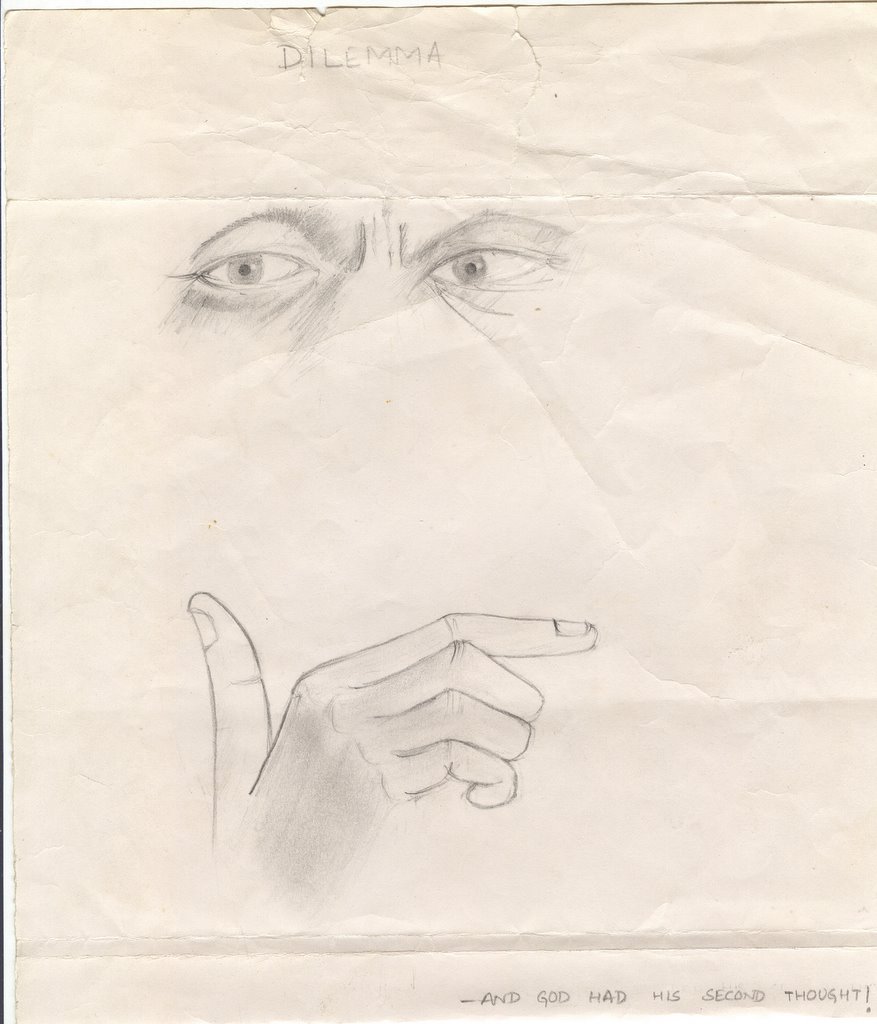
this is the other one that is a bit interesting... A very old sketch, it had to pass through the seven seas (and the customs) more than once!
Tuesday, November 29, 2005
One of mine as well...
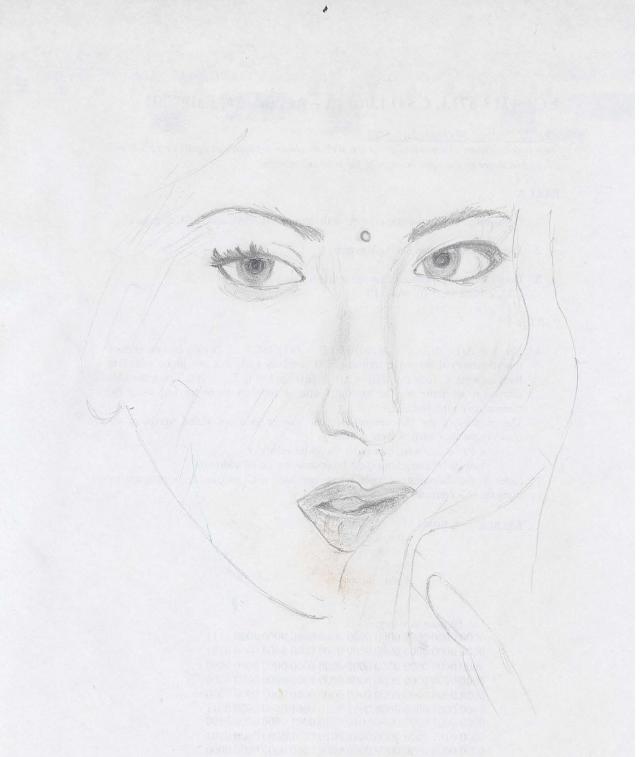
I left sketching long ago... here is one of those... I am not sure if any one recognises who she is supposed to be.
Friday, November 18, 2005
Osmania Biscuit XI-- Straange!!!
OK!
Before I reveal how Lingam Yadav and Obul Reddy finally come face to face, let me actually tell you some history of Lingam, which is of course completely irrelevant to the context. Nevertheless, I have decided to reveal this matter of complete secrecy, though I cant give any explanation of why would someone want to hide it or why would someone want to tell such a claptrap (synonyms: moonshine, gobbledygook, balderdash, hogwash, baloney).
Anyways, though most of the Yadavs of Saleemnagar Colony, Malakpet (Hyd-36) trace their origin from UP directly, the family of Lingam has had quite interesting tale in terms of the devious route it took...
When Krishna convinced peoople of Mathura that Mathura is no longer a safe refuge against the recurring invasions of the Mighty Emperor of Magadh- Jarasandha, many people joined him in that epic journey and they reached the Prabhasa Kshetra in Gujarat and established the city of Dwaraka. Now, as time flew, people began to settle more and more inwards and southwards. The Yadavs in question migrated after many centuries to the south of the Vindhya mountains, and settled in the country there along with many others.
Those were tumultous times...
Clearly the people of Dwaraka were excellent in cattle management-- the quality of milk, the species of buffalo and cow, and the kind of grass the fed to the cattle were all mysteriously wonderful. Through marine trade, the people of Dwaraka actually succeeded in bringing the best grass of south american grasslands (which, actually, scientists later found out to be "alfa-alfa" from the Pampas). So, very soon, they began to grow very rich and be held in high esteem.
Now the Rashtrakuta King (Rashtrakutas were a dynasty that ruled over Maharashtra in ancient times) was very wise, though meek, and his general was constantly plotting to pull off a coup and become the King. But the Yadavs (who had now risen to become the royal advisors ) saw through this plot and were ever eager to alert the King of the general's evil intentions. So you see, the Yadavs incurred the wrath of the general.
One night, after a celebration of cow festival, when everyone thought peace reigned supreme in the land, the general finally executed his long-planned plan, and of course, his planning was very well planned as well.
After taking control of the army, he slew the King's personal guard, went into the royal chamber and murdered the King. Hence, to the history, he is well-known (notoriously) as Dhondoba Et-tu-bruté.
The Yadavs were not spared as well... many of their folk were put to death. Lingam's ancestor (known only as "Bongu") had only a single child, and the couple were chased throughout the village and they fled into the graveyard, where the killers didnt dare come because of the undertaker Sepulkar, who was believed to be a master of black magic. Presently, Sepulkar was busy dealing with own enemy, the short-tempered and "hot"headed Thermal Jain, who had insulted him 17 years ago. Though Thermal Jain was a good natured Marwadi, he was short-tempered and that caused his downfall.
So, Sepulkar didnt budge from his crusade and so the couple had to run elsewhere for help. Luckily, they found the good natured prostitute hukkar and her pimp-cum-boyfriend fakkar. They knew the importance of tte Yadav dynasty and the help it would render to the coming Indian generations. Also, they wanted to do the right thing once in their life of sin. So, exchanged clothes with the Yadav couple and ran in the direction of the killers, succesfully diverting their attention (some attribute the origin of STDs in Maharashtra to this moment in History).
Thus escaping, the Yadav couple made their way down south, in a city where people from different regions and languages co-existed. They came to a house which was shared by three bachelors-- Smelly-onian from the Tamil land, feno-menon from "geraLa" and piss-in-the-paati from Andhra. Thus the Yadav dynasty was secured and they began to live a decent life in that area (A lot of stories are woven around these three bachelors-- about their earlier witty exploits, and later about their comicly succesfull efforts to save "the Bongu's Heir" but this is not the time). Lingam's great grandfather (titled Bongu-IV) moved to Naizaam during World War II, and settled in a village near the then Hyderabad called "theegalaguda". Later, the very same area is known as Saleem Nagar.
Note : This history is recorded in the journals of the japanese monk EkO naaraayaanaa when he visited India.
Before I reveal how Lingam Yadav and Obul Reddy finally come face to face, let me actually tell you some history of Lingam, which is of course completely irrelevant to the context. Nevertheless, I have decided to reveal this matter of complete secrecy, though I cant give any explanation of why would someone want to hide it or why would someone want to tell such a claptrap (synonyms: moonshine, gobbledygook, balderdash, hogwash, baloney).
Anyways, though most of the Yadavs of Saleemnagar Colony, Malakpet (Hyd-36) trace their origin from UP directly, the family of Lingam has had quite interesting tale in terms of the devious route it took...
When Krishna convinced peoople of Mathura that Mathura is no longer a safe refuge against the recurring invasions of the Mighty Emperor of Magadh- Jarasandha, many people joined him in that epic journey and they reached the Prabhasa Kshetra in Gujarat and established the city of Dwaraka. Now, as time flew, people began to settle more and more inwards and southwards. The Yadavs in question migrated after many centuries to the south of the Vindhya mountains, and settled in the country there along with many others.
Those were tumultous times...
Clearly the people of Dwaraka were excellent in cattle management-- the quality of milk, the species of buffalo and cow, and the kind of grass the fed to the cattle were all mysteriously wonderful. Through marine trade, the people of Dwaraka actually succeeded in bringing the best grass of south american grasslands (which, actually, scientists later found out to be "alfa-alfa" from the Pampas). So, very soon, they began to grow very rich and be held in high esteem.
Now the Rashtrakuta King (Rashtrakutas were a dynasty that ruled over Maharashtra in ancient times) was very wise, though meek, and his general was constantly plotting to pull off a coup and become the King. But the Yadavs (who had now risen to become the royal advisors ) saw through this plot and were ever eager to alert the King of the general's evil intentions. So you see, the Yadavs incurred the wrath of the general.
One night, after a celebration of cow festival, when everyone thought peace reigned supreme in the land, the general finally executed his long-planned plan, and of course, his planning was very well planned as well.
After taking control of the army, he slew the King's personal guard, went into the royal chamber and murdered the King. Hence, to the history, he is well-known (notoriously) as Dhondoba Et-tu-bruté.
The Yadavs were not spared as well... many of their folk were put to death. Lingam's ancestor (known only as "Bongu") had only a single child, and the couple were chased throughout the village and they fled into the graveyard, where the killers didnt dare come because of the undertaker Sepulkar, who was believed to be a master of black magic. Presently, Sepulkar was busy dealing with own enemy, the short-tempered and "hot"headed Thermal Jain, who had insulted him 17 years ago. Though Thermal Jain was a good natured Marwadi, he was short-tempered and that caused his downfall.
So, Sepulkar didnt budge from his crusade and so the couple had to run elsewhere for help. Luckily, they found the good natured prostitute hukkar and her pimp-cum-boyfriend fakkar. They knew the importance of tte Yadav dynasty and the help it would render to the coming Indian generations. Also, they wanted to do the right thing once in their life of sin. So, exchanged clothes with the Yadav couple and ran in the direction of the killers, succesfully diverting their attention (some attribute the origin of STDs in Maharashtra to this moment in History).
Thus escaping, the Yadav couple made their way down south, in a city where people from different regions and languages co-existed. They came to a house which was shared by three bachelors-- Smelly-onian from the Tamil land, feno-menon from "geraLa" and piss-in-the-paati from Andhra. Thus the Yadav dynasty was secured and they began to live a decent life in that area (A lot of stories are woven around these three bachelors-- about their earlier witty exploits, and later about their comicly succesfull efforts to save "the Bongu's Heir" but this is not the time). Lingam's great grandfather (titled Bongu-IV) moved to Naizaam during World War II, and settled in a village near the then Hyderabad called "theegalaguda". Later, the very same area is known as Saleem Nagar.
Note : This history is recorded in the journals of the japanese monk EkO naaraayaanaa when he visited India.
Thursday, November 10, 2005
green deepavali
A very good friend of mine when I was at GE:
http://anandanubhava.blogspot.com/2005/11/having-blast.html
http://anandanubhava.blogspot.com/2005/11/having-blast.html
Wednesday, October 26, 2005
Tuesday, October 18, 2005
Seven Drunken Nights
Seven Drunken Nights
(Traditional Irish Song)
(Traditional Irish Song)
___
As I went home on Monday night as drunk as drunk could be
I saw a horse outside the door where my old horse should be
Well, I called me wife and I said to her: Will you kindly tell to me
Who owns that horse outside the door where my old horse should be?
Ah, you're drunk,
you're drunk you silly old fool,
still you can not see
That's a lovely sow that me mother sent to me
Well, it's many a day I've travelled a hundred miles or more
But a saddle on a sow sure I never saw before.
---
And as I went home on Tuesday night as drunk as drunk could be
I saw a coat behind the door where my old coat should be
Well, I called me wife and I said to her: Will you kindly tell to me
Who owns that coat behind the door where my old coat should be
Ah, you're drunk,
you're drunk you silly old fool,
still you can not see
you're drunk you silly old fool,
still you can not see
That's a woollen blanket that me mother sent to me
Well, it's many a day I've travelled a hundred miles or more
But buttons in a blanket sure I never saw before.
---
And as I went home on Wednesday night as drunk as drunk could be
I saw a pipe up on the chair where my old pipe should be
Well, I called me wife and I said to her: Will you kindly tell to me
Who owns that pipe up on the chair where my old pipe should be
Ah, you're drunk,
you're drunk you silly old fool,
still you can not see
you're drunk you silly old fool,
still you can not see
That's a lovely tin whistle that me mother sent to me
Well, it's many a day I've travelled a hundred miles or more
But tobacco in a tin whistle sure I never saw before.
---
And as I went home on Thursday night as drunk as drunk could be
I saw two boots beneath the bed where my old boots should be
Well, I called me wife and I said to her: Will you kindly tell to me
Who owns them boots beneath the bed where my old boots should be
Ah, you're drunk,
you're drunk you silly old fool,
still you can not see
you're drunk you silly old fool,
still you can not see
They're two lovely Geranium pots me mother sent to me
Well, it's many a day I've travelled a hundred miles or more
But laces in Geranium pots I never saw before.
---
And as I went home on Friday night as drunk as drunk could be
I saw a head upon the bed where my old head should be
Well, I called me wife and I said to her: Will you kindly tell to me
Who owns that head upon the bed where my old head should be
Ah, you're drunk,
you're drunk you silly old fool,
still you can not see
you're drunk you silly old fool,
still you can not see
That's a baby boy that me mother sent to me
Well, it's many a day I've travelled a hundred miles or more
But a baby boy with his whiskers on sure I never saw before.
---
And as I went home on Saturday night as drunk as drunk could be
I saw two hands upon her breasts where my old hands should be
Well, I called me wife and I said to her: Will you kindly tell to me
Who owns them hands upon your breasts where my old hands should be
Ah, you're drunk,
you're drunk you silly old fool,
still you can not see
you're drunk you silly old fool,
still you can not see
That's a lovely night gown that me mother sent to me
Well, it's many a day I've travelled a hundred miles or more
But fingers in a night gown sure I never saw before.
---
As I went home on Sunday night as drunk as drunk could be
I saw a thing in her thing where my old thing should be
Well, I called me wife and I said to her: Will you kindly tell to me
Who owns that thing in your thing where my old thing should be
Ah, you're drunk,
you're drunk you silly old fool,
still you can not see
you're drunk you silly old fool,
still you can not see
That's a lovely tin whistle that me mother sent to me
Well, it's many a day I've travelled a hundred miles or more
But hair on a tin whistle sure I never saw before.
Monday, October 17, 2005
A visit to the barber
From Out of butter and water: the Hindu creation by Sudhanva Deshpande
To the extent that India is still a predominantly agricultural society, these festivals, and the various rituals that go with them, are an organic part of people’s lives, and not just corporate inducements to an urban elite to consume more and more in the globalized marketplace. Yet, since these festivals and rituals have actually evolved over a very long period of time, they are now most often taken for granted; like the self-existent creator, they just exist, with neither beginning nor end. For most practitioners of these rituals, much of the original meaning is either unimportant, or simply lost under centuries of cultural sedimentation.
Yet ideas persist over centuries and pop up at you when you least expect them. Last week, I needed a haircut, and so I went to the barber who has performed this service since I was about ten. It is a veritable ritual, evolved over two decades or so. It begins with his magnanimously offering me tea, and ends with his never returning change. In between, he asks about my family, I about his; he checks if I am still off smoking, I if he is off drink. Through all this, of course, we discuss politics, sports, and anything else of topical interest. This time, I asked him how he was told the universe came into being. He laughed, snipped off a tuft of hair on my forehead, and said: “Who knows how all this was created? Who was around to see? Even the gods were born after something existed, so who can tell what happened when nothing existed?”
My barber has not read the Rig Veda. But if he were to, some day, he will be struck by the following hymn:
Then even nothingness was not, nor existence.
There was no air then, nor the heavens beyond it.
Who covered it? Where was it? In whose keeping?
Was there then cosmic water, in depths unfathomed?
But, after all, who knows, and who can say,
Whence it all came, and how creation happened?
The gods themselves are later than creation,
So who knows truly whence it has arisen?
(Rig Veda, X, 129)
http://www.unesco.org/courier/2001_05/uk/doss24.htm
To the extent that India is still a predominantly agricultural society, these festivals, and the various rituals that go with them, are an organic part of people’s lives, and not just corporate inducements to an urban elite to consume more and more in the globalized marketplace. Yet, since these festivals and rituals have actually evolved over a very long period of time, they are now most often taken for granted; like the self-existent creator, they just exist, with neither beginning nor end. For most practitioners of these rituals, much of the original meaning is either unimportant, or simply lost under centuries of cultural sedimentation.
Yet ideas persist over centuries and pop up at you when you least expect them. Last week, I needed a haircut, and so I went to the barber who has performed this service since I was about ten. It is a veritable ritual, evolved over two decades or so. It begins with his magnanimously offering me tea, and ends with his never returning change. In between, he asks about my family, I about his; he checks if I am still off smoking, I if he is off drink. Through all this, of course, we discuss politics, sports, and anything else of topical interest. This time, I asked him how he was told the universe came into being. He laughed, snipped off a tuft of hair on my forehead, and said: “Who knows how all this was created? Who was around to see? Even the gods were born after something existed, so who can tell what happened when nothing existed?”
My barber has not read the Rig Veda. But if he were to, some day, he will be struck by the following hymn:
Then even nothingness was not, nor existence.
There was no air then, nor the heavens beyond it.
Who covered it? Where was it? In whose keeping?
Was there then cosmic water, in depths unfathomed?
But, after all, who knows, and who can say,
Whence it all came, and how creation happened?
The gods themselves are later than creation,
So who knows truly whence it has arisen?
(Rig Veda, X, 129)
http://www.unesco.org/courier/2001_05/uk/doss24.htm
Hum sab azaad ho gaye
From the rediff special Death ruled the beautiful mountains:
I noticed a man laughing on a bridge. I heard him say, "The police died in the thana (police station) and the qaidis (the prisoners) died in the jailkhana (prison). Hum sab azaad ho gaye (we are all free)." He was a schoolteacher who had lost his senses because more than 300 students and teachers at the Springfield School in Bagh died in the earthquake. He was one of the few survivors.
--Hamid Mir, Islamabad.
I noticed a man laughing on a bridge. I heard him say, "The police died in the thana (police station) and the qaidis (the prisoners) died in the jailkhana (prison). Hum sab azaad ho gaye (we are all free)." He was a schoolteacher who had lost his senses because more than 300 students and teachers at the Springfield School in Bagh died in the earthquake. He was one of the few survivors.
--Hamid Mir, Islamabad.
Friday, September 30, 2005
Bhatiyar
The other legendary raga that I adore immensely is the Bhatiyar. I am pretty damned sure everyone of us has heard it and some of us even remember it. Remember "poorab se surya uga" --the ad for literacy sung by Kavitha Krishnamurthy on DD??
yup! Thats the one! Almost too easy to identify.. you really cant miss the energy and freshness of this one! A classic morning raga!
Incidentally, this raga has been tried on by Unnikrishnan. He has tuned an annamacharya kriti "nanda nandana" quite beautifully to Bhatiyar (he calls it Bhatyari).
http://www.musicindiaonline.com/l/1/m/ragam.176/
There seem to be no film songs in this raga though I heard one old ghazal on radio with combination of Lalit (Tu hain mera prem devatha) and Bhatiyar (Hindustani classical singer Jitendra Abhisheki has actually come up with a jod-raga called Lalith-Bhatiyar).
Most usage of Bhatiyar in the light classical arena, it seems, has ben done by Ghati composers...
Anyways, for some inexplicable reason, I took "Sri Gananatham bhajamyaham" in Kanakangi from the movie Sruthilayalu, and retuned it to Bhatiyar, much to the horror of Bhargavarama...
yup! Thats the one! Almost too easy to identify.. you really cant miss the energy and freshness of this one! A classic morning raga!
Incidentally, this raga has been tried on by Unnikrishnan. He has tuned an annamacharya kriti "nanda nandana" quite beautifully to Bhatiyar (he calls it Bhatyari).
http://www.musicindiaonline.com/l/1/m/ragam.176/
There seem to be no film songs in this raga though I heard one old ghazal on radio with combination of Lalit (Tu hain mera prem devatha) and Bhatiyar (Hindustani classical singer Jitendra Abhisheki has actually come up with a jod-raga called Lalith-Bhatiyar).
Most usage of Bhatiyar in the light classical arena, it seems, has ben done by Ghati composers...
Anyways, for some inexplicable reason, I took "Sri Gananatham bhajamyaham" in Kanakangi from the movie Sruthilayalu, and retuned it to Bhatiyar, much to the horror of Bhargavarama...
Thursday, September 22, 2005
shankara
Hindustani raga Shankara is one of the most august ragas with insurmountable grandeur. Very easy to identify, it is highly surprising that carnatic musicians have not explored much into it. The only composition that I can cite from the south is a music piece from the movie Maayaabazaar coutesy Ghantasala--A ragamalika (Shankara is starting raga, and the most prominent) heard when Balarama is accorded a royal welcome by Shakuni and gang. It follows similar notation to that of the following song from Sehgal: http://www.sawf.org/audio/shankara/klsaigal.ram
Most people from the south have also heard Shankara (albeit unknowingly) in one of the forms of Hanuman chalisa.
Here is an experiment in Shankara--It is still in concept stage (not sure how to give notes... this raga has some meends). Also, lyrics may need fine tuning.
p: Sham karatha Shankara!
Triloka dyuthikara!
a: Mahesham Bhavesham bhave
Shambhave Shubhakara!
c: Mahaarudranaaraayana ugra roopa
PraLayaagni hoomkaara naada swaroopa
BrhatkOtibrahmaandalokaadhinaatha
RaNadundubi jayajayadhwaanakara!
Kedar.
Most people from the south have also heard Shankara (albeit unknowingly) in one of the forms of Hanuman chalisa.
Here is an experiment in Shankara--It is still in concept stage (not sure how to give notes... this raga has some meends). Also, lyrics may need fine tuning.
p: Sham karatha Shankara!
Triloka dyuthikara!
a: Mahesham Bhavesham bhave
Shambhave Shubhakara!
c: Mahaarudranaaraayana ugra roopa
PraLayaagni hoomkaara naada swaroopa
BrhatkOtibrahmaandalokaadhinaatha
RaNadundubi jayajayadhwaanakara!
Kedar.
Monday, September 19, 2005
A very small story
(the story has been lying in my vault for a long time now, sent to me by kedar long back)
A small idol of Ganesha, a picture of Rama and family, and another small idol of Saraswathi were the first thing Varun saw as soon as he opened his eyes that day, as he did everyday—but it wasn’t day yet; only the lights in the hall were switched on. It was only 5:30 in the morning, and he almost never got up before 7:00, in his life of 8 years. He felt refreshed at once and got up from the bed. He walked into the hall. He knew, his father was taking bath, from the chants he said during his bath. His mother was out in the backyard in a silk sari and she was picking flowers. She just had a “head-bath” as it is called in our country and had her towel wrapped on her head along with her hair. He went into the kitchen which also had a compartment for Gods. His grandmother was making something out of black-coloured mud.
“What are you doing grandma?” he inquired
“I am making two idols of oxen. It’s “poLa” today.” She told him without lifting her head, engrossed in her work. He vaguely remembered they were talking yesterday night after supper about getting up early today because it is some festival.
“It is a festival of the country-side. On this day, people pay their respects to the farm animals which sustain them. We used to celebrate it on a big scale in our village when I was young. Now very few even remember it,” she mused pausing for a moment, and then resumed her work.
Varun and his little brother Ashvin always liked to celebrate festivals—major or minor. The younger one showed more enthusiasm of the two even though he was only beginning to understand what was going on. He just had to be there at the puja, he had to be the one to ring the bell while giving aarti (though his hands use to tire easily), and he had to be the one to give theertham to all others in the house (Prasadam rights, he ‘gifted’ to his elder brother out of his fabled generosity). Now he was fast asleep. The puja was about to begin and the elders would not allow Varun to wake up his brother—A recipe for calamity of the worst kind.
Varun quickly took a bath and attended puja and aarti (he already knew most of the common aarti songs by heart). After a while, Ashvin woke up and found his brother already dressed up for school. He wondered a bit at this, but was still sleepy. Varun was careful enough not to say anything at that time. After a while, Varun heard loud wails and saw brother coming out of the kitchen crying. He immediately knew what had happened—Ashvin had come to know of the festival puja and aarti. And now, there seemed to be no end to his crying. His parents and grandmother tried to console him with words and promises of next time, but the crying wouldn’t stop. Varun sat for his breakfast contemplating how to bring the situation in control. He finally struck on an idea, but hesitated whether it would work. Well, he knew the only way to see if it worked was to test it. He went to his brother whose eyes were still watery and said something in his ear. The crying stopped, but it was sometime before he could smile and be in his usual sunny disposition. They went to school and the day passed on. When his father came back that evening, he was relieved to find everything normal.
After supper, all of them sat together awhile and went to bed. But after sometime, the two brothers got up and went stealthily into kitchen. They had their own plans. About half-an-hour later, a familiar aroma filled the house, and a faint ringing sound was being heard. Varun’s mother got up and hurried into the kitchen. She was puzzled by what she saw. Varun wore his father’s silk dhoti (almost perfectly) and was performing puja just like his father. Sitting beside was his brother who seemingly took care of all arrangements from flowers, sweets for offerings, incense, and all. These were arrayed in front of him in the most disciplined fashion. Ashvin was sitting with his eyes closed and his little palms joined together. There was such sincerity and devotion in his face that she thought not all the temptations and dangers joined together would dissuade him from his present state. She didn’t disturb them. She went back and came back with her husband and mother-in-law. They saw the two perform the puja very quietly from the corner of the room. And after puja, Varun started singing aarti in his sincere voice, and the elders looked at one-another in silent admiration and felt proud of their children. Of course, Ashvin got to ring the bell and he relished it with utmost delight even though he was dead tired and sleepy. And then Varun offered theertham and Prasadam, and gave some to his little brother. They were about to fold the ceremony for the day when the elders suddenly walked into the kitchen to the surprise (and a little embarrassment) of the children. But they simply took aarti and prasadam with same devotion and seriousness that the children had and kissed the children.
Then they took the sleepy children back to their rooms, wondering if there was anything more from life that they needed.
-- Kedar
A small idol of Ganesha, a picture of Rama and family, and another small idol of Saraswathi were the first thing Varun saw as soon as he opened his eyes that day, as he did everyday—but it wasn’t day yet; only the lights in the hall were switched on. It was only 5:30 in the morning, and he almost never got up before 7:00, in his life of 8 years. He felt refreshed at once and got up from the bed. He walked into the hall. He knew, his father was taking bath, from the chants he said during his bath. His mother was out in the backyard in a silk sari and she was picking flowers. She just had a “head-bath” as it is called in our country and had her towel wrapped on her head along with her hair. He went into the kitchen which also had a compartment for Gods. His grandmother was making something out of black-coloured mud.
“What are you doing grandma?” he inquired
“I am making two idols of oxen. It’s “poLa” today.” She told him without lifting her head, engrossed in her work. He vaguely remembered they were talking yesterday night after supper about getting up early today because it is some festival.
“It is a festival of the country-side. On this day, people pay their respects to the farm animals which sustain them. We used to celebrate it on a big scale in our village when I was young. Now very few even remember it,” she mused pausing for a moment, and then resumed her work.
Varun and his little brother Ashvin always liked to celebrate festivals—major or minor. The younger one showed more enthusiasm of the two even though he was only beginning to understand what was going on. He just had to be there at the puja, he had to be the one to ring the bell while giving aarti (though his hands use to tire easily), and he had to be the one to give theertham to all others in the house (Prasadam rights, he ‘gifted’ to his elder brother out of his fabled generosity). Now he was fast asleep. The puja was about to begin and the elders would not allow Varun to wake up his brother—A recipe for calamity of the worst kind.
Varun quickly took a bath and attended puja and aarti (he already knew most of the common aarti songs by heart). After a while, Ashvin woke up and found his brother already dressed up for school. He wondered a bit at this, but was still sleepy. Varun was careful enough not to say anything at that time. After a while, Varun heard loud wails and saw brother coming out of the kitchen crying. He immediately knew what had happened—Ashvin had come to know of the festival puja and aarti. And now, there seemed to be no end to his crying. His parents and grandmother tried to console him with words and promises of next time, but the crying wouldn’t stop. Varun sat for his breakfast contemplating how to bring the situation in control. He finally struck on an idea, but hesitated whether it would work. Well, he knew the only way to see if it worked was to test it. He went to his brother whose eyes were still watery and said something in his ear. The crying stopped, but it was sometime before he could smile and be in his usual sunny disposition. They went to school and the day passed on. When his father came back that evening, he was relieved to find everything normal.
After supper, all of them sat together awhile and went to bed. But after sometime, the two brothers got up and went stealthily into kitchen. They had their own plans. About half-an-hour later, a familiar aroma filled the house, and a faint ringing sound was being heard. Varun’s mother got up and hurried into the kitchen. She was puzzled by what she saw. Varun wore his father’s silk dhoti (almost perfectly) and was performing puja just like his father. Sitting beside was his brother who seemingly took care of all arrangements from flowers, sweets for offerings, incense, and all. These were arrayed in front of him in the most disciplined fashion. Ashvin was sitting with his eyes closed and his little palms joined together. There was such sincerity and devotion in his face that she thought not all the temptations and dangers joined together would dissuade him from his present state. She didn’t disturb them. She went back and came back with her husband and mother-in-law. They saw the two perform the puja very quietly from the corner of the room. And after puja, Varun started singing aarti in his sincere voice, and the elders looked at one-another in silent admiration and felt proud of their children. Of course, Ashvin got to ring the bell and he relished it with utmost delight even though he was dead tired and sleepy. And then Varun offered theertham and Prasadam, and gave some to his little brother. They were about to fold the ceremony for the day when the elders suddenly walked into the kitchen to the surprise (and a little embarrassment) of the children. But they simply took aarti and prasadam with same devotion and seriousness that the children had and kissed the children.
Then they took the sleepy children back to their rooms, wondering if there was anything more from life that they needed.
-- Kedar
Friday, September 16, 2005
Osmania Biscuit VIII-- Lingam Yadav vs. Obul Reddy
He hates him-- I swear he hates him like hell! He even conspires to kill Obul Reddy. Lingam secretly believes I think about Obul more than I do about him! Poor Lingam's raat ki neend has been haraamed because of his morbid antipathy towards Obul. He tried lots of pseudo-innocuous machinations to get the address and/or phone number of his adversary from me, but he failed... not because I didnt want to give it to him, but because I myself didnt know where he is/was! I hardly know Obul for God's sake!!
But that wouldnt satisfy him... He thinks I am protecting Obul from him.
I still remember that day when I first saw the name 'Obul Reddy' in the paper... I actually had a good laugh because that was the first time I heard the name! Lingam, though, was a little circumspect in his reaction... and later I told him about how I went to even meet him, but alas! I could find him, and how I got into CBIT because of Obul Reddy (though accidentally), his condescending smirk was quite obvious! The third time, when I said I wanted to meet Obul once, that did it! His rage knew no bounds, and he swore he will kill that ******** !!
That day, he looked more dangerous than
1) the green-gochi clad "Ekelex Mahabali"
2) the duo of Veerabahu and GhanOdara
3) Veera Paandya Katta Bommana
4) or even Suryam for that matter who has only 2 of those instead of 3!!!! (Oops! sorry.. cudnt resist!).
Yup! we all saw the scene flabbergasted! Poor Jumman miya got to bear the brunt of his anger when Lingam's gutka was sprayed all over his kurta as a fractal image (only I know how much I tried to take that kurta from him!). Jumman was so depressed that he didnt fix "tube-lightla srinivas's" scooter in his "A1-mekanik" shop lying there fro a week already, which infuriated Srinivas to no end and he didnt go to "idly pavan's" place to fix some elctrical problem they had, resulting that they didnt have electricity all day and missed the cricket match, which dint please Idly's uncle Yellaji (dont ask me! thats a pet name among the really really Andhra folks!), and he hit the 'Ironing boy' Dasaratha, which made his mother launch a two-and-a-half hour long invective against the "sharma residency" which later petered down into muttered curses and spits in a vectored direction.
Which got me thinking, what has all this got to do with poor Obul Reddy, whose only fault was that he got the rank 2347 in EAMCET-1997, one ahead of me.
Nevertheless, I know I have to stay tuned for the Ragnarok, the epic final battle between Lingam Yadav and Obul Reddy, and some even argue the magnitude of this surpasses that of even QuickGun Murugun's and RicePlate Reddy's battle!
But that wouldnt satisfy him... He thinks I am protecting Obul from him.
I still remember that day when I first saw the name 'Obul Reddy' in the paper... I actually had a good laugh because that was the first time I heard the name! Lingam, though, was a little circumspect in his reaction... and later I told him about how I went to even meet him, but alas! I could find him, and how I got into CBIT because of Obul Reddy (though accidentally), his condescending smirk was quite obvious! The third time, when I said I wanted to meet Obul once, that did it! His rage knew no bounds, and he swore he will kill that ******** !!
That day, he looked more dangerous than
1) the green-gochi clad "Ekelex Mahabali"
2) the duo of Veerabahu and GhanOdara
3) Veera Paandya Katta Bommana
4) or even Suryam for that matter who has only 2 of those instead of 3!!!! (Oops! sorry.. cudnt resist!).
Yup! we all saw the scene flabbergasted! Poor Jumman miya got to bear the brunt of his anger when Lingam's gutka was sprayed all over his kurta as a fractal image (only I know how much I tried to take that kurta from him!). Jumman was so depressed that he didnt fix "tube-lightla srinivas's" scooter in his "A1-mekanik" shop lying there fro a week already, which infuriated Srinivas to no end and he didnt go to "idly pavan's" place to fix some elctrical problem they had, resulting that they didnt have electricity all day and missed the cricket match, which dint please Idly's uncle Yellaji (dont ask me! thats a pet name among the really really Andhra folks!), and he hit the 'Ironing boy' Dasaratha, which made his mother launch a two-and-a-half hour long invective against the "sharma residency" which later petered down into muttered curses and spits in a vectored direction.
Which got me thinking, what has all this got to do with poor Obul Reddy, whose only fault was that he got the rank 2347 in EAMCET-1997, one ahead of me.
Nevertheless, I know I have to stay tuned for the Ragnarok, the epic final battle between Lingam Yadav and Obul Reddy, and some even argue the magnitude of this surpasses that of even QuickGun Murugun's and RicePlate Reddy's battle!
Monday, September 05, 2005
Tempest of Manna.
3 people.
Me and a couple of 'muh home boys' (thats friends in african-american!) were walking towards commercial street on Sunday eve around 7 PM when it happened. And how everyone ran here and there... makes me remember that line from Molla Ramayanam-- sandula gondula doori sattumi lemin! (On seeing the humiliating fate of the kings and princes who tried to lift Siva DhanuSa, the other suitors ran helter-skelter and hid themselves in bylanes to escape that insult!).
It rained so heavily, so all of a sudden, that we were completely caught unawares.
Now, we are standing under the porch of some shop waiting for the rain to abate. Mahesh, the eldest one, is desperately looking for autos.. no one wants to come to either CMH road or Domlur, and if they are ready, they are asking for 60-70 rupees (it would normally take abt 30/-). So he is in a circular loop and thats about him... and the other guy Nitin, well... he is so frustrated that he starts looking at the wet babes (did I mention they were wet?) to take his mind of the current "predicament".
Anyways, what do I do? I dont take notice of anyone at all, and start making up some tune in Miya-ki-Malhar ( "bole re papihara" is in that raga). And I proudly declare to Nitin... "this is a Malhar." And he looks at me angrily and says ," its raining and and you sing malhar?? Are you nuts??" (Not that it rained heavily because I sang Malhar, but you know how people like to have a scape-goat!).
And then it dawned on me how Cacophonix the bard must have felt in that village... savages! Barbarians! ...Sigh! I promptly changed track to Basant Bahar. Soon, I realised I was tilting more towards Basant and Bahar was increasingly left out. And Basant gave way to the closely allied Panthuvarali... and slowly the r1 and d1 dissappeared and I was left with...
Amruthavarshini!
A tune slowly materialised, and I started adding words to it. I finished it today.
It comes out this way:
p: nannu kaana rava, veyi kanula deva!
ilalOna neeku, satevvaru....
a: nee mahima juupi, nannu brovaleva,
Indra Mahendra Surendra Devendra
ch:vidyutvajra dhara, Shachi kanthi kara
sarva dukha hara, vRtra samhara...
viraminchu nee mahapraLayavarshini
tilakinchu naa gaana Amruthavarshnini.
This is my first telugu experiment.
As usual, I am having nightmares with the tala part (shooting for Adi). Anyways, I have nost mentioned the swaras here... (an open invitation for all to use this sahityam to whichever tune. Imagine... you can be a part of the only kriti dedicated to Indra!). Any corrections, improvements to the lyrics are always welcome.
Kedar.
PS: It was just a rainy evening... its very interesting how people make such a big deal out of it!
Me and a couple of 'muh home boys' (thats friends in african-american!) were walking towards commercial street on Sunday eve around 7 PM when it happened. And how everyone ran here and there... makes me remember that line from Molla Ramayanam-- sandula gondula doori sattumi lemin! (On seeing the humiliating fate of the kings and princes who tried to lift Siva DhanuSa, the other suitors ran helter-skelter and hid themselves in bylanes to escape that insult!).
It rained so heavily, so all of a sudden, that we were completely caught unawares.
Now, we are standing under the porch of some shop waiting for the rain to abate. Mahesh, the eldest one, is desperately looking for autos.. no one wants to come to either CMH road or Domlur, and if they are ready, they are asking for 60-70 rupees (it would normally take abt 30/-). So he is in a circular loop and thats about him... and the other guy Nitin, well... he is so frustrated that he starts looking at the wet babes (did I mention they were wet?) to take his mind of the current "predicament".
Anyways, what do I do? I dont take notice of anyone at all, and start making up some tune in Miya-ki-Malhar ( "bole re papihara" is in that raga). And I proudly declare to Nitin... "this is a Malhar." And he looks at me angrily and says ," its raining and and you sing malhar?? Are you nuts??" (Not that it rained heavily because I sang Malhar, but you know how people like to have a scape-goat!).
And then it dawned on me how Cacophonix the bard must have felt in that village... savages! Barbarians! ...Sigh! I promptly changed track to Basant Bahar. Soon, I realised I was tilting more towards Basant and Bahar was increasingly left out. And Basant gave way to the closely allied Panthuvarali... and slowly the r1 and d1 dissappeared and I was left with...
Amruthavarshini!
A tune slowly materialised, and I started adding words to it. I finished it today.
It comes out this way:
p: nannu kaana rava, veyi kanula deva!
ilalOna neeku, satevvaru....
a: nee mahima juupi, nannu brovaleva,
Indra Mahendra Surendra Devendra
ch:vidyutvajra dhara, Shachi kanthi kara
sarva dukha hara, vRtra samhara...
viraminchu nee mahapraLayavarshini
tilakinchu naa gaana Amruthavarshnini.
This is my first telugu experiment.
As usual, I am having nightmares with the tala part (shooting for Adi). Anyways, I have nost mentioned the swaras here... (an open invitation for all to use this sahityam to whichever tune. Imagine... you can be a part of the only kriti dedicated to Indra!). Any corrections, improvements to the lyrics are always welcome.
Kedar.
PS: It was just a rainy evening... its very interesting how people make such a big deal out of it!
Saturday, August 27, 2005
Revelations 1:1
I have had some revelations lately that I want to share...
1)Krishna---
I will not sing of Krishna.
NEVER!
Before I explain why, let me try to see whats the difference between a magician and a teacher.--
A magician will never reveal his secret to you... he wants to be an enigma, somebody from the other world, and he wants to be praised... if his trick or metier is revealed, he will go out of business.
A teacher, on the other hand, has to let his students know whats going on behind the scene,-- thats his job.. if he cant explain, he will go out of business... or his purpose is not completed!
Unfortunately, the great warrior and hero Krishna, has been relegated to lead a life of non-existence as any other God in temples and fables. All along, he taught people to look at the big picture-- the broader perspective, and be pro-active... dont wait for something to happen... go and meet your destiny.... Nope! didnt happen! A teacher mistaken for a conjurer!
I rather respect Krishna and take him as my role model for IPR (Inter-Personal Relations) , Pro-Activeness, and Broader Perspective than waste my time in singing abt his glory.
2) ISKCON---
I feel they have gone evangelistic! I mean, lets face it... the Bhakti movement has failed! No one wants to surrender himself/herself to God and let Him take you where He intends to! And thats not the way the universe works! They even have a jewish name (almost!) for their God that they call Krssna! Before I explain that, let me tell you that hebrew alphabet doesnt have any vowels... so the name for their God is spelt JHWH (Jehowah). So, u see the single 'a' at the end saved the ISKCON! But believe me, thats just a masquerade!
3)Rama---
He, I came to understand, represents the open loop system. Unchangeable... no feedback! Unfortunately, nature dont work that way... there is always feedback... so they had to transport this fellow to another universe, which is euphemistically called "treta yuga". A better role model is, again, krishna who is a perfect closed-loop system.
4)Mass Customisation--
A term I heard just yesterday. An oxymoron literally-- what is customised is never produced in mass, and what is mass produced is never customised. But still it exists. A company in Japan makes "Mass-Customisable" bicyles-- you go into the shop, and you give your measurements to the guys and they will adjust their finished prooud to suit you and send it within a week! Fine! So what?... exactly! Indian religion (No names!) is exactly that! Mass-customised! You can take what you want... leave the rest.. no issues! What beauty! what flexibility!
And still those desi agnostics have the guts to compare our religion with others!
Kedar.
1)Krishna---
I will not sing of Krishna.
NEVER!
Before I explain why, let me try to see whats the difference between a magician and a teacher.--
A magician will never reveal his secret to you... he wants to be an enigma, somebody from the other world, and he wants to be praised... if his trick or metier is revealed, he will go out of business.
A teacher, on the other hand, has to let his students know whats going on behind the scene,-- thats his job.. if he cant explain, he will go out of business... or his purpose is not completed!
Unfortunately, the great warrior and hero Krishna, has been relegated to lead a life of non-existence as any other God in temples and fables. All along, he taught people to look at the big picture-- the broader perspective, and be pro-active... dont wait for something to happen... go and meet your destiny.... Nope! didnt happen! A teacher mistaken for a conjurer!
I rather respect Krishna and take him as my role model for IPR (Inter-Personal Relations) , Pro-Activeness, and Broader Perspective than waste my time in singing abt his glory.
2) ISKCON---
I feel they have gone evangelistic! I mean, lets face it... the Bhakti movement has failed! No one wants to surrender himself/herself to God and let Him take you where He intends to! And thats not the way the universe works! They even have a jewish name (almost!) for their God that they call Krssna! Before I explain that, let me tell you that hebrew alphabet doesnt have any vowels... so the name for their God is spelt JHWH (Jehowah). So, u see the single 'a' at the end saved the ISKCON! But believe me, thats just a masquerade!
3)Rama---
He, I came to understand, represents the open loop system. Unchangeable... no feedback! Unfortunately, nature dont work that way... there is always feedback... so they had to transport this fellow to another universe, which is euphemistically called "treta yuga". A better role model is, again, krishna who is a perfect closed-loop system.
4)Mass Customisation--
A term I heard just yesterday. An oxymoron literally-- what is customised is never produced in mass, and what is mass produced is never customised. But still it exists. A company in Japan makes "Mass-Customisable" bicyles-- you go into the shop, and you give your measurements to the guys and they will adjust their finished prooud to suit you and send it within a week! Fine! So what?... exactly! Indian religion (No names!) is exactly that! Mass-customised! You can take what you want... leave the rest.. no issues! What beauty! what flexibility!
And still those desi agnostics have the guts to compare our religion with others!
Kedar.
Monday, August 22, 2005
Discretion
Reuben: Himy, would you listen to this?
Himy: Do we have a choice?
Mutti: A lot of it wasn't meant to be taken literally.
[...]
Mutti: It's a nice story, Adam and Eve. bound with moral fibre...but asking a grown man to believe it... It's a nice story. It's just that. Just a story. Catholic religion is based on a mistranslation.
Himy: Enough already. Ruben, say something.
Mutti: Listen. Are you busy? I'll tell you the whole story. The Septuagint scholars mistranslatedthe Hebrew word for "young woman"...into the Greek word for "virgin." It was an easy mistake to make...because there was only a subtle difference in the spelling. So, they came up with a prophecy: "Behold, the virgin shall conceive and bear us a son." You understand? It was "virgin" that caught people's attention. It's not everyday a virgin conceives and bears a son. But leave that for a couple of hundred years to stew...and next thing you know you have...the Holy Catholic Church!
Himy: Oy vay, what are you saying?
Mutti: I'm saying, just because it's written...doesn't make it so. Gives them hope. It's not important whether it's fact or fiction. People like to believe.
============================================================
That... was a scene from Snatch, a brilliant brit movie by Guy Ritchie.
I did some research and found this:
As it happens, the Greek translators had made a mistake. When they were translating the Hebrew writings into the Greek Septuagint and similar translations, they converted the Hebrew word " 'almah " as the Greek equivalent of our English word for virgin. " 'Almah" appears 9 other times in the Hebrew Scriptures; in each case it means "young woman". When the scriptures referred to a virgin (and they do over 50 times) they always used the Hebrew word "betulah". So, Isaiah appears to have referred to a young woman becoming pregnant (a rather ordinary event).
Some English translators are accurate to the original Hebrew:
Revised English Bible: "...a young woman is with child..."
Revised Standard Version: "...a young woman shall conceive..."
James Moffatt Translation: "...a young woman with child..."
New Revised Standard Version: "...the young woman is with child..."
Others completely mistranslate the Hebrew and refer to the woman as both pregnant and a virgin; implying a miracle. This neatly settles the conflict that would otherwise occur between Isaiah and Matthew 1:22-23. (The author of Matthew quoted Isaiah as describing a virgin who was pregnant before becoming sexually active):
New International Version: "...the virgin will be with child..."
The Living Bible: "...a child shall be born to a virgin..."
Contemporary English Version: "...a virgin is pregnant...".
In a footnote, they say that the "Hebrew word did not imply a virgin birth". They give "young woman" as an alternate. Others went part way. They mistranslated the Hebrew and said that the woman had been a virgin. However, they imply that the woman might have been a virgin, who engaged in sexual intercourse and then became pregnant:
American Standard Version: "...a virgin shall conceive..."
Amplified Bible: "...the young woman who is unmarried and a virgin shall conceive..."
King James Version: "...a virgin shall conceive..."
New Living Translation: "...the virgin shall conceive a child..."
New Century Version: "...the virgin will be pregnant...".
They also admit in a footnote that the original Hebrew word really means "a young woman". Some versions are vague and can be interpreted in many ways:
New World Translation: "...the maiden herself will actually become pregnant..."
The Jerusalem Bible: "...the maiden is with child..."
Young's Literal Translation: "...the virgin is conceiving"
The story in Isaiah 7:14 appears to be unrelated to the birth of Jesus. It describes a siege of Jerusalem by the Syrians about 715 BCE. The child that was born to the young woman at the time was a sign from God that the siege would be lifted and that Jerusalem would continue as before. The prophecy was completely fulfilled more than 700 years before the birth of Jesus.
===============================================================
Similar statements could be made regarding any religion-- Islam, Buddhism, Hinduism (if there is such a thing!)... but does the general populace need to know these things? discretion!... thats the word... As a rule, most are not ready to accept the truth.
Over to Morpheus:
"The Matrix is a system, Neo. That system is our enemy. But when you're inside, you look around, what do you see? Businessmen, teachers, lawyers, carpenters. The very minds of the people we are trying to save. But until we do, these people are still a part of that system and that makes them our enemy. You have to understand, most of these people are not ready to be unplugged. And many of them are so inert, so hopelessly dependent on the system, that they will fight to protect it. "
Though we cant take the quote as-is in th religious context, we can take the gist that most are not ready to accept the truth that its the symbolism and moral of a story that has to be digested, not the literal meaning-- Hanuman was not a monkey, Bhagavath Geetha episode didnt happen at all, Moses didnt cause the Sea to divide or bring the ten plagues on Egypt, and Christ was a jew and was married happily to Mary Magdalene. All these things might be true, but naked truth cannot drive the human race. We need something to hold on to... something to believe.
Kedar.
Himy: Do we have a choice?
Mutti: A lot of it wasn't meant to be taken literally.
[...]
Mutti: It's a nice story, Adam and Eve. bound with moral fibre...but asking a grown man to believe it... It's a nice story. It's just that. Just a story. Catholic religion is based on a mistranslation.
Himy: Enough already. Ruben, say something.
Mutti: Listen. Are you busy? I'll tell you the whole story. The Septuagint scholars mistranslatedthe Hebrew word for "young woman"...into the Greek word for "virgin." It was an easy mistake to make...because there was only a subtle difference in the spelling. So, they came up with a prophecy: "Behold, the virgin shall conceive and bear us a son." You understand? It was "virgin" that caught people's attention. It's not everyday a virgin conceives and bears a son. But leave that for a couple of hundred years to stew...and next thing you know you have...the Holy Catholic Church!
Himy: Oy vay, what are you saying?
Mutti: I'm saying, just because it's written...doesn't make it so. Gives them hope. It's not important whether it's fact or fiction. People like to believe.
============================================================
That... was a scene from Snatch, a brilliant brit movie by Guy Ritchie.
I did some research and found this:
As it happens, the Greek translators had made a mistake. When they were translating the Hebrew writings into the Greek Septuagint and similar translations, they converted the Hebrew word " 'almah " as the Greek equivalent of our English word for virgin. " 'Almah" appears 9 other times in the Hebrew Scriptures; in each case it means "young woman". When the scriptures referred to a virgin (and they do over 50 times) they always used the Hebrew word "betulah". So, Isaiah appears to have referred to a young woman becoming pregnant (a rather ordinary event).
Some English translators are accurate to the original Hebrew:
Revised English Bible: "...a young woman is with child..."
Revised Standard Version: "...a young woman shall conceive..."
James Moffatt Translation: "...a young woman with child..."
New Revised Standard Version: "...the young woman is with child..."
Others completely mistranslate the Hebrew and refer to the woman as both pregnant and a virgin; implying a miracle. This neatly settles the conflict that would otherwise occur between Isaiah and Matthew 1:22-23. (The author of Matthew quoted Isaiah as describing a virgin who was pregnant before becoming sexually active):
New International Version: "...the virgin will be with child..."
The Living Bible: "...a child shall be born to a virgin..."
Contemporary English Version: "...a virgin is pregnant...".
In a footnote, they say that the "Hebrew word did not imply a virgin birth". They give "young woman" as an alternate. Others went part way. They mistranslated the Hebrew and said that the woman had been a virgin. However, they imply that the woman might have been a virgin, who engaged in sexual intercourse and then became pregnant:
American Standard Version: "...a virgin shall conceive..."
Amplified Bible: "...the young woman who is unmarried and a virgin shall conceive..."
King James Version: "...a virgin shall conceive..."
New Living Translation: "...the virgin shall conceive a child..."
New Century Version: "...the virgin will be pregnant...".
They also admit in a footnote that the original Hebrew word really means "a young woman". Some versions are vague and can be interpreted in many ways:
New World Translation: "...the maiden herself will actually become pregnant..."
The Jerusalem Bible: "...the maiden is with child..."
Young's Literal Translation: "...the virgin is conceiving"
The story in Isaiah 7:14 appears to be unrelated to the birth of Jesus. It describes a siege of Jerusalem by the Syrians about 715 BCE. The child that was born to the young woman at the time was a sign from God that the siege would be lifted and that Jerusalem would continue as before. The prophecy was completely fulfilled more than 700 years before the birth of Jesus.
===============================================================
Similar statements could be made regarding any religion-- Islam, Buddhism, Hinduism (if there is such a thing!)... but does the general populace need to know these things? discretion!... thats the word... As a rule, most are not ready to accept the truth.
Over to Morpheus:
"The Matrix is a system, Neo. That system is our enemy. But when you're inside, you look around, what do you see? Businessmen, teachers, lawyers, carpenters. The very minds of the people we are trying to save. But until we do, these people are still a part of that system and that makes them our enemy. You have to understand, most of these people are not ready to be unplugged. And many of them are so inert, so hopelessly dependent on the system, that they will fight to protect it. "
Though we cant take the quote as-is in th religious context, we can take the gist that most are not ready to accept the truth that its the symbolism and moral of a story that has to be digested, not the literal meaning-- Hanuman was not a monkey, Bhagavath Geetha episode didnt happen at all, Moses didnt cause the Sea to divide or bring the ten plagues on Egypt, and Christ was a jew and was married happily to Mary Magdalene. All these things might be true, but naked truth cannot drive the human race. We need something to hold on to... something to believe.
Kedar.
Friday, August 12, 2005
Pahadi
Often overlooked, pahadi is one of the most beautiful folk melodies. Not surprisingly, there are many "good" and "decent" Pahadi songs from the films. But a few of them stand tall as titans amongst the humble and homely denizens of this raga.
telugu:
1) Saagara sangamam theme: this is the first because it is from the King himself! And what melody! We can as well add "mounamela noyi" in the same point. And the theme of "April 1 vidudhala" as well!
2) Sakhi He keSi mathana -- Swarna kamalam :the dhrupad style singing and pakhawaj in the background from an amazingly amalgamating ambience of romance, the sweetest beauty, and devotion.
3) Brindavanamadi andaridi -- Missamma : feels like Durga (Suddha Saveri), moves like Durga, but is actually not Durga! Very very very enchanting. The Hindi version "Brindavan ka kishan kanhaiyya" has much more melodic content.
Hindi:
1) In Aakhon ki masti ke -- Umrao Jaan: right from the initial alap to the end, the slow and gracious movements of this one would have you believe Pahadi can mimic the grandeur and august majesty that the Old Maharaga Bhoopali (Mohanam) commands as well (Pahadi is a degenerate or a "kshudra" version of Bhoopali). By the way, you have control yourself really hard not to concentrate on the lyrics if you want to listen to the melody... hyper lyrics!
2) Kabhi Kabhi mere dil mein -- Kabhi Kabhi: clearly one of the greatest Pahadi songs in Hindi ever ... you want to know why Pahadi isnt given so much importance. The instrumentation, lyrics, melody,.... everything is just right.
3) Dekha ek khwaab to yeh silsile hue -- Silsila: The way the Anupallavi ascends the ladder of the notes leaves you panting.. for more! The most amazing thing about this one is that it makes composing look so simple.. and yet, this is one of the most complicated songs ever.
4) Lag jaa gale ke phir yeh -- Woh kaun thi: A chalice overflowing with beauty, I still remember the first time I heard (or saw) this song, while watching that movie at home late night. Every time I hear this, a trance ensues! This one wont let you forget it... A song remembered even in the after-life! (sic!)
5) Rulake gaya sapana mera -- Jewel thief: A frequent song on the radio, whenever I hear this song from the radio of the "Asian scooter works" in front of my home in Hyd, I go running to that shop to listen to this one! The lake shown in the song (a fake one, though) has really captivated my attention.
There are many others like "chalte chalte" from Paakeezah, "Chaudvi ka chand ho" from Chaudvi ka chand, "isharon isharon mein" from Kashmir ki kali... but aforementioned songs are the ones that, to me, are "more equal among equals".
telugu:
1) Saagara sangamam theme: this is the first because it is from the King himself! And what melody! We can as well add "mounamela noyi" in the same point. And the theme of "April 1 vidudhala" as well!
2) Sakhi He keSi mathana -- Swarna kamalam :the dhrupad style singing and pakhawaj in the background from an amazingly amalgamating ambience of romance, the sweetest beauty, and devotion.
3) Brindavanamadi andaridi -- Missamma : feels like Durga (Suddha Saveri), moves like Durga, but is actually not Durga! Very very very enchanting. The Hindi version "Brindavan ka kishan kanhaiyya" has much more melodic content.
Hindi:
1) In Aakhon ki masti ke -- Umrao Jaan: right from the initial alap to the end, the slow and gracious movements of this one would have you believe Pahadi can mimic the grandeur and august majesty that the Old Maharaga Bhoopali (Mohanam) commands as well (Pahadi is a degenerate or a "kshudra" version of Bhoopali). By the way, you have control yourself really hard not to concentrate on the lyrics if you want to listen to the melody... hyper lyrics!
2) Kabhi Kabhi mere dil mein -- Kabhi Kabhi: clearly one of the greatest Pahadi songs in Hindi ever ... you want to know why Pahadi isnt given so much importance. The instrumentation, lyrics, melody,.... everything is just right.
3) Dekha ek khwaab to yeh silsile hue -- Silsila: The way the Anupallavi ascends the ladder of the notes leaves you panting.. for more! The most amazing thing about this one is that it makes composing look so simple.. and yet, this is one of the most complicated songs ever.
4) Lag jaa gale ke phir yeh -- Woh kaun thi: A chalice overflowing with beauty, I still remember the first time I heard (or saw) this song, while watching that movie at home late night. Every time I hear this, a trance ensues! This one wont let you forget it... A song remembered even in the after-life! (sic!)
5) Rulake gaya sapana mera -- Jewel thief: A frequent song on the radio, whenever I hear this song from the radio of the "Asian scooter works" in front of my home in Hyd, I go running to that shop to listen to this one! The lake shown in the song (a fake one, though) has really captivated my attention.
There are many others like "chalte chalte" from Paakeezah, "Chaudvi ka chand ho" from Chaudvi ka chand, "isharon isharon mein" from Kashmir ki kali... but aforementioned songs are the ones that, to me, are "more equal among equals".
Friday, August 05, 2005
breathes there a man...
Breathes there the man, with soul so dead,
Who never to himself hath said,
This is my own, my native land!
Whose heart hath ne'er within him burn'd,
As home his footsteps he hath turn'd,
From wandering on a foreign strand!
If such there breathe, go, mark him well;
For him no Minstrel raptures swell;
High though his titles, proud his name,
Boundless his wealth as wish can claim;
Despite those titles, power, and pelf,
The wretch, concentred all in self,
Living, shall forfeit fair renown,
And, doubly dying, shall go down
To the vile dust, from whence he sprung,
Unwept, unhonor'd, and unsung.
The Lay of the Last Minstrel, Sixth Canto
-- Sir Walter Scott
Who never to himself hath said,
This is my own, my native land!
Whose heart hath ne'er within him burn'd,
As home his footsteps he hath turn'd,
From wandering on a foreign strand!
If such there breathe, go, mark him well;
For him no Minstrel raptures swell;
High though his titles, proud his name,
Boundless his wealth as wish can claim;
Despite those titles, power, and pelf,
The wretch, concentred all in self,
Living, shall forfeit fair renown,
And, doubly dying, shall go down
To the vile dust, from whence he sprung,
Unwept, unhonor'd, and unsung.
The Lay of the Last Minstrel, Sixth Canto
-- Sir Walter Scott
Friday, July 22, 2005
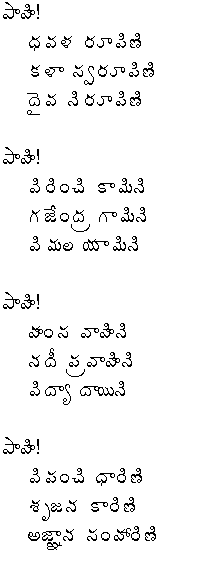
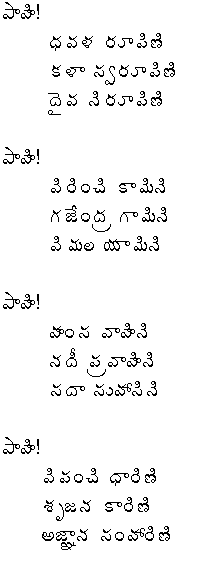
Monday, July 18, 2005
Nalinakanthi kriti - old
... with reference to this previous post of kedar
Shelves dusted once again... this was the 'actual' one written and composed by kedar in Nalinakanthi sometime last year. Do not know if Kedar himself has it!!
red=tara sthaayi, blue=mandra sthaayi
Pallavi:
g r m , | g r s n|| p n s g | r , , , ||
dhyaaye padmini hiranmayee
r m p m | g r m p || n n p m | g r s , || ………|| g r m , ||
hari hrudayasthite tribhuvana pujithe……..|| dhyaye||
Anupallavi:
p n , p | s , , , || g r m g | r , , , ||
chakOra bandhu sahodaree
s g r s | n p m , || g r p , | m g r s || ……….|| g r m , ||
saagara tanaye uluuka vaahane ……………..|| dhyaye||
p , m , | g , r s || n g r m |g [r], , , ||
Hiranya nalina kanthi mathi
r , s n |[p] , s g r || m p , m | g r s , ||
hema malini vibhavari
p n p , | s , , , || g r m g | r , , , ||
dhana dhaanya kari sree devi
s g r s | n p m , || g r p , | m g r s || ……….|| g r m , ||
mangala daayini sukha pradaayini ……………..|| dhyaye||
Shelves dusted once again... this was the 'actual' one written and composed by kedar in Nalinakanthi sometime last year. Do not know if Kedar himself has it!!
red=tara sthaayi, blue=mandra sthaayi
Pallavi:
g r m , | g r s n|| p n s g | r , , , ||
dhyaaye padmini hiranmayee
r m p m | g r m p || n n p m | g r s , || ………|| g r m , ||
hari hrudayasthite tribhuvana pujithe……..|| dhyaye||
Anupallavi:
p n , p | s , , , || g r m g | r , , , ||
chakOra bandhu sahodaree
s g r s | n p m , || g r p , | m g r s || ……….|| g r m , ||
saagara tanaye uluuka vaahane ……………..|| dhyaye||
p , m , | g , r s || n g r m |g [r], , , ||
Hiranya nalina kanthi mathi
r , s n |[p] , s g r || m p , m | g r s , ||
hema malini vibhavari
p n p , | s , , , || g r m g | r , , , ||
dhana dhaanya kari sree devi
s g r s | n p m , || g r p , | m g r s || ……….|| g r m , ||
mangala daayini sukha pradaayini ……………..|| dhyaye||
Wednesday, July 13, 2005
Hero
Though a bhakta of Siva, Ravana committed heinous crimes (in the language of UNHRC junta) such as plundering, rape, murder, etc.,
So what is that single thing that redeemed Ravana.. He who desired another's wife (the another being none other than the Lord Himself)? the word "Rama" escaped his lips while he was crashing to the ground as a result of the arrow of Rama. That singular moment of divine thought was the source of his redemption.
And what is that single thing that makes the gultest of the gults (read 'muggles', not just telugu people) Ramesh ( a .com by the way... if you get me... and the object of Prasad's innermost thoughts!) greater than any other gult according to me??
The singular act of his that catapulted his image in my eyes was the fact that he liked the movie "Hero", starring Jet Li. He even gave me a discourse on the movie and urged me to watch it. I mean, for me, there is no other tool known to me to separate gults from other people. Not a single gult that I know has liked it, and I have been laughed at (to my great satisfaction to know I am not one of them) for liking that movie. But here is this fellow from Kurnool, not only does he see the movie, he even recommends me to see it! (I mean, generally, people dont just come up to me and recommend movies like that...) Thats the one thing I like abt him (other than the fact that he was the one who gave me the Monica Bellucci clip!).
Clearly, one of the greatest movies I have even seen. The whole movie is a discussion between an ambitious King who desires to expand his kingdom and a hero who has returned after killing the King's three most feared assassins to collect his reward.
I cannot do the injustice of spoiling the suspense and twists, but this I do say that apart from the story and the highest morals involved in the movie, the best part is the use of colours... if you enjoyed watching that song from Sakhi wherein each stanza has an associated colour, you will love this one even more! The whole movie is divided into different perspectives--each of its own colour.. and finally the truth in all white. The fights are beautifully choreographed and locale-effects feature such artistry that would bring an artist to tears!
So what is that single thing that redeemed Ravana.. He who desired another's wife (the another being none other than the Lord Himself)? the word "Rama" escaped his lips while he was crashing to the ground as a result of the arrow of Rama. That singular moment of divine thought was the source of his redemption.
And what is that single thing that makes the gultest of the gults (read 'muggles', not just telugu people) Ramesh ( a .com by the way... if you get me... and the object of Prasad's innermost thoughts!) greater than any other gult according to me??
The singular act of his that catapulted his image in my eyes was the fact that he liked the movie "Hero", starring Jet Li. He even gave me a discourse on the movie and urged me to watch it. I mean, for me, there is no other tool known to me to separate gults from other people. Not a single gult that I know has liked it, and I have been laughed at (to my great satisfaction to know I am not one of them) for liking that movie. But here is this fellow from Kurnool, not only does he see the movie, he even recommends me to see it! (I mean, generally, people dont just come up to me and recommend movies like that...) Thats the one thing I like abt him (other than the fact that he was the one who gave me the Monica Bellucci clip!).
Clearly, one of the greatest movies I have even seen. The whole movie is a discussion between an ambitious King who desires to expand his kingdom and a hero who has returned after killing the King's three most feared assassins to collect his reward.
I cannot do the injustice of spoiling the suspense and twists, but this I do say that apart from the story and the highest morals involved in the movie, the best part is the use of colours... if you enjoyed watching that song from Sakhi wherein each stanza has an associated colour, you will love this one even more! The whole movie is divided into different perspectives--each of its own colour.. and finally the truth in all white. The fights are beautifully choreographed and locale-effects feature such artistry that would bring an artist to tears!
Thursday, July 07, 2005
This is from the archives of rec.music.indian.classical (RMIC for short) :
Havanur Jan 14 2004, 11:48 pm wrote:
bod...@yahoo.com (Manohar Bodas) wrote in message > There is one more Shankh- Dwani. Shankara and Hansdwani.
May I also submit
1) Yama Kauns - combination of Yaman and Malkauns leading to an instant ...
2) Khalas - from Khamaj and Bhimpalas
If you think that is tasteless how about the bongish Poori Bhoji, a mix of Pooriya and Kambhoji?
Havanur Jan 14 2004, 11:48 pm wrote:
bod...@yahoo.com (Manohar Bodas) wrote in message > There is one more Shankh- Dwani. Shankara and Hansdwani.
May I also submit
1) Yama Kauns - combination of Yaman and Malkauns leading to an instant ...
2) Khalas - from Khamaj and Bhimpalas
If you think that is tasteless how about the bongish Poori Bhoji, a mix of Pooriya and Kambhoji?
Sunday, July 03, 2005
The Trio
First of all came Hema Malini,
then came Meenakshi Sheshadri,
and now, finally, Vidya Balan.
For me, the Trio is complete.
then came Meenakshi Sheshadri,
and now, finally, Vidya Balan.
For me, the Trio is complete.
Friday, July 01, 2005
Wednesday, June 29, 2005
Veena Sessions
Last saturday, I saw something new... something I had never seen with my naked eye! I saw two Veenas... one of which was actually played, and the person who happened to play the veena happened to be my new friend, and the kritis he played were actually decided by me!
About 4 days earlier, I zeroed in on about 6 kritis for our "veena session" on saturday and handed them over to Mahadev Prasad, a gentle human filled with devotion, hiding an ent-like anger roused only when the relevant topics are brought up. Coming from a Lingayat family, his countenance bears an unusual resemblance to the Three-Eyed One Himself. Every morning in the bus, he reads some stanzas from the "Soundarya Lahari" of Adi Sankara with unbriddled enthusiasm and unwavering perseverence.
He learnt veena for more than 10 years, and he still learns new kritis whenever time permits a hiatus from the research work at the GE John F. Welch Technology Centre, Bangalore. Thanks to my nosy probing, I finally found somebody into classical in GE.
By the way, the kritis he played:
1) Varnam-- Sahana
2) Swarajathi --Kamakshi -- Bhairavi
3) Paripaalayamaam -- Reetigowla
4) Daru Varnam --Maatemalayadhwaja -- Khamas (Yup! see how much I like them??)
5) Kanakana -- VaraaLi
6) Thillana -- DhanaSri (This is the thillana by MSS that I call "bhimpalasi" becasue it feels exactly like it.. Mahadev told me its actually called DhanaSri)
We are supposed to have another session this saturday... cant wait! (though this time, sense prevails and there is only one varnam.. but with nine ragas though!)
About 4 days earlier, I zeroed in on about 6 kritis for our "veena session" on saturday and handed them over to Mahadev Prasad, a gentle human filled with devotion, hiding an ent-like anger roused only when the relevant topics are brought up. Coming from a Lingayat family, his countenance bears an unusual resemblance to the Three-Eyed One Himself. Every morning in the bus, he reads some stanzas from the "Soundarya Lahari" of Adi Sankara with unbriddled enthusiasm and unwavering perseverence.
He learnt veena for more than 10 years, and he still learns new kritis whenever time permits a hiatus from the research work at the GE John F. Welch Technology Centre, Bangalore. Thanks to my nosy probing, I finally found somebody into classical in GE.
By the way, the kritis he played:
1) Varnam-- Sahana
2) Swarajathi --Kamakshi -- Bhairavi
3) Paripaalayamaam -- Reetigowla
4) Daru Varnam --Maatemalayadhwaja -- Khamas (Yup! see how much I like them??)
5) Kanakana -- VaraaLi
6) Thillana -- DhanaSri (This is the thillana by MSS that I call "bhimpalasi" becasue it feels exactly like it.. Mahadev told me its actually called DhanaSri)
We are supposed to have another session this saturday... cant wait! (though this time, sense prevails and there is only one varnam.. but with nine ragas though!)
Saturday, June 25, 2005
Nalinakanthi Kriti
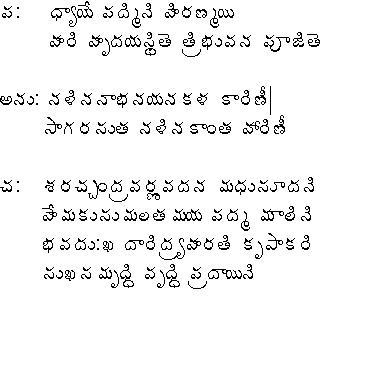 First of all... I dont know where to post this... so I am posting it at myblog!
Months ago, I had "composed" a kriti on Lakshmi in Nalinakanthi.
Bad attempt... neither lyrics, nor music was worth mentioning... but anyways, I lost it. I believe Vidya has it...
Got enthu again, and this time, at least the lyrics part is a bit "oker". This time, its not the adi talam... its the misra-chapu! adjusted the lyrics for the taalam...
Got the pallavi swaras figured out... working on other parts... please please please.. any advice on either improving the lyrics or any offer on providing music (esp PRC) and you are a life saver!!!
As you can see, the pic is a screen shot.. used telugu lipi editor.
movie spree
Ok... ppl!!!
I have returned to my senses!
Here are the movies I have bought on my Hyd trip last weekend:
1) Missamma (VCD)
2) Gundamma Katha (VCD)
3) Appu Chesi Pappu koodu (VCD)
4) PeLLi chesi choodu (VCD)
5) Baiju Baawra (DVD)
6) Phantom of the Opera (VCD)
7) Amadeus (VCD).
all around Rs.1200.. not a bad deal... what say??
I have returned to my senses!
Here are the movies I have bought on my Hyd trip last weekend:
1) Missamma (VCD)
2) Gundamma Katha (VCD)
3) Appu Chesi Pappu koodu (VCD)
4) PeLLi chesi choodu (VCD)
5) Baiju Baawra (DVD)
6) Phantom of the Opera (VCD)
7) Amadeus (VCD).
all around Rs.1200.. not a bad deal... what say??
Friday, June 24, 2005
Osmania Biscuit VII - Tiger Bal Reddy kismat
Its been a long time now. But I still recall the way the man talked to me for the first time. No formalities, no unnecessary modalities, just an honest nod and a terse comment that, if it was any other person, they could never take a guess that I was from hyderabad but not him! He is Lingam Yadav. He still visits our Kaiser-e-Hind cafe in Old Malakpet, especially when he meets Kedar, me and Laxman, our colony youth association leader.
People speak of Lingam's knowledge and humour. But few know of his expertise in predicting (rather declaring!) electoral results. That was the time when each and every street kid in our old city could tell you that Salahuddin Owaisi would sweep the Hyderabad seat once more. Lingam just kept smiling all along. He would not have got that out but for us friends; We were sitting in Light of Yadgaar that day, nalla Yadgiri had just ordered one more Dilkhush and chai and Lingam was just having his 8th Osmania Biscuit, "Charminar Baddam kodtadu ee saari, sawwaal ledu"... he said. We were staring at him in disbelief !! a minute of silence and we were still waiting for him to continue... "Patherghatti, Purani galli, Basheer mohalla, Lal Darwaza inka Langar Houz kelli pakka khabar unnadi maa poragalladi ... Baddam ki full guddinranta"
he said with almost no reaction, sipping his chai.
That was one of those rare occasions when Baddam Bal Reddy won the Hyderabad seat, against all odds. But we knew it days before the results!
We already know, "Lingam Yadav doesnt lie when he is eating Osmania Biscuit"
and we should also know, "Whatever Lingam Yadav says when having chai, will happen"
Vidya
People speak of Lingam's knowledge and humour. But few know of his expertise in predicting (rather declaring!) electoral results. That was the time when each and every street kid in our old city could tell you that Salahuddin Owaisi would sweep the Hyderabad seat once more. Lingam just kept smiling all along. He would not have got that out but for us friends; We were sitting in Light of Yadgaar that day, nalla Yadgiri had just ordered one more Dilkhush and chai and Lingam was just having his 8th Osmania Biscuit, "Charminar Baddam kodtadu ee saari, sawwaal ledu"... he said. We were staring at him in disbelief !! a minute of silence and we were still waiting for him to continue... "Patherghatti, Purani galli, Basheer mohalla, Lal Darwaza inka Langar Houz kelli pakka khabar unnadi maa poragalladi ... Baddam ki full guddinranta"
he said with almost no reaction, sipping his chai.
That was one of those rare occasions when Baddam Bal Reddy won the Hyderabad seat, against all odds. But we knew it days before the results!
We already know, "Lingam Yadav doesnt lie when he is eating Osmania Biscuit"
and we should also know, "Whatever Lingam Yadav says when having chai, will happen"
Vidya
Thursday, June 16, 2005
The end of Arwen Undómiel
This part of the story is present in an appendix of LOTR (meanings of some of the lesser known terms and persons are given below):
The Third Age ended thus in victory and hope; and yet grievous among the sorrows of that Age was the parting of Elrond and Arwen, for they were sundered by the Sea and by a doom beyond the end of the world. When the Great Ring was unmade and the Three were shorn of their power, then Elrond grew weary at last and forsook Middle-earth, never to return. But Arwen became as a mortal woman, and yet it was not her lot to die until all that she had gained was lost.
As Queen of Elves and Men she dwelt with Aragorn for six-score years in great glory and bliss; yet at last he felt the approach of old age and knew that the span of his life-days was drawing to an end, long though it had been. Then Aragorn said to Arwen:
"At last, Lady Evenstar, fairest in this world, and most beloved, my world is fading. Lo! we have gathered, and we have spent, and now the time of payment draws near."
Arwen knew what he intended, and long had forseen it, nonetheless she was overborne by her grief. "Would you then, lord, before your time leave your people that live by your word?" she said.
"Not before my time," he answered. "For if I will not go now, then I must soon go perforce. And Eldarion our son is a man full-ripe for kingship."
Then going to the House of the Kings in the Silent Street, Aragorn laid him down on the long bed that had been prepared for him. There he said farewell to Eldarion*, and gave into his hands the winged crown of Gondor and the sceptre of Arnor; and then all left him save Arwen, and she stood alone by his bed. And for all her wisdom and lineage she could not forbear to plead with him to stay yet for a while. She was not yet weary of her days, and thus she tasted the bitterness of the mortality that she had taken upon her.
"Lady Undómiel*," said Aragorn, "the hour is indeed hard, yet it was made even in that day when we met under the white birches in the garden of Elrond where none now walk. And on the hill of Cerin Amroth* when we forsook both the Shadow and the Twilight this doom we accepted. Take counsel with yourself, beloved, and ask whether you would indeed have me wait until I wither and fall from my high seat unmanned and witless. Nay, lady, I am the last of the Númenoreans and the latest King of the Elder Days; and to me has been given not only a span thrice that of Men of Middle-earth, but also the grace to go at my will, and give back the gift. Now, therefore, I will sleep.
"I speak no comfort to you, for there is no comfort for such pain within the circles of the world. The uttermost choice is before you, to repent and go to the Havens and bear away into the West the memory of our days together that shall there be evergreen but never more than memory; or else to abide the Doom of Men."
"Nay, dear lord," she said, "that choice is long over. There is now no ship that would bear me hence, and I must indeed abide the Doom of Men, whether I will or I nill: the loss and the silence. But I say to you, King of the Númenoreans, not till now have I understood the tale of your people and their fall. As wicked fools I scorned them, but I pity them at last. For if this is indeed, as the Eldar* say, the gift of the One to Men, it is bitter to receive."
"So it seems," he said. "But let us not be overthrown in the final test, who of old renounced the Shadow and the Ring. In sorrow we must go, but not in despair. Behold! We are not bound for ever to the circles of the world, and beyond them is more than memory, Farewell!"
"Estel*, Estel!" she cried, and with that even as he took her hand and kissed it, he fell into sleep. Then a great beauty was revealed in him, so that all who after came there looked on him in wonder; for they saw that the grace of his youth, and the valour of his manhood, and the wisdom and majesty of his age were blended together. And long there he lay, an image of the splendour of the Kings of Men in glory undimmed before the breaking of the world.
But Arwen went forth from the House, and the light in her eyes was quenched, and it seemed to her people that she had become cold and grey as nightfall in winter that comes without a star. Then she said farewell to Eldarion, and to her daughters, and to all whom she had loved; and she went out from the city of Minas Tirith and passed away to the land of Lórien, and dwelt there alone under the fading trees until the winter came. Galadriel had passed away and Celeborn also was gone, and the land was silent.
There at last when the mallorn-leaves were falling, but spring had not yet come, she laid herself to rest upon Cerin Amroth; and there is her green grave, until the world is changed, and all the days of her life are utterly forgotten by men that come after, and elanor and niphredil bloom no more east of the Sea.
Eldarion=son of Aragorn and Arwen
Undomiel=elvish for evening star, epithet of Arwen
Cerin Amroth=a beautiful hill (or mound) in Lothlorien
Eldar=elves
Estel=childhood name given to Aragorn by Elrond to hide his identity, means "hope"
The Third Age ended thus in victory and hope; and yet grievous among the sorrows of that Age was the parting of Elrond and Arwen, for they were sundered by the Sea and by a doom beyond the end of the world. When the Great Ring was unmade and the Three were shorn of their power, then Elrond grew weary at last and forsook Middle-earth, never to return. But Arwen became as a mortal woman, and yet it was not her lot to die until all that she had gained was lost.
As Queen of Elves and Men she dwelt with Aragorn for six-score years in great glory and bliss; yet at last he felt the approach of old age and knew that the span of his life-days was drawing to an end, long though it had been. Then Aragorn said to Arwen:
"At last, Lady Evenstar, fairest in this world, and most beloved, my world is fading. Lo! we have gathered, and we have spent, and now the time of payment draws near."
Arwen knew what he intended, and long had forseen it, nonetheless she was overborne by her grief. "Would you then, lord, before your time leave your people that live by your word?" she said.
"Not before my time," he answered. "For if I will not go now, then I must soon go perforce. And Eldarion our son is a man full-ripe for kingship."
Then going to the House of the Kings in the Silent Street, Aragorn laid him down on the long bed that had been prepared for him. There he said farewell to Eldarion*, and gave into his hands the winged crown of Gondor and the sceptre of Arnor; and then all left him save Arwen, and she stood alone by his bed. And for all her wisdom and lineage she could not forbear to plead with him to stay yet for a while. She was not yet weary of her days, and thus she tasted the bitterness of the mortality that she had taken upon her.
"Lady Undómiel*," said Aragorn, "the hour is indeed hard, yet it was made even in that day when we met under the white birches in the garden of Elrond where none now walk. And on the hill of Cerin Amroth* when we forsook both the Shadow and the Twilight this doom we accepted. Take counsel with yourself, beloved, and ask whether you would indeed have me wait until I wither and fall from my high seat unmanned and witless. Nay, lady, I am the last of the Númenoreans and the latest King of the Elder Days; and to me has been given not only a span thrice that of Men of Middle-earth, but also the grace to go at my will, and give back the gift. Now, therefore, I will sleep.
"I speak no comfort to you, for there is no comfort for such pain within the circles of the world. The uttermost choice is before you, to repent and go to the Havens and bear away into the West the memory of our days together that shall there be evergreen but never more than memory; or else to abide the Doom of Men."
"Nay, dear lord," she said, "that choice is long over. There is now no ship that would bear me hence, and I must indeed abide the Doom of Men, whether I will or I nill: the loss and the silence. But I say to you, King of the Númenoreans, not till now have I understood the tale of your people and their fall. As wicked fools I scorned them, but I pity them at last. For if this is indeed, as the Eldar* say, the gift of the One to Men, it is bitter to receive."
"So it seems," he said. "But let us not be overthrown in the final test, who of old renounced the Shadow and the Ring. In sorrow we must go, but not in despair. Behold! We are not bound for ever to the circles of the world, and beyond them is more than memory, Farewell!"
"Estel*, Estel!" she cried, and with that even as he took her hand and kissed it, he fell into sleep. Then a great beauty was revealed in him, so that all who after came there looked on him in wonder; for they saw that the grace of his youth, and the valour of his manhood, and the wisdom and majesty of his age were blended together. And long there he lay, an image of the splendour of the Kings of Men in glory undimmed before the breaking of the world.
But Arwen went forth from the House, and the light in her eyes was quenched, and it seemed to her people that she had become cold and grey as nightfall in winter that comes without a star. Then she said farewell to Eldarion, and to her daughters, and to all whom she had loved; and she went out from the city of Minas Tirith and passed away to the land of Lórien, and dwelt there alone under the fading trees until the winter came. Galadriel had passed away and Celeborn also was gone, and the land was silent.
There at last when the mallorn-leaves were falling, but spring had not yet come, she laid herself to rest upon Cerin Amroth; and there is her green grave, until the world is changed, and all the days of her life are utterly forgotten by men that come after, and elanor and niphredil bloom no more east of the Sea.
Eldarion=son of Aragorn and Arwen
Undomiel=elvish for evening star, epithet of Arwen
Cerin Amroth=a beautiful hill (or mound) in Lothlorien
Eldar=elves
Estel=childhood name given to Aragorn by Elrond to hide his identity, means "hope"
Tuesday, June 14, 2005
A thought
Something to think about--
As I walk to the bus stop everyday, a caucasian lady stands in the front of the gate of a posh hotel on the way and feeds three dogs from her hand. One fine day, it dawned on me that I actually knew those dogs-- one of them looked exactly like one of my friends returning from US and working in an MNC, another one looked like my undergrad friend from computer science presently in a software company, and the last one (which was doing its best to impress the white woman by rolling over its belly and licking her feet) looked exactly like that beef-eating guy on my trans-atlantic flight who was so proud of his achiement of getting a job in US of A that he didnt mind letting me know of it.
Cant wait to join them to get my share of morsels!!
As I walk to the bus stop everyday, a caucasian lady stands in the front of the gate of a posh hotel on the way and feeds three dogs from her hand. One fine day, it dawned on me that I actually knew those dogs-- one of them looked exactly like one of my friends returning from US and working in an MNC, another one looked like my undergrad friend from computer science presently in a software company, and the last one (which was doing its best to impress the white woman by rolling over its belly and licking her feet) looked exactly like that beef-eating guy on my trans-atlantic flight who was so proud of his achiement of getting a job in US of A that he didnt mind letting me know of it.
Cant wait to join them to get my share of morsels!!
Monday, June 13, 2005
Osmania biscuit VI-- Lingam's train ride
This is a letter I got from Lingam yesterday. He says that he has good English, but that he loves to use local words and phrases amidst only to show that he is proud of his culture...
is that a fact?
Dear Dost,
Lingam here. I have safely reached Bangalore and found a place to live. Train was very fursat se, you know! They told me that because it was a special train, it stopped in small stations for a long time. If you ask me, special trains should go faster and dabbuna complete the journey, but this is not our Saleem Nagar--that train ride was antha lolli lolli anuko raadu!
As you know, it has been many years since I travelled by train. So it was a little new for me. When I got into the train and went to my berth, a little girl was already sleeping there. I looked around for her parents, but no one was interested. I didnt feel like waking up that little girl. I thought her parents would come after the train starts and sat beside her. The train started, and I wanted to rest a little, but the girl didnt wake up and no one came to take her. I started asking other people there-- "Is this your girl?" No one said yes. You know-- It was a total tamaasha!
Adding to that, I suddenly had to go to the bathroom-- that too "number 2"... I went for the toilet, but it said "Please avoid using toilets when the train is stationary." Dhath teri.... Trains are so developed these days-- they sell even books and pencils these days. I thought they will sell scales also and wanted to ask for one for you because you need them right? (Lingam always remembers only the word "scale" of Very Large Scale Inegration). I did not feel like going to toilet where they sell such posh things useful for big study (Lingam's word for higher studies) . What to do, I controlled and sat.
Then I remembered your lecture that day on enjoying train rides. Jarra relaxed little. I too started enjoying all passing things-- trees, houses, bridges, names of small stations, and I started reading the boards in English , you know-- It was "MAHABOOBNAGAR" station-- arey! I know some people from Mahaboobnagar. Actually very famous there. Every rickshaw man knows them. I was actually feeling nice, then the train started moving and I saw another board-- "CANTEEN", then "CLOAK ROOM", then "TOILET"-- Deenamma! I suddenly remembered I had to go to toilet.
And then, when I was very much in trouble, someone new came to me and asked "Is this your girl?" I didnt know what to say... All other people in compartment--I still remember how they laughed! How my damaak rotated you know! And adding to that, ijjat kachra anuko!
Unknowingly, my hand went into my pocket and I received my third and biggest shock-- I forgot to bring my osmania biscuit packet from home. Actually, that is why I am writing this letter. Though Bangalore is a new city, I searched for 2 days, but I couldnt find a shop that sells osmania biscuits. Can you please post them to me? But be careful-- they should not break! I know you are smart enough (he means rich enough!) to find a way to post them unspoiled.
your friend,
Lingam Yadav
Xth Passed (Private)
is that a fact?
Dear Dost,
Lingam here. I have safely reached Bangalore and found a place to live. Train was very fursat se, you know! They told me that because it was a special train, it stopped in small stations for a long time. If you ask me, special trains should go faster and dabbuna complete the journey, but this is not our Saleem Nagar--that train ride was antha lolli lolli anuko raadu!
As you know, it has been many years since I travelled by train. So it was a little new for me. When I got into the train and went to my berth, a little girl was already sleeping there. I looked around for her parents, but no one was interested. I didnt feel like waking up that little girl. I thought her parents would come after the train starts and sat beside her. The train started, and I wanted to rest a little, but the girl didnt wake up and no one came to take her. I started asking other people there-- "Is this your girl?" No one said yes. You know-- It was a total tamaasha!
Adding to that, I suddenly had to go to the bathroom-- that too "number 2"... I went for the toilet, but it said "Please avoid using toilets when the train is stationary." Dhath teri.... Trains are so developed these days-- they sell even books and pencils these days. I thought they will sell scales also and wanted to ask for one for you because you need them right? (Lingam always remembers only the word "scale" of Very Large Scale Inegration). I did not feel like going to toilet where they sell such posh things useful for big study (Lingam's word for higher studies) . What to do, I controlled and sat.
Then I remembered your lecture that day on enjoying train rides. Jarra relaxed little. I too started enjoying all passing things-- trees, houses, bridges, names of small stations, and I started reading the boards in English , you know-- It was "MAHABOOBNAGAR" station-- arey! I know some people from Mahaboobnagar. Actually very famous there. Every rickshaw man knows them. I was actually feeling nice, then the train started moving and I saw another board-- "CANTEEN", then "CLOAK ROOM", then "TOILET"-- Deenamma! I suddenly remembered I had to go to toilet.
And then, when I was very much in trouble, someone new came to me and asked "Is this your girl?" I didnt know what to say... All other people in compartment--I still remember how they laughed! How my damaak rotated you know! And adding to that, ijjat kachra anuko!
Unknowingly, my hand went into my pocket and I received my third and biggest shock-- I forgot to bring my osmania biscuit packet from home. Actually, that is why I am writing this letter. Though Bangalore is a new city, I searched for 2 days, but I couldnt find a shop that sells osmania biscuits. Can you please post them to me? But be careful-- they should not break! I know you are smart enough (he means rich enough!) to find a way to post them unspoiled.
your friend,
Lingam Yadav
Xth Passed (Private)
Thursday, June 09, 2005
An Ode to Bhairavaar
There is a very famous temple complex in Houston, TX called the Meenakshi Temple. It is mostly managed by Tamilians and so the names of the Gods there are "Sambarified." A small temple housed in the complex hallowed to Bhairava has the board "Bhairavaar." In an instant, the Ghost of Vikatakavi got into me and this precipitated:
Bhairavaar
Goes to war
In his red car,
Slays demons
But fears womans
As he wears only lemons.
Bhairavaar
Goes to war
In his red car,
Slays demons
But fears womans
As he wears only lemons.
Wednesday, June 08, 2005
Sick man's food
It is actually called sick man's food, but it is actually much more than that! It is analogous to pongal/pongali of the South but not equal--Other than the facts that it is dry, and black- pepper seeds are not used, it is not generally used for auspicious occasions. It is for one of those cozy evenings when it is a bit cold and drizzling outside, everyone is home early quite coincidentally and has an air tranquility and contentment around him/her. Believe me when I say there is no antidote to the pleasure got from having "garam garam" Khichdi along with saar (charu in telugu).
There is a curious "fact" (if you will) surrounding Khichdi... no matter how cleverly you estimate the amout of rice and daal and cook it, it is always insufficient for the lot. Someone is always unsatisfied looking eagerly down the empty vessel. The de ja vu happened happened for the nth time the other day when my friend's wife made Khichdi. The interesting thing was, I told them the funda about Khichdi before we started to eat and still it happened.
There is a curious "fact" (if you will) surrounding Khichdi... no matter how cleverly you estimate the amout of rice and daal and cook it, it is always insufficient for the lot. Someone is always unsatisfied looking eagerly down the empty vessel. The de ja vu happened happened for the nth time the other day when my friend's wife made Khichdi. The interesting thing was, I told them the funda about Khichdi before we started to eat and still it happened.
Monday, June 06, 2005
A small revelation
I was going to post another of those pesudo-humourous adventures of Lingam yadav when I had a sort of epiphany today.
Everything--emotions, aspirations, relationships, status in society, quality of life, the life itself, and finally, the God we worship--- is just a state of mind defined by a particular set of parameters. Everything we take in as an input, worthy of remembrance, from our senses finally ends up only as a defined state in the mind--"how we reacted to it". To every organism on this intriguing planet, "what exists" has so little meaning over "what it does/means to me" that "what it does/means to me" becomes more "real" than "what it actually is". Only Hallucinations...Illusions...
Perhaps that is what Gita, Bach, and Morpheus were trying to tell us...
Everything--emotions, aspirations, relationships, status in society, quality of life, the life itself, and finally, the God we worship--- is just a state of mind defined by a particular set of parameters. Everything we take in as an input, worthy of remembrance, from our senses finally ends up only as a defined state in the mind--"how we reacted to it". To every organism on this intriguing planet, "what exists" has so little meaning over "what it does/means to me" that "what it does/means to me" becomes more "real" than "what it actually is". Only Hallucinations...Illusions...
Perhaps that is what Gita, Bach, and Morpheus were trying to tell us...
Saturday, June 04, 2005
For my partners in crime
Ok... Last night was really stormy... Aakarsh's and Flute's poems made me do all this... dont blame me!
Poem-I: An Ode To The Poet
Shall I sing of the pen that watered thy thought?
Shall I sing of the paper that sustained thy thought?
Shall I sing of the time that nurtured thy thought?
Shall I sing of the Almighty that gave soul to thy thought ?
Nay--
I shall sing only of myself, blessed enough to relish thy thought!
Poem-II: Of Beauty Priceless
A thousand verses put together
Cannot rival a single syllable
Spilt from the urn of the heart,
A blossom of fragance incomparable.
No Frost or keats do I know
At this very moment of time,
For all I know, I wasnt there
When they created their rhyme.
Yes, I write poems too!
Not bad ones to be true--
But now, I prefer to be
As a friend of the poet free.
Such are the cruel ways of our times,
Only on a rare day is such beauty wrought;
Still my soul is in great climes,
For even this is cheaply bought!
Poem III : An Ode To The Divine Verse
My heart reels under pleasure
Everytime I glance at Thee;
It aches with elation,
burdened under the glee.
It is good Thou are not mine,
O creation so Godly and fine!
Had Thou were born in me,
Surely, my soul would have succumbed to Thee.
Kedar.
Poem-I: An Ode To The Poet
Shall I sing of the pen that watered thy thought?
Shall I sing of the paper that sustained thy thought?
Shall I sing of the time that nurtured thy thought?
Shall I sing of the Almighty that gave soul to thy thought ?
Nay--
I shall sing only of myself, blessed enough to relish thy thought!
Poem-II: Of Beauty Priceless
A thousand verses put together
Cannot rival a single syllable
Spilt from the urn of the heart,
A blossom of fragance incomparable.
No Frost or keats do I know
At this very moment of time,
For all I know, I wasnt there
When they created their rhyme.
Yes, I write poems too!
Not bad ones to be true--
But now, I prefer to be
As a friend of the poet free.
Such are the cruel ways of our times,
Only on a rare day is such beauty wrought;
Still my soul is in great climes,
For even this is cheaply bought!
Poem III : An Ode To The Divine Verse
My heart reels under pleasure
Everytime I glance at Thee;
It aches with elation,
burdened under the glee.
It is good Thou are not mine,
O creation so Godly and fine!
Had Thou were born in me,
Surely, my soul would have succumbed to Thee.
Kedar.
Friday, June 03, 2005
Misfortune Denied
This is the longest poem (may be not by content, but by style) I have come up with. I wanted to make this into a kind of "singable" poem; didnt succeed completely though... written around the same time as the Bathos. Again, this one has the classical language.
Misfortune Denied
I sit to weave a solemn raiment
To contain the sea of my lament
Of sorrows long forgotten
Yet, still stung this moment.
Perches a creature
Upon my nape
Morbid in appearance
Hideous in shape.
He Begins to gnaw at hope
And begins to bruise my pride.
The onset left me numb
And flung me aside.
Pointed ears, long nose
Beady eyes, raised brows
Bat-like wings, ugly claws
As I look, a sly smile grows
Who art thou and why dost thou come unto me--
I enquired.
He replied:
Abhorrent and cunning mate
Yet, bowed in awe and held great
Ever so early, never late
I am the wretched ill-fate.
A menace beyond time
And a shadow forever dark,
A ravenous hunter ever,
I seldom miss my mark.
Subtle are my makings
Though never a praise,
Whole Kingdoms vanish
With just a wily gaze.
Weapon of Gods and Demons
No loyalty doth I know
Ever in the hearts of men
Despair doth I sow.
I am the glory,
I am the twist,
I am the satire,
The lucid I mist.
Harken to me, O Mortal!
For I am upon thee now,
And soon, I shall enslave thee
To Me then, thy will shall avow.
Unmoved, I said:
Nay lord!
I'd bow at Thy power
And be as Thou would see,
But for the one I am,
Wretched than Thee.
In me, Thou shall find
Only pride entangled;
Base will fit for none,
And conscience mangled
O Nefarious One!
I shall sing songs of glory
Hallowed to Thee alone,
Neither God nor Devil
I answer to Thee alone.
Wilt Thou take me Lord
As Thy thrall, as Thy slave?
And take me, as Thy vassal,
Beyond the mortal grave?
At that, His pride shook,
And His might stirred.
And He roared:
Enough! Thou lowly mortal!
Thy doom shant haggle with thee.
Yet in truth thou spake,
Thou art, indeed, wretched than Me!
No vassals do I take,
To thy sorrow I leave thee hither.
He then spat upon me
And flew away elsewither.
As I resume to gather
Shreds of my gloom,
Neither well nor ill
No fortune graces my doom.
Kedar.
Misfortune Denied
I sit to weave a solemn raiment
To contain the sea of my lament
Of sorrows long forgotten
Yet, still stung this moment.
Perches a creature
Upon my nape
Morbid in appearance
Hideous in shape.
He Begins to gnaw at hope
And begins to bruise my pride.
The onset left me numb
And flung me aside.
Pointed ears, long nose
Beady eyes, raised brows
Bat-like wings, ugly claws
As I look, a sly smile grows
Who art thou and why dost thou come unto me--
I enquired.
He replied:
Abhorrent and cunning mate
Yet, bowed in awe and held great
Ever so early, never late
I am the wretched ill-fate.
A menace beyond time
And a shadow forever dark,
A ravenous hunter ever,
I seldom miss my mark.
Subtle are my makings
Though never a praise,
Whole Kingdoms vanish
With just a wily gaze.
Weapon of Gods and Demons
No loyalty doth I know
Ever in the hearts of men
Despair doth I sow.
I am the glory,
I am the twist,
I am the satire,
The lucid I mist.
Harken to me, O Mortal!
For I am upon thee now,
And soon, I shall enslave thee
To Me then, thy will shall avow.
Unmoved, I said:
Nay lord!
I'd bow at Thy power
And be as Thou would see,
But for the one I am,
Wretched than Thee.
In me, Thou shall find
Only pride entangled;
Base will fit for none,
And conscience mangled
O Nefarious One!
I shall sing songs of glory
Hallowed to Thee alone,
Neither God nor Devil
I answer to Thee alone.
Wilt Thou take me Lord
As Thy thrall, as Thy slave?
And take me, as Thy vassal,
Beyond the mortal grave?
At that, His pride shook,
And His might stirred.
And He roared:
Enough! Thou lowly mortal!
Thy doom shant haggle with thee.
Yet in truth thou spake,
Thou art, indeed, wretched than Me!
No vassals do I take,
To thy sorrow I leave thee hither.
He then spat upon me
And flew away elsewither.
As I resume to gather
Shreds of my gloom,
Neither well nor ill
No fortune graces my doom.
Kedar.
Thursday, June 02, 2005
A Bathos in Romance
Ok! Some disclaimers:
This is not me, and any resemblence between the narrator of the poem and myself (alive or dead)is purely coincidental! Unfortunately, I am not the romantic type. I always wanted to write a love poem, so I did (about two and a half years ago).
A Bathos in Romance
I look out into the window
Into the bare remains of snow
And bare remains of green that vanished ago.
Once stood spring here,
Brought she hope here,
That I'd find the one I was looking for dear.
A fair maiden used to dance
In my heart and used to glance
At me, her knight in shining armour and lance.
Stung by love, I searched for her;
Lost myself but looked for her;
Mad I was, fool I was, and hapless I was for her.
Many a lass passed my way,
And the heart stopped at each's say;
But soon realised, wasnt the one to make my day
And thus passed the spring--
Hope, but only hope did she bring
And left me to lament, when I wanted to sing.
Sorrow in eyes, gloom in heart
Are the treasures left to my part
But cling to me these, and faithfully do their part.
All the hope I had left my in tyranny,
Emptiness quells the short-lived mutiny,
Reigns supreme in my heart, and drives me to my destiny.
If its better to have loved and lost than to have never loved at all, it is too much to ask for a chance to lose in love then to die without it?
--Kedar.
P.S. : I experimented with a completely new style and rhyming for the first time through this poem.
This is not me, and any resemblence between the narrator of the poem and myself (alive or dead)is purely coincidental! Unfortunately, I am not the romantic type. I always wanted to write a love poem, so I did (about two and a half years ago).
A Bathos in Romance
I look out into the window
Into the bare remains of snow
And bare remains of green that vanished ago.
Once stood spring here,
Brought she hope here,
That I'd find the one I was looking for dear.
A fair maiden used to dance
In my heart and used to glance
At me, her knight in shining armour and lance.
Stung by love, I searched for her;
Lost myself but looked for her;
Mad I was, fool I was, and hapless I was for her.
Many a lass passed my way,
And the heart stopped at each's say;
But soon realised, wasnt the one to make my day
And thus passed the spring--
Hope, but only hope did she bring
And left me to lament, when I wanted to sing.
Sorrow in eyes, gloom in heart
Are the treasures left to my part
But cling to me these, and faithfully do their part.
All the hope I had left my in tyranny,
Emptiness quells the short-lived mutiny,
Reigns supreme in my heart, and drives me to my destiny.
If its better to have loved and lost than to have never loved at all, it is too much to ask for a chance to lose in love then to die without it?
--Kedar.
P.S. : I experimented with a completely new style and rhyming for the first time through this poem.
Wednesday, June 01, 2005
A Requiem to Pride
A Requiem to Pride
Once upon a time, a rampart broken stood
As one eroded by time, and ruined by fate would.
The ones it guarded stranded it alone,
The poetic mending wall was left to moan.
Defending it was, for all its glory,
In all its time, it never felt sorry
For all it did to separate hearts
And all the unity it did to parts.
But now it rues with all the remorse
That was never there when those
Blinded by it and given in to the tide*
Sorely failed to see the other side.
Too late now, it laments, even to perish;
For fate, in it, did not cherish
Alas! The end could have left it unforsaken,
But for the roads that were never taken.
Kedar.
*tide of anger.
This is the first of the "valid" ones that I came up with. I believe it was in the 4th yr of my undergrad...
Once upon a time, a rampart broken stood
As one eroded by time, and ruined by fate would.
The ones it guarded stranded it alone,
The poetic mending wall was left to moan.
Defending it was, for all its glory,
In all its time, it never felt sorry
For all it did to separate hearts
And all the unity it did to parts.
But now it rues with all the remorse
That was never there when those
Blinded by it and given in to the tide*
Sorely failed to see the other side.
Too late now, it laments, even to perish;
For fate, in it, did not cherish
Alas! The end could have left it unforsaken,
But for the roads that were never taken.
Kedar.
*tide of anger.
This is the first of the "valid" ones that I came up with. I believe it was in the 4th yr of my undergrad...
Subscribe to:
Posts (Atom)