Arda Vs. Aryavartha
The juxtaposition of Indian Mythology with Tolkien's Mythology produces some very interesting parallels. However, I strongly suggest that they remain only those-- parallels, and I urge the readers against riding the current band-wagon of "everything is Indian".
It is interesting that Tolkien's literature doesnt have the words "God" or "Divine". His world (called the Arda, of which "Middle-Earth" forms a part) is a quite natural , matter-of-fact one where "magic", or "divine intervention" as Jules puts it in "Pulp Fiction", are as present as they are absent. The people depend on their own selves for protection and expect no miracle from any deity. But then there are Miracles and unexplained incidents. As for Elves, that which Samwise calls magic, is what they call skill-- the same skill that wrought the Silmarils, rings of power and the cloaks of the Fellowship.
Tolkein, as is said by himself, wanted to create a mythology for England because it had none of its own. The central theme of Ainulindale and Valaquenta, the first two chapters of Silmarillion is the concept of One God, Angels, and a fallen Angel who turns people away from Good-- the premises of Christianity. But along the way, because of the robustness of the starting idea and the fecund imagination of Tolkien, the mythology departed from its starting point and took on a unique form of itself. It is a kown fact that Tolkien, a professor of Old English and a Historian, included also the elements of the Nordic mythology into his world-- the Elven language of Quenya is supposed to be derived from Finnish. Yet, the ancient pre-abrahamic nature-worshipping mythologies of the world are so connected that we can already see parallels emerging thereof between the two aforementioned in the title.
It is worthwhile to note that the powers of the world, collectively called the Valar (plural of Vala), are much more than just Angels of the Abrahamic religions--
Manwe, the King of Valar, is the lord of winds,
Varda (who in middle-earth is called Elbereth), Manwe's consort is the giver of light-- she made the stars and the ancient lamps that shone in Arda,
Aule is lord of all the Arda's crust-- Mountains, plains, etc,
Yavanna, Aule's consort holds dominion on all things that green and growing,
Ulmo is the lord of waters, and so on...
In a single sentence, they are powers of nature, the equivalent of the 33 deities of Rig Veda suggesting a polytheistic nature resembling those of Greeco-Roman or Nordic Mythos.
Yet, there is a deeper similarity than this: Silmarillion begins (I think) with:
"In the beginning there was Eru, the One, who in Arda is called Illuvatar". Illuvatar is of course the name for "God" in Tolkien's Myth and then the story continues saying that He created the Ainur, of who, the Valar are the more powerful ones. This should immediately lead us to the concept of "Henotheism"-- the Vedic religion, and the Indian religion right now, demanded a seperate kind of term to describe them-- They are polytheistic on the outer side, but the concept of "One" forms the underlying matrix for all theories that emanate out of them. Also, note that the conept of "One" is absent from Greeco-Roman and Nordic Mythologies.
Secondly, Ainulindale-- "The Music of the Ainur" is said to have made the world. The One gave them a theme to sing and when they sang it, the world materialised out of their song. This, as Indians, we can relate to the concept of "aadi naada"-- the eternal anaahata (meaning that which doesnt make a "sound") rhythm that existed before eternity.
And lastly, if you look at the map of Arda in the First Age (which resembles a real-world map), you will find that the land of Hildorien, where Men woke up first i.e., created, lies exactly where India is. Well, well...Ahem! No comments.
well, actually 2 final comments:
1) Alas that people talk of "the others" in the same breath as Tolkien!
2) Since I am not a scholar, I dont have to bother about copyrights (or copylefts) of this very important article.
Wednesday, December 21, 2005


Monday, December 19, 2005
Of Caradhras and Tom Bambadil
All the characters in LOTR are divided into two camps-- powers of light and justice symbolising the good and powers of darnkess symbolising the bad. One one level, this seems very much like the wars of Aryas and Dasyus and Devas and Asuras highlighted in Rig Veda, though it might take a different kind of post to delve into the similarities between Tolkienian world called "middle earth" and the world described in the Rig Veda.
Only two characters of LOTR are mysterious in their aspect of siding with no one-- they serve no master and they have none to do them homage.
One of them is Tom Bombadil and the other, Mount Caradhras. In the movie, Tom is of course conspicuous by his absence but Caradhras by himself is shown powerless -- Saruman is shown chanting curses from the top of the Orthanc tower to cause the snowfall on Caradhras. In the book, Caradhras has his own personality and it is told that he does not like humans (men) climbing him, so he causes snowfall on his own. Yet, he is not in league with Sauron. He simply doesnt want any man to cross him, and he doesnt care about the tidings of the world. This actually makes sense because He was there even before Morgoth, the master of Sauron corrupted the earth, and He knows He will be there even after the dominion of Sauron, though Sauron were to regain the One and his rule lasted an eternity.
On the other hand, Tom is shown to be indifferent to the power of the One Ring, or rather, the One has no power over him. He is shown to be happy in his own place with his "goldberry" by his side and he is a gentle, humane, and good and he is said to be "the eldest" (curiously, the same title is conferred by Galadriel to Treebeard). Yet, he is not on the side of elves, dwarves or men though he will help those in his land at need.
Some feel that the inclusion of Tom Bombadil is the only weak link in the most robust "true fiction" produced in the twentieth century. The song and story of Tom Bombadil was written by Tolkien for kids before he began writing LOTR, and then, for some reason that either I dont know or dont remember, he included it in the story. When Frodo reaches Rivendel and the council of Elrond begins, Tolkien promptly covers his tracks by saying that its not wise to give Tom the responsibility of guarding the One Ring because he would be negligent and might throw it away simply because he is unaffected by it. Hmm... Convincing?
There are many theories about who Tom Bombadil is, the most popular being one that associates Tom with Aule and Goldberry with Yavanna, though that has been disproved by some.
Nevertheless, we do see that there are striking similarities between the way the two are dealt with-- showing that there are many other powers in the world that are either good or bad by nature, though it is not necessary that they be in league with the respective "eponymous" powers.
Only two characters of LOTR are mysterious in their aspect of siding with no one-- they serve no master and they have none to do them homage.
One of them is Tom Bombadil and the other, Mount Caradhras. In the movie, Tom is of course conspicuous by his absence but Caradhras by himself is shown powerless -- Saruman is shown chanting curses from the top of the Orthanc tower to cause the snowfall on Caradhras. In the book, Caradhras has his own personality and it is told that he does not like humans (men) climbing him, so he causes snowfall on his own. Yet, he is not in league with Sauron. He simply doesnt want any man to cross him, and he doesnt care about the tidings of the world. This actually makes sense because He was there even before Morgoth, the master of Sauron corrupted the earth, and He knows He will be there even after the dominion of Sauron, though Sauron were to regain the One and his rule lasted an eternity.
On the other hand, Tom is shown to be indifferent to the power of the One Ring, or rather, the One has no power over him. He is shown to be happy in his own place with his "goldberry" by his side and he is a gentle, humane, and good and he is said to be "the eldest" (curiously, the same title is conferred by Galadriel to Treebeard). Yet, he is not on the side of elves, dwarves or men though he will help those in his land at need.
Some feel that the inclusion of Tom Bombadil is the only weak link in the most robust "true fiction" produced in the twentieth century. The song and story of Tom Bombadil was written by Tolkien for kids before he began writing LOTR, and then, for some reason that either I dont know or dont remember, he included it in the story. When Frodo reaches Rivendel and the council of Elrond begins, Tolkien promptly covers his tracks by saying that its not wise to give Tom the responsibility of guarding the One Ring because he would be negligent and might throw it away simply because he is unaffected by it. Hmm... Convincing?
There are many theories about who Tom Bombadil is, the most popular being one that associates Tom with Aule and Goldberry with Yavanna, though that has been disproved by some.
Nevertheless, we do see that there are striking similarities between the way the two are dealt with-- showing that there are many other powers in the world that are either good or bad by nature, though it is not necessary that they be in league with the respective "eponymous" powers.
Monday, December 05, 2005
Vande Mataram
1) Vande Mataram Traditional, in Desh.
2) Vande Mataram rendition by Sudha Raghunathan,in traditional Desh tune (with her own spin).
3) Vande Mataram from Anand Math (1951) (I am afraid this is not the original song sung by Hemant Kumar et al).
4) Vande Mataram in Khambavati by a seemingly young Mogubai Kurdikar (Mother of Kishori Amonkar).. a very old recording-- 1947.
5) Vande Mataram in Brindavani Saranga by Vishnupant Phagnis.. this is older-- 1920s.
6) Vande Mataram in kafi by Omkarnath Thakur. Again, very old-- 1938-39.
7) Vande Mataram from "Vande Mataram" album by A.R.Rahman -- Traditional, in Desh with wonderful Saxophone by Chris "Snake" Davis.
2) Vande Mataram rendition by Sudha Raghunathan,in traditional Desh tune (with her own spin).
3) Vande Mataram from Anand Math (1951) (I am afraid this is not the original song sung by Hemant Kumar et al).
4) Vande Mataram in Khambavati by a seemingly young Mogubai Kurdikar (Mother of Kishori Amonkar).. a very old recording-- 1947.
5) Vande Mataram in Brindavani Saranga by Vishnupant Phagnis.. this is older-- 1920s.
6) Vande Mataram in kafi by Omkarnath Thakur. Again, very old-- 1938-39.
7) Vande Mataram from "Vande Mataram" album by A.R.Rahman -- Traditional, in Desh with wonderful Saxophone by Chris "Snake" Davis.
Wednesday, November 30, 2005
the other one...
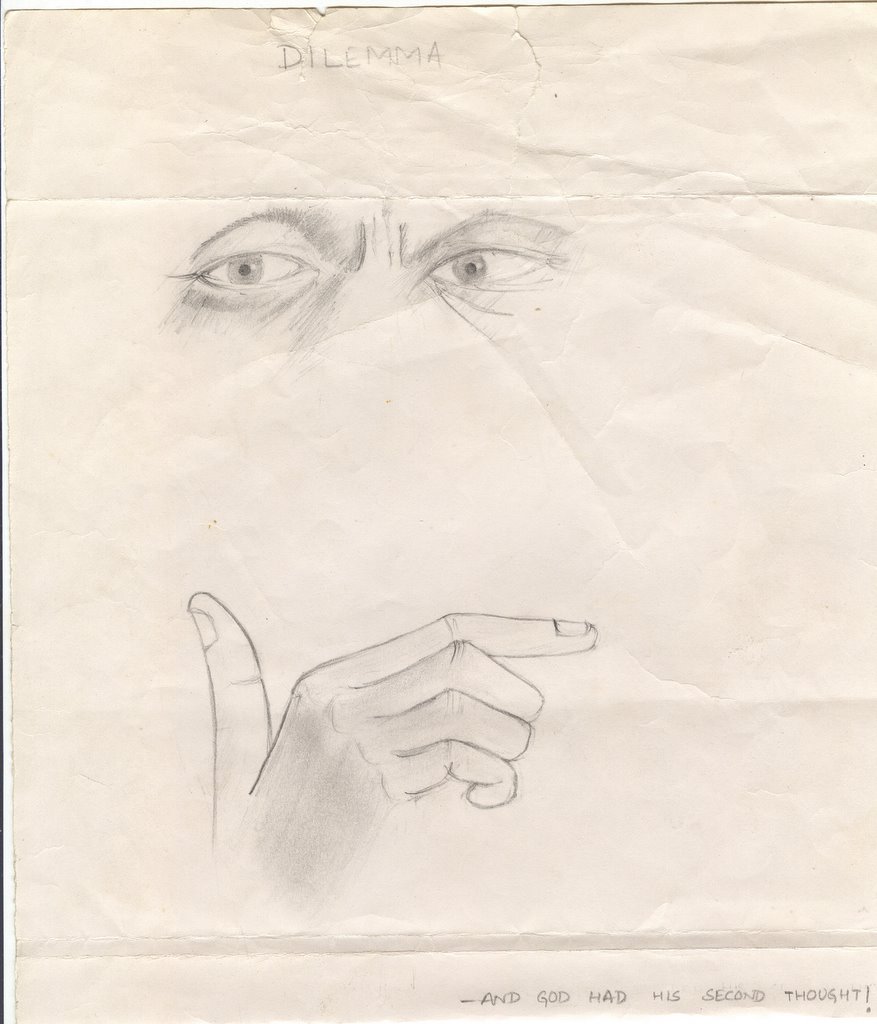
this is the other one that is a bit interesting... A very old sketch, it had to pass through the seven seas (and the customs) more than once!
Tuesday, November 29, 2005
One of mine as well...
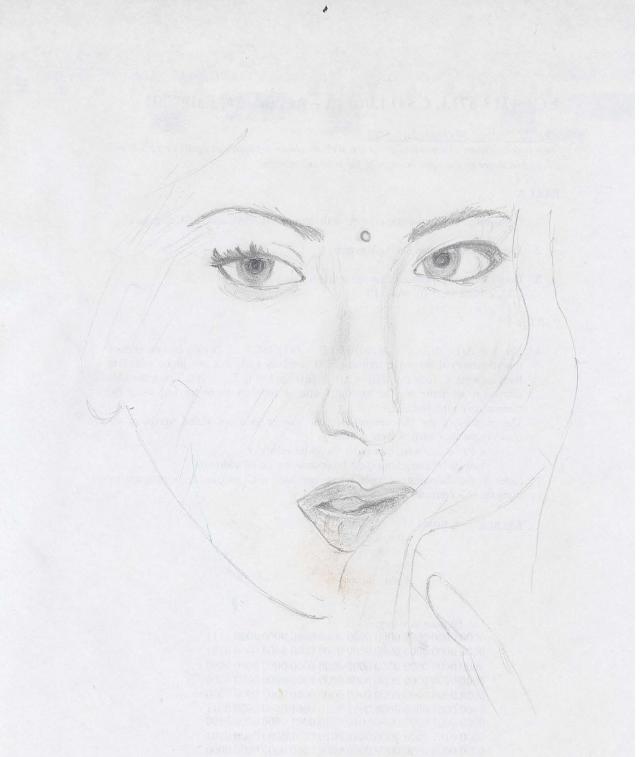
I left sketching long ago... here is one of those... I am not sure if any one recognises who she is supposed to be.
Friday, November 18, 2005
Osmania Biscuit XI-- Straange!!!
OK!
Before I reveal how Lingam Yadav and Obul Reddy finally come face to face, let me actually tell you some history of Lingam, which is of course completely irrelevant to the context. Nevertheless, I have decided to reveal this matter of complete secrecy, though I cant give any explanation of why would someone want to hide it or why would someone want to tell such a claptrap (synonyms: moonshine, gobbledygook, balderdash, hogwash, baloney).
Anyways, though most of the Yadavs of Saleemnagar Colony, Malakpet (Hyd-36) trace their origin from UP directly, the family of Lingam has had quite interesting tale in terms of the devious route it took...
When Krishna convinced peoople of Mathura that Mathura is no longer a safe refuge against the recurring invasions of the Mighty Emperor of Magadh- Jarasandha, many people joined him in that epic journey and they reached the Prabhasa Kshetra in Gujarat and established the city of Dwaraka. Now, as time flew, people began to settle more and more inwards and southwards. The Yadavs in question migrated after many centuries to the south of the Vindhya mountains, and settled in the country there along with many others.
Those were tumultous times...
Clearly the people of Dwaraka were excellent in cattle management-- the quality of milk, the species of buffalo and cow, and the kind of grass the fed to the cattle were all mysteriously wonderful. Through marine trade, the people of Dwaraka actually succeeded in bringing the best grass of south american grasslands (which, actually, scientists later found out to be "alfa-alfa" from the Pampas). So, very soon, they began to grow very rich and be held in high esteem.
Now the Rashtrakuta King (Rashtrakutas were a dynasty that ruled over Maharashtra in ancient times) was very wise, though meek, and his general was constantly plotting to pull off a coup and become the King. But the Yadavs (who had now risen to become the royal advisors ) saw through this plot and were ever eager to alert the King of the general's evil intentions. So you see, the Yadavs incurred the wrath of the general.
One night, after a celebration of cow festival, when everyone thought peace reigned supreme in the land, the general finally executed his long-planned plan, and of course, his planning was very well planned as well.
After taking control of the army, he slew the King's personal guard, went into the royal chamber and murdered the King. Hence, to the history, he is well-known (notoriously) as Dhondoba Et-tu-bruté.
The Yadavs were not spared as well... many of their folk were put to death. Lingam's ancestor (known only as "Bongu") had only a single child, and the couple were chased throughout the village and they fled into the graveyard, where the killers didnt dare come because of the undertaker Sepulkar, who was believed to be a master of black magic. Presently, Sepulkar was busy dealing with own enemy, the short-tempered and "hot"headed Thermal Jain, who had insulted him 17 years ago. Though Thermal Jain was a good natured Marwadi, he was short-tempered and that caused his downfall.
So, Sepulkar didnt budge from his crusade and so the couple had to run elsewhere for help. Luckily, they found the good natured prostitute hukkar and her pimp-cum-boyfriend fakkar. They knew the importance of tte Yadav dynasty and the help it would render to the coming Indian generations. Also, they wanted to do the right thing once in their life of sin. So, exchanged clothes with the Yadav couple and ran in the direction of the killers, succesfully diverting their attention (some attribute the origin of STDs in Maharashtra to this moment in History).
Thus escaping, the Yadav couple made their way down south, in a city where people from different regions and languages co-existed. They came to a house which was shared by three bachelors-- Smelly-onian from the Tamil land, feno-menon from "geraLa" and piss-in-the-paati from Andhra. Thus the Yadav dynasty was secured and they began to live a decent life in that area (A lot of stories are woven around these three bachelors-- about their earlier witty exploits, and later about their comicly succesfull efforts to save "the Bongu's Heir" but this is not the time). Lingam's great grandfather (titled Bongu-IV) moved to Naizaam during World War II, and settled in a village near the then Hyderabad called "theegalaguda". Later, the very same area is known as Saleem Nagar.
Note : This history is recorded in the journals of the japanese monk EkO naaraayaanaa when he visited India.
Before I reveal how Lingam Yadav and Obul Reddy finally come face to face, let me actually tell you some history of Lingam, which is of course completely irrelevant to the context. Nevertheless, I have decided to reveal this matter of complete secrecy, though I cant give any explanation of why would someone want to hide it or why would someone want to tell such a claptrap (synonyms: moonshine, gobbledygook, balderdash, hogwash, baloney).
Anyways, though most of the Yadavs of Saleemnagar Colony, Malakpet (Hyd-36) trace their origin from UP directly, the family of Lingam has had quite interesting tale in terms of the devious route it took...
When Krishna convinced peoople of Mathura that Mathura is no longer a safe refuge against the recurring invasions of the Mighty Emperor of Magadh- Jarasandha, many people joined him in that epic journey and they reached the Prabhasa Kshetra in Gujarat and established the city of Dwaraka. Now, as time flew, people began to settle more and more inwards and southwards. The Yadavs in question migrated after many centuries to the south of the Vindhya mountains, and settled in the country there along with many others.
Those were tumultous times...
Clearly the people of Dwaraka were excellent in cattle management-- the quality of milk, the species of buffalo and cow, and the kind of grass the fed to the cattle were all mysteriously wonderful. Through marine trade, the people of Dwaraka actually succeeded in bringing the best grass of south american grasslands (which, actually, scientists later found out to be "alfa-alfa" from the Pampas). So, very soon, they began to grow very rich and be held in high esteem.
Now the Rashtrakuta King (Rashtrakutas were a dynasty that ruled over Maharashtra in ancient times) was very wise, though meek, and his general was constantly plotting to pull off a coup and become the King. But the Yadavs (who had now risen to become the royal advisors ) saw through this plot and were ever eager to alert the King of the general's evil intentions. So you see, the Yadavs incurred the wrath of the general.
One night, after a celebration of cow festival, when everyone thought peace reigned supreme in the land, the general finally executed his long-planned plan, and of course, his planning was very well planned as well.
After taking control of the army, he slew the King's personal guard, went into the royal chamber and murdered the King. Hence, to the history, he is well-known (notoriously) as Dhondoba Et-tu-bruté.
The Yadavs were not spared as well... many of their folk were put to death. Lingam's ancestor (known only as "Bongu") had only a single child, and the couple were chased throughout the village and they fled into the graveyard, where the killers didnt dare come because of the undertaker Sepulkar, who was believed to be a master of black magic. Presently, Sepulkar was busy dealing with own enemy, the short-tempered and "hot"headed Thermal Jain, who had insulted him 17 years ago. Though Thermal Jain was a good natured Marwadi, he was short-tempered and that caused his downfall.
So, Sepulkar didnt budge from his crusade and so the couple had to run elsewhere for help. Luckily, they found the good natured prostitute hukkar and her pimp-cum-boyfriend fakkar. They knew the importance of tte Yadav dynasty and the help it would render to the coming Indian generations. Also, they wanted to do the right thing once in their life of sin. So, exchanged clothes with the Yadav couple and ran in the direction of the killers, succesfully diverting their attention (some attribute the origin of STDs in Maharashtra to this moment in History).
Thus escaping, the Yadav couple made their way down south, in a city where people from different regions and languages co-existed. They came to a house which was shared by three bachelors-- Smelly-onian from the Tamil land, feno-menon from "geraLa" and piss-in-the-paati from Andhra. Thus the Yadav dynasty was secured and they began to live a decent life in that area (A lot of stories are woven around these three bachelors-- about their earlier witty exploits, and later about their comicly succesfull efforts to save "the Bongu's Heir" but this is not the time). Lingam's great grandfather (titled Bongu-IV) moved to Naizaam during World War II, and settled in a village near the then Hyderabad called "theegalaguda". Later, the very same area is known as Saleem Nagar.
Note : This history is recorded in the journals of the japanese monk EkO naaraayaanaa when he visited India.
Thursday, November 10, 2005
green deepavali
A very good friend of mine when I was at GE:
http://anandanubhava.blogspot.com/2005/11/having-blast.html
http://anandanubhava.blogspot.com/2005/11/having-blast.html
Wednesday, October 26, 2005
Tuesday, October 18, 2005
Seven Drunken Nights
Seven Drunken Nights
(Traditional Irish Song)
(Traditional Irish Song)
___
As I went home on Monday night as drunk as drunk could be
I saw a horse outside the door where my old horse should be
Well, I called me wife and I said to her: Will you kindly tell to me
Who owns that horse outside the door where my old horse should be?
Ah, you're drunk,
you're drunk you silly old fool,
still you can not see
That's a lovely sow that me mother sent to me
Well, it's many a day I've travelled a hundred miles or more
But a saddle on a sow sure I never saw before.
---
And as I went home on Tuesday night as drunk as drunk could be
I saw a coat behind the door where my old coat should be
Well, I called me wife and I said to her: Will you kindly tell to me
Who owns that coat behind the door where my old coat should be
Ah, you're drunk,
you're drunk you silly old fool,
still you can not see
you're drunk you silly old fool,
still you can not see
That's a woollen blanket that me mother sent to me
Well, it's many a day I've travelled a hundred miles or more
But buttons in a blanket sure I never saw before.
---
And as I went home on Wednesday night as drunk as drunk could be
I saw a pipe up on the chair where my old pipe should be
Well, I called me wife and I said to her: Will you kindly tell to me
Who owns that pipe up on the chair where my old pipe should be
Ah, you're drunk,
you're drunk you silly old fool,
still you can not see
you're drunk you silly old fool,
still you can not see
That's a lovely tin whistle that me mother sent to me
Well, it's many a day I've travelled a hundred miles or more
But tobacco in a tin whistle sure I never saw before.
---
And as I went home on Thursday night as drunk as drunk could be
I saw two boots beneath the bed where my old boots should be
Well, I called me wife and I said to her: Will you kindly tell to me
Who owns them boots beneath the bed where my old boots should be
Ah, you're drunk,
you're drunk you silly old fool,
still you can not see
you're drunk you silly old fool,
still you can not see
They're two lovely Geranium pots me mother sent to me
Well, it's many a day I've travelled a hundred miles or more
But laces in Geranium pots I never saw before.
---
And as I went home on Friday night as drunk as drunk could be
I saw a head upon the bed where my old head should be
Well, I called me wife and I said to her: Will you kindly tell to me
Who owns that head upon the bed where my old head should be
Ah, you're drunk,
you're drunk you silly old fool,
still you can not see
you're drunk you silly old fool,
still you can not see
That's a baby boy that me mother sent to me
Well, it's many a day I've travelled a hundred miles or more
But a baby boy with his whiskers on sure I never saw before.
---
And as I went home on Saturday night as drunk as drunk could be
I saw two hands upon her breasts where my old hands should be
Well, I called me wife and I said to her: Will you kindly tell to me
Who owns them hands upon your breasts where my old hands should be
Ah, you're drunk,
you're drunk you silly old fool,
still you can not see
you're drunk you silly old fool,
still you can not see
That's a lovely night gown that me mother sent to me
Well, it's many a day I've travelled a hundred miles or more
But fingers in a night gown sure I never saw before.
---
As I went home on Sunday night as drunk as drunk could be
I saw a thing in her thing where my old thing should be
Well, I called me wife and I said to her: Will you kindly tell to me
Who owns that thing in your thing where my old thing should be
Ah, you're drunk,
you're drunk you silly old fool,
still you can not see
you're drunk you silly old fool,
still you can not see
That's a lovely tin whistle that me mother sent to me
Well, it's many a day I've travelled a hundred miles or more
But hair on a tin whistle sure I never saw before.
Monday, October 17, 2005
A visit to the barber
From Out of butter and water: the Hindu creation by Sudhanva Deshpande
To the extent that India is still a predominantly agricultural society, these festivals, and the various rituals that go with them, are an organic part of people’s lives, and not just corporate inducements to an urban elite to consume more and more in the globalized marketplace. Yet, since these festivals and rituals have actually evolved over a very long period of time, they are now most often taken for granted; like the self-existent creator, they just exist, with neither beginning nor end. For most practitioners of these rituals, much of the original meaning is either unimportant, or simply lost under centuries of cultural sedimentation.
Yet ideas persist over centuries and pop up at you when you least expect them. Last week, I needed a haircut, and so I went to the barber who has performed this service since I was about ten. It is a veritable ritual, evolved over two decades or so. It begins with his magnanimously offering me tea, and ends with his never returning change. In between, he asks about my family, I about his; he checks if I am still off smoking, I if he is off drink. Through all this, of course, we discuss politics, sports, and anything else of topical interest. This time, I asked him how he was told the universe came into being. He laughed, snipped off a tuft of hair on my forehead, and said: “Who knows how all this was created? Who was around to see? Even the gods were born after something existed, so who can tell what happened when nothing existed?”
My barber has not read the Rig Veda. But if he were to, some day, he will be struck by the following hymn:
Then even nothingness was not, nor existence.
There was no air then, nor the heavens beyond it.
Who covered it? Where was it? In whose keeping?
Was there then cosmic water, in depths unfathomed?
But, after all, who knows, and who can say,
Whence it all came, and how creation happened?
The gods themselves are later than creation,
So who knows truly whence it has arisen?
(Rig Veda, X, 129)
http://www.unesco.org/courier/2001_05/uk/doss24.htm
To the extent that India is still a predominantly agricultural society, these festivals, and the various rituals that go with them, are an organic part of people’s lives, and not just corporate inducements to an urban elite to consume more and more in the globalized marketplace. Yet, since these festivals and rituals have actually evolved over a very long period of time, they are now most often taken for granted; like the self-existent creator, they just exist, with neither beginning nor end. For most practitioners of these rituals, much of the original meaning is either unimportant, or simply lost under centuries of cultural sedimentation.
Yet ideas persist over centuries and pop up at you when you least expect them. Last week, I needed a haircut, and so I went to the barber who has performed this service since I was about ten. It is a veritable ritual, evolved over two decades or so. It begins with his magnanimously offering me tea, and ends with his never returning change. In between, he asks about my family, I about his; he checks if I am still off smoking, I if he is off drink. Through all this, of course, we discuss politics, sports, and anything else of topical interest. This time, I asked him how he was told the universe came into being. He laughed, snipped off a tuft of hair on my forehead, and said: “Who knows how all this was created? Who was around to see? Even the gods were born after something existed, so who can tell what happened when nothing existed?”
My barber has not read the Rig Veda. But if he were to, some day, he will be struck by the following hymn:
Then even nothingness was not, nor existence.
There was no air then, nor the heavens beyond it.
Who covered it? Where was it? In whose keeping?
Was there then cosmic water, in depths unfathomed?
But, after all, who knows, and who can say,
Whence it all came, and how creation happened?
The gods themselves are later than creation,
So who knows truly whence it has arisen?
(Rig Veda, X, 129)
http://www.unesco.org/courier/2001_05/uk/doss24.htm
Hum sab azaad ho gaye
From the rediff special Death ruled the beautiful mountains:
I noticed a man laughing on a bridge. I heard him say, "The police died in the thana (police station) and the qaidis (the prisoners) died in the jailkhana (prison). Hum sab azaad ho gaye (we are all free)." He was a schoolteacher who had lost his senses because more than 300 students and teachers at the Springfield School in Bagh died in the earthquake. He was one of the few survivors.
--Hamid Mir, Islamabad.
I noticed a man laughing on a bridge. I heard him say, "The police died in the thana (police station) and the qaidis (the prisoners) died in the jailkhana (prison). Hum sab azaad ho gaye (we are all free)." He was a schoolteacher who had lost his senses because more than 300 students and teachers at the Springfield School in Bagh died in the earthquake. He was one of the few survivors.
--Hamid Mir, Islamabad.
Friday, September 30, 2005
Bhatiyar
The other legendary raga that I adore immensely is the Bhatiyar. I am pretty damned sure everyone of us has heard it and some of us even remember it. Remember "poorab se surya uga" --the ad for literacy sung by Kavitha Krishnamurthy on DD??
yup! Thats the one! Almost too easy to identify.. you really cant miss the energy and freshness of this one! A classic morning raga!
Incidentally, this raga has been tried on by Unnikrishnan. He has tuned an annamacharya kriti "nanda nandana" quite beautifully to Bhatiyar (he calls it Bhatyari).
http://www.musicindiaonline.com/l/1/m/ragam.176/
There seem to be no film songs in this raga though I heard one old ghazal on radio with combination of Lalit (Tu hain mera prem devatha) and Bhatiyar (Hindustani classical singer Jitendra Abhisheki has actually come up with a jod-raga called Lalith-Bhatiyar).
Most usage of Bhatiyar in the light classical arena, it seems, has ben done by Ghati composers...
Anyways, for some inexplicable reason, I took "Sri Gananatham bhajamyaham" in Kanakangi from the movie Sruthilayalu, and retuned it to Bhatiyar, much to the horror of Bhargavarama...
yup! Thats the one! Almost too easy to identify.. you really cant miss the energy and freshness of this one! A classic morning raga!
Incidentally, this raga has been tried on by Unnikrishnan. He has tuned an annamacharya kriti "nanda nandana" quite beautifully to Bhatiyar (he calls it Bhatyari).
http://www.musicindiaonline.com/l/1/m/ragam.176/
There seem to be no film songs in this raga though I heard one old ghazal on radio with combination of Lalit (Tu hain mera prem devatha) and Bhatiyar (Hindustani classical singer Jitendra Abhisheki has actually come up with a jod-raga called Lalith-Bhatiyar).
Most usage of Bhatiyar in the light classical arena, it seems, has ben done by Ghati composers...
Anyways, for some inexplicable reason, I took "Sri Gananatham bhajamyaham" in Kanakangi from the movie Sruthilayalu, and retuned it to Bhatiyar, much to the horror of Bhargavarama...
Thursday, September 22, 2005
shankara
Hindustani raga Shankara is one of the most august ragas with insurmountable grandeur. Very easy to identify, it is highly surprising that carnatic musicians have not explored much into it. The only composition that I can cite from the south is a music piece from the movie Maayaabazaar coutesy Ghantasala--A ragamalika (Shankara is starting raga, and the most prominent) heard when Balarama is accorded a royal welcome by Shakuni and gang. It follows similar notation to that of the following song from Sehgal: http://www.sawf.org/audio/shankara/klsaigal.ram
Most people from the south have also heard Shankara (albeit unknowingly) in one of the forms of Hanuman chalisa.
Here is an experiment in Shankara--It is still in concept stage (not sure how to give notes... this raga has some meends). Also, lyrics may need fine tuning.
p: Sham karatha Shankara!
Triloka dyuthikara!
a: Mahesham Bhavesham bhave
Shambhave Shubhakara!
c: Mahaarudranaaraayana ugra roopa
PraLayaagni hoomkaara naada swaroopa
BrhatkOtibrahmaandalokaadhinaatha
RaNadundubi jayajayadhwaanakara!
Kedar.
Most people from the south have also heard Shankara (albeit unknowingly) in one of the forms of Hanuman chalisa.
Here is an experiment in Shankara--It is still in concept stage (not sure how to give notes... this raga has some meends). Also, lyrics may need fine tuning.
p: Sham karatha Shankara!
Triloka dyuthikara!
a: Mahesham Bhavesham bhave
Shambhave Shubhakara!
c: Mahaarudranaaraayana ugra roopa
PraLayaagni hoomkaara naada swaroopa
BrhatkOtibrahmaandalokaadhinaatha
RaNadundubi jayajayadhwaanakara!
Kedar.
Monday, September 19, 2005
A very small story
(the story has been lying in my vault for a long time now, sent to me by kedar long back)
A small idol of Ganesha, a picture of Rama and family, and another small idol of Saraswathi were the first thing Varun saw as soon as he opened his eyes that day, as he did everyday—but it wasn’t day yet; only the lights in the hall were switched on. It was only 5:30 in the morning, and he almost never got up before 7:00, in his life of 8 years. He felt refreshed at once and got up from the bed. He walked into the hall. He knew, his father was taking bath, from the chants he said during his bath. His mother was out in the backyard in a silk sari and she was picking flowers. She just had a “head-bath” as it is called in our country and had her towel wrapped on her head along with her hair. He went into the kitchen which also had a compartment for Gods. His grandmother was making something out of black-coloured mud.
“What are you doing grandma?” he inquired
“I am making two idols of oxen. It’s “poLa” today.” She told him without lifting her head, engrossed in her work. He vaguely remembered they were talking yesterday night after supper about getting up early today because it is some festival.
“It is a festival of the country-side. On this day, people pay their respects to the farm animals which sustain them. We used to celebrate it on a big scale in our village when I was young. Now very few even remember it,” she mused pausing for a moment, and then resumed her work.
Varun and his little brother Ashvin always liked to celebrate festivals—major or minor. The younger one showed more enthusiasm of the two even though he was only beginning to understand what was going on. He just had to be there at the puja, he had to be the one to ring the bell while giving aarti (though his hands use to tire easily), and he had to be the one to give theertham to all others in the house (Prasadam rights, he ‘gifted’ to his elder brother out of his fabled generosity). Now he was fast asleep. The puja was about to begin and the elders would not allow Varun to wake up his brother—A recipe for calamity of the worst kind.
Varun quickly took a bath and attended puja and aarti (he already knew most of the common aarti songs by heart). After a while, Ashvin woke up and found his brother already dressed up for school. He wondered a bit at this, but was still sleepy. Varun was careful enough not to say anything at that time. After a while, Varun heard loud wails and saw brother coming out of the kitchen crying. He immediately knew what had happened—Ashvin had come to know of the festival puja and aarti. And now, there seemed to be no end to his crying. His parents and grandmother tried to console him with words and promises of next time, but the crying wouldn’t stop. Varun sat for his breakfast contemplating how to bring the situation in control. He finally struck on an idea, but hesitated whether it would work. Well, he knew the only way to see if it worked was to test it. He went to his brother whose eyes were still watery and said something in his ear. The crying stopped, but it was sometime before he could smile and be in his usual sunny disposition. They went to school and the day passed on. When his father came back that evening, he was relieved to find everything normal.
After supper, all of them sat together awhile and went to bed. But after sometime, the two brothers got up and went stealthily into kitchen. They had their own plans. About half-an-hour later, a familiar aroma filled the house, and a faint ringing sound was being heard. Varun’s mother got up and hurried into the kitchen. She was puzzled by what she saw. Varun wore his father’s silk dhoti (almost perfectly) and was performing puja just like his father. Sitting beside was his brother who seemingly took care of all arrangements from flowers, sweets for offerings, incense, and all. These were arrayed in front of him in the most disciplined fashion. Ashvin was sitting with his eyes closed and his little palms joined together. There was such sincerity and devotion in his face that she thought not all the temptations and dangers joined together would dissuade him from his present state. She didn’t disturb them. She went back and came back with her husband and mother-in-law. They saw the two perform the puja very quietly from the corner of the room. And after puja, Varun started singing aarti in his sincere voice, and the elders looked at one-another in silent admiration and felt proud of their children. Of course, Ashvin got to ring the bell and he relished it with utmost delight even though he was dead tired and sleepy. And then Varun offered theertham and Prasadam, and gave some to his little brother. They were about to fold the ceremony for the day when the elders suddenly walked into the kitchen to the surprise (and a little embarrassment) of the children. But they simply took aarti and prasadam with same devotion and seriousness that the children had and kissed the children.
Then they took the sleepy children back to their rooms, wondering if there was anything more from life that they needed.
-- Kedar
A small idol of Ganesha, a picture of Rama and family, and another small idol of Saraswathi were the first thing Varun saw as soon as he opened his eyes that day, as he did everyday—but it wasn’t day yet; only the lights in the hall were switched on. It was only 5:30 in the morning, and he almost never got up before 7:00, in his life of 8 years. He felt refreshed at once and got up from the bed. He walked into the hall. He knew, his father was taking bath, from the chants he said during his bath. His mother was out in the backyard in a silk sari and she was picking flowers. She just had a “head-bath” as it is called in our country and had her towel wrapped on her head along with her hair. He went into the kitchen which also had a compartment for Gods. His grandmother was making something out of black-coloured mud.
“What are you doing grandma?” he inquired
“I am making two idols of oxen. It’s “poLa” today.” She told him without lifting her head, engrossed in her work. He vaguely remembered they were talking yesterday night after supper about getting up early today because it is some festival.
“It is a festival of the country-side. On this day, people pay their respects to the farm animals which sustain them. We used to celebrate it on a big scale in our village when I was young. Now very few even remember it,” she mused pausing for a moment, and then resumed her work.
Varun and his little brother Ashvin always liked to celebrate festivals—major or minor. The younger one showed more enthusiasm of the two even though he was only beginning to understand what was going on. He just had to be there at the puja, he had to be the one to ring the bell while giving aarti (though his hands use to tire easily), and he had to be the one to give theertham to all others in the house (Prasadam rights, he ‘gifted’ to his elder brother out of his fabled generosity). Now he was fast asleep. The puja was about to begin and the elders would not allow Varun to wake up his brother—A recipe for calamity of the worst kind.
Varun quickly took a bath and attended puja and aarti (he already knew most of the common aarti songs by heart). After a while, Ashvin woke up and found his brother already dressed up for school. He wondered a bit at this, but was still sleepy. Varun was careful enough not to say anything at that time. After a while, Varun heard loud wails and saw brother coming out of the kitchen crying. He immediately knew what had happened—Ashvin had come to know of the festival puja and aarti. And now, there seemed to be no end to his crying. His parents and grandmother tried to console him with words and promises of next time, but the crying wouldn’t stop. Varun sat for his breakfast contemplating how to bring the situation in control. He finally struck on an idea, but hesitated whether it would work. Well, he knew the only way to see if it worked was to test it. He went to his brother whose eyes were still watery and said something in his ear. The crying stopped, but it was sometime before he could smile and be in his usual sunny disposition. They went to school and the day passed on. When his father came back that evening, he was relieved to find everything normal.
After supper, all of them sat together awhile and went to bed. But after sometime, the two brothers got up and went stealthily into kitchen. They had their own plans. About half-an-hour later, a familiar aroma filled the house, and a faint ringing sound was being heard. Varun’s mother got up and hurried into the kitchen. She was puzzled by what she saw. Varun wore his father’s silk dhoti (almost perfectly) and was performing puja just like his father. Sitting beside was his brother who seemingly took care of all arrangements from flowers, sweets for offerings, incense, and all. These were arrayed in front of him in the most disciplined fashion. Ashvin was sitting with his eyes closed and his little palms joined together. There was such sincerity and devotion in his face that she thought not all the temptations and dangers joined together would dissuade him from his present state. She didn’t disturb them. She went back and came back with her husband and mother-in-law. They saw the two perform the puja very quietly from the corner of the room. And after puja, Varun started singing aarti in his sincere voice, and the elders looked at one-another in silent admiration and felt proud of their children. Of course, Ashvin got to ring the bell and he relished it with utmost delight even though he was dead tired and sleepy. And then Varun offered theertham and Prasadam, and gave some to his little brother. They were about to fold the ceremony for the day when the elders suddenly walked into the kitchen to the surprise (and a little embarrassment) of the children. But they simply took aarti and prasadam with same devotion and seriousness that the children had and kissed the children.
Then they took the sleepy children back to their rooms, wondering if there was anything more from life that they needed.
-- Kedar
Friday, September 16, 2005
Osmania Biscuit VIII-- Lingam Yadav vs. Obul Reddy
He hates him-- I swear he hates him like hell! He even conspires to kill Obul Reddy. Lingam secretly believes I think about Obul more than I do about him! Poor Lingam's raat ki neend has been haraamed because of his morbid antipathy towards Obul. He tried lots of pseudo-innocuous machinations to get the address and/or phone number of his adversary from me, but he failed... not because I didnt want to give it to him, but because I myself didnt know where he is/was! I hardly know Obul for God's sake!!
But that wouldnt satisfy him... He thinks I am protecting Obul from him.
I still remember that day when I first saw the name 'Obul Reddy' in the paper... I actually had a good laugh because that was the first time I heard the name! Lingam, though, was a little circumspect in his reaction... and later I told him about how I went to even meet him, but alas! I could find him, and how I got into CBIT because of Obul Reddy (though accidentally), his condescending smirk was quite obvious! The third time, when I said I wanted to meet Obul once, that did it! His rage knew no bounds, and he swore he will kill that ******** !!
That day, he looked more dangerous than
1) the green-gochi clad "Ekelex Mahabali"
2) the duo of Veerabahu and GhanOdara
3) Veera Paandya Katta Bommana
4) or even Suryam for that matter who has only 2 of those instead of 3!!!! (Oops! sorry.. cudnt resist!).
Yup! we all saw the scene flabbergasted! Poor Jumman miya got to bear the brunt of his anger when Lingam's gutka was sprayed all over his kurta as a fractal image (only I know how much I tried to take that kurta from him!). Jumman was so depressed that he didnt fix "tube-lightla srinivas's" scooter in his "A1-mekanik" shop lying there fro a week already, which infuriated Srinivas to no end and he didnt go to "idly pavan's" place to fix some elctrical problem they had, resulting that they didnt have electricity all day and missed the cricket match, which dint please Idly's uncle Yellaji (dont ask me! thats a pet name among the really really Andhra folks!), and he hit the 'Ironing boy' Dasaratha, which made his mother launch a two-and-a-half hour long invective against the "sharma residency" which later petered down into muttered curses and spits in a vectored direction.
Which got me thinking, what has all this got to do with poor Obul Reddy, whose only fault was that he got the rank 2347 in EAMCET-1997, one ahead of me.
Nevertheless, I know I have to stay tuned for the Ragnarok, the epic final battle between Lingam Yadav and Obul Reddy, and some even argue the magnitude of this surpasses that of even QuickGun Murugun's and RicePlate Reddy's battle!
But that wouldnt satisfy him... He thinks I am protecting Obul from him.
I still remember that day when I first saw the name 'Obul Reddy' in the paper... I actually had a good laugh because that was the first time I heard the name! Lingam, though, was a little circumspect in his reaction... and later I told him about how I went to even meet him, but alas! I could find him, and how I got into CBIT because of Obul Reddy (though accidentally), his condescending smirk was quite obvious! The third time, when I said I wanted to meet Obul once, that did it! His rage knew no bounds, and he swore he will kill that ******** !!
That day, he looked more dangerous than
1) the green-gochi clad "Ekelex Mahabali"
2) the duo of Veerabahu and GhanOdara
3) Veera Paandya Katta Bommana
4) or even Suryam for that matter who has only 2 of those instead of 3!!!! (Oops! sorry.. cudnt resist!).
Yup! we all saw the scene flabbergasted! Poor Jumman miya got to bear the brunt of his anger when Lingam's gutka was sprayed all over his kurta as a fractal image (only I know how much I tried to take that kurta from him!). Jumman was so depressed that he didnt fix "tube-lightla srinivas's" scooter in his "A1-mekanik" shop lying there fro a week already, which infuriated Srinivas to no end and he didnt go to "idly pavan's" place to fix some elctrical problem they had, resulting that they didnt have electricity all day and missed the cricket match, which dint please Idly's uncle Yellaji (dont ask me! thats a pet name among the really really Andhra folks!), and he hit the 'Ironing boy' Dasaratha, which made his mother launch a two-and-a-half hour long invective against the "sharma residency" which later petered down into muttered curses and spits in a vectored direction.
Which got me thinking, what has all this got to do with poor Obul Reddy, whose only fault was that he got the rank 2347 in EAMCET-1997, one ahead of me.
Nevertheless, I know I have to stay tuned for the Ragnarok, the epic final battle between Lingam Yadav and Obul Reddy, and some even argue the magnitude of this surpasses that of even QuickGun Murugun's and RicePlate Reddy's battle!
Monday, September 05, 2005
Tempest of Manna.
3 people.
Me and a couple of 'muh home boys' (thats friends in african-american!) were walking towards commercial street on Sunday eve around 7 PM when it happened. And how everyone ran here and there... makes me remember that line from Molla Ramayanam-- sandula gondula doori sattumi lemin! (On seeing the humiliating fate of the kings and princes who tried to lift Siva DhanuSa, the other suitors ran helter-skelter and hid themselves in bylanes to escape that insult!).
It rained so heavily, so all of a sudden, that we were completely caught unawares.
Now, we are standing under the porch of some shop waiting for the rain to abate. Mahesh, the eldest one, is desperately looking for autos.. no one wants to come to either CMH road or Domlur, and if they are ready, they are asking for 60-70 rupees (it would normally take abt 30/-). So he is in a circular loop and thats about him... and the other guy Nitin, well... he is so frustrated that he starts looking at the wet babes (did I mention they were wet?) to take his mind of the current "predicament".
Anyways, what do I do? I dont take notice of anyone at all, and start making up some tune in Miya-ki-Malhar ( "bole re papihara" is in that raga). And I proudly declare to Nitin... "this is a Malhar." And he looks at me angrily and says ," its raining and and you sing malhar?? Are you nuts??" (Not that it rained heavily because I sang Malhar, but you know how people like to have a scape-goat!).
And then it dawned on me how Cacophonix the bard must have felt in that village... savages! Barbarians! ...Sigh! I promptly changed track to Basant Bahar. Soon, I realised I was tilting more towards Basant and Bahar was increasingly left out. And Basant gave way to the closely allied Panthuvarali... and slowly the r1 and d1 dissappeared and I was left with...
Amruthavarshini!
A tune slowly materialised, and I started adding words to it. I finished it today.
It comes out this way:
p: nannu kaana rava, veyi kanula deva!
ilalOna neeku, satevvaru....
a: nee mahima juupi, nannu brovaleva,
Indra Mahendra Surendra Devendra
ch:vidyutvajra dhara, Shachi kanthi kara
sarva dukha hara, vRtra samhara...
viraminchu nee mahapraLayavarshini
tilakinchu naa gaana Amruthavarshnini.
This is my first telugu experiment.
As usual, I am having nightmares with the tala part (shooting for Adi). Anyways, I have nost mentioned the swaras here... (an open invitation for all to use this sahityam to whichever tune. Imagine... you can be a part of the only kriti dedicated to Indra!). Any corrections, improvements to the lyrics are always welcome.
Kedar.
PS: It was just a rainy evening... its very interesting how people make such a big deal out of it!
Me and a couple of 'muh home boys' (thats friends in african-american!) were walking towards commercial street on Sunday eve around 7 PM when it happened. And how everyone ran here and there... makes me remember that line from Molla Ramayanam-- sandula gondula doori sattumi lemin! (On seeing the humiliating fate of the kings and princes who tried to lift Siva DhanuSa, the other suitors ran helter-skelter and hid themselves in bylanes to escape that insult!).
It rained so heavily, so all of a sudden, that we were completely caught unawares.
Now, we are standing under the porch of some shop waiting for the rain to abate. Mahesh, the eldest one, is desperately looking for autos.. no one wants to come to either CMH road or Domlur, and if they are ready, they are asking for 60-70 rupees (it would normally take abt 30/-). So he is in a circular loop and thats about him... and the other guy Nitin, well... he is so frustrated that he starts looking at the wet babes (did I mention they were wet?) to take his mind of the current "predicament".
Anyways, what do I do? I dont take notice of anyone at all, and start making up some tune in Miya-ki-Malhar ( "bole re papihara" is in that raga). And I proudly declare to Nitin... "this is a Malhar." And he looks at me angrily and says ," its raining and and you sing malhar?? Are you nuts??" (Not that it rained heavily because I sang Malhar, but you know how people like to have a scape-goat!).
And then it dawned on me how Cacophonix the bard must have felt in that village... savages! Barbarians! ...Sigh! I promptly changed track to Basant Bahar. Soon, I realised I was tilting more towards Basant and Bahar was increasingly left out. And Basant gave way to the closely allied Panthuvarali... and slowly the r1 and d1 dissappeared and I was left with...
Amruthavarshini!
A tune slowly materialised, and I started adding words to it. I finished it today.
It comes out this way:
p: nannu kaana rava, veyi kanula deva!
ilalOna neeku, satevvaru....
a: nee mahima juupi, nannu brovaleva,
Indra Mahendra Surendra Devendra
ch:vidyutvajra dhara, Shachi kanthi kara
sarva dukha hara, vRtra samhara...
viraminchu nee mahapraLayavarshini
tilakinchu naa gaana Amruthavarshnini.
This is my first telugu experiment.
As usual, I am having nightmares with the tala part (shooting for Adi). Anyways, I have nost mentioned the swaras here... (an open invitation for all to use this sahityam to whichever tune. Imagine... you can be a part of the only kriti dedicated to Indra!). Any corrections, improvements to the lyrics are always welcome.
Kedar.
PS: It was just a rainy evening... its very interesting how people make such a big deal out of it!
Saturday, August 27, 2005
Revelations 1:1
I have had some revelations lately that I want to share...
1)Krishna---
I will not sing of Krishna.
NEVER!
Before I explain why, let me try to see whats the difference between a magician and a teacher.--
A magician will never reveal his secret to you... he wants to be an enigma, somebody from the other world, and he wants to be praised... if his trick or metier is revealed, he will go out of business.
A teacher, on the other hand, has to let his students know whats going on behind the scene,-- thats his job.. if he cant explain, he will go out of business... or his purpose is not completed!
Unfortunately, the great warrior and hero Krishna, has been relegated to lead a life of non-existence as any other God in temples and fables. All along, he taught people to look at the big picture-- the broader perspective, and be pro-active... dont wait for something to happen... go and meet your destiny.... Nope! didnt happen! A teacher mistaken for a conjurer!
I rather respect Krishna and take him as my role model for IPR (Inter-Personal Relations) , Pro-Activeness, and Broader Perspective than waste my time in singing abt his glory.
2) ISKCON---
I feel they have gone evangelistic! I mean, lets face it... the Bhakti movement has failed! No one wants to surrender himself/herself to God and let Him take you where He intends to! And thats not the way the universe works! They even have a jewish name (almost!) for their God that they call Krssna! Before I explain that, let me tell you that hebrew alphabet doesnt have any vowels... so the name for their God is spelt JHWH (Jehowah). So, u see the single 'a' at the end saved the ISKCON! But believe me, thats just a masquerade!
3)Rama---
He, I came to understand, represents the open loop system. Unchangeable... no feedback! Unfortunately, nature dont work that way... there is always feedback... so they had to transport this fellow to another universe, which is euphemistically called "treta yuga". A better role model is, again, krishna who is a perfect closed-loop system.
4)Mass Customisation--
A term I heard just yesterday. An oxymoron literally-- what is customised is never produced in mass, and what is mass produced is never customised. But still it exists. A company in Japan makes "Mass-Customisable" bicyles-- you go into the shop, and you give your measurements to the guys and they will adjust their finished prooud to suit you and send it within a week! Fine! So what?... exactly! Indian religion (No names!) is exactly that! Mass-customised! You can take what you want... leave the rest.. no issues! What beauty! what flexibility!
And still those desi agnostics have the guts to compare our religion with others!
Kedar.
1)Krishna---
I will not sing of Krishna.
NEVER!
Before I explain why, let me try to see whats the difference between a magician and a teacher.--
A magician will never reveal his secret to you... he wants to be an enigma, somebody from the other world, and he wants to be praised... if his trick or metier is revealed, he will go out of business.
A teacher, on the other hand, has to let his students know whats going on behind the scene,-- thats his job.. if he cant explain, he will go out of business... or his purpose is not completed!
Unfortunately, the great warrior and hero Krishna, has been relegated to lead a life of non-existence as any other God in temples and fables. All along, he taught people to look at the big picture-- the broader perspective, and be pro-active... dont wait for something to happen... go and meet your destiny.... Nope! didnt happen! A teacher mistaken for a conjurer!
I rather respect Krishna and take him as my role model for IPR (Inter-Personal Relations) , Pro-Activeness, and Broader Perspective than waste my time in singing abt his glory.
2) ISKCON---
I feel they have gone evangelistic! I mean, lets face it... the Bhakti movement has failed! No one wants to surrender himself/herself to God and let Him take you where He intends to! And thats not the way the universe works! They even have a jewish name (almost!) for their God that they call Krssna! Before I explain that, let me tell you that hebrew alphabet doesnt have any vowels... so the name for their God is spelt JHWH (Jehowah). So, u see the single 'a' at the end saved the ISKCON! But believe me, thats just a masquerade!
3)Rama---
He, I came to understand, represents the open loop system. Unchangeable... no feedback! Unfortunately, nature dont work that way... there is always feedback... so they had to transport this fellow to another universe, which is euphemistically called "treta yuga". A better role model is, again, krishna who is a perfect closed-loop system.
4)Mass Customisation--
A term I heard just yesterday. An oxymoron literally-- what is customised is never produced in mass, and what is mass produced is never customised. But still it exists. A company in Japan makes "Mass-Customisable" bicyles-- you go into the shop, and you give your measurements to the guys and they will adjust their finished prooud to suit you and send it within a week! Fine! So what?... exactly! Indian religion (No names!) is exactly that! Mass-customised! You can take what you want... leave the rest.. no issues! What beauty! what flexibility!
And still those desi agnostics have the guts to compare our religion with others!
Kedar.
Monday, August 22, 2005
Discretion
Reuben: Himy, would you listen to this?
Himy: Do we have a choice?
Mutti: A lot of it wasn't meant to be taken literally.
[...]
Mutti: It's a nice story, Adam and Eve. bound with moral fibre...but asking a grown man to believe it... It's a nice story. It's just that. Just a story. Catholic religion is based on a mistranslation.
Himy: Enough already. Ruben, say something.
Mutti: Listen. Are you busy? I'll tell you the whole story. The Septuagint scholars mistranslatedthe Hebrew word for "young woman"...into the Greek word for "virgin." It was an easy mistake to make...because there was only a subtle difference in the spelling. So, they came up with a prophecy: "Behold, the virgin shall conceive and bear us a son." You understand? It was "virgin" that caught people's attention. It's not everyday a virgin conceives and bears a son. But leave that for a couple of hundred years to stew...and next thing you know you have...the Holy Catholic Church!
Himy: Oy vay, what are you saying?
Mutti: I'm saying, just because it's written...doesn't make it so. Gives them hope. It's not important whether it's fact or fiction. People like to believe.
============================================================
That... was a scene from Snatch, a brilliant brit movie by Guy Ritchie.
I did some research and found this:
As it happens, the Greek translators had made a mistake. When they were translating the Hebrew writings into the Greek Septuagint and similar translations, they converted the Hebrew word " 'almah " as the Greek equivalent of our English word for virgin. " 'Almah" appears 9 other times in the Hebrew Scriptures; in each case it means "young woman". When the scriptures referred to a virgin (and they do over 50 times) they always used the Hebrew word "betulah". So, Isaiah appears to have referred to a young woman becoming pregnant (a rather ordinary event).
Some English translators are accurate to the original Hebrew:
Revised English Bible: "...a young woman is with child..."
Revised Standard Version: "...a young woman shall conceive..."
James Moffatt Translation: "...a young woman with child..."
New Revised Standard Version: "...the young woman is with child..."
Others completely mistranslate the Hebrew and refer to the woman as both pregnant and a virgin; implying a miracle. This neatly settles the conflict that would otherwise occur between Isaiah and Matthew 1:22-23. (The author of Matthew quoted Isaiah as describing a virgin who was pregnant before becoming sexually active):
New International Version: "...the virgin will be with child..."
The Living Bible: "...a child shall be born to a virgin..."
Contemporary English Version: "...a virgin is pregnant...".
In a footnote, they say that the "Hebrew word did not imply a virgin birth". They give "young woman" as an alternate. Others went part way. They mistranslated the Hebrew and said that the woman had been a virgin. However, they imply that the woman might have been a virgin, who engaged in sexual intercourse and then became pregnant:
American Standard Version: "...a virgin shall conceive..."
Amplified Bible: "...the young woman who is unmarried and a virgin shall conceive..."
King James Version: "...a virgin shall conceive..."
New Living Translation: "...the virgin shall conceive a child..."
New Century Version: "...the virgin will be pregnant...".
They also admit in a footnote that the original Hebrew word really means "a young woman". Some versions are vague and can be interpreted in many ways:
New World Translation: "...the maiden herself will actually become pregnant..."
The Jerusalem Bible: "...the maiden is with child..."
Young's Literal Translation: "...the virgin is conceiving"
The story in Isaiah 7:14 appears to be unrelated to the birth of Jesus. It describes a siege of Jerusalem by the Syrians about 715 BCE. The child that was born to the young woman at the time was a sign from God that the siege would be lifted and that Jerusalem would continue as before. The prophecy was completely fulfilled more than 700 years before the birth of Jesus.
===============================================================
Similar statements could be made regarding any religion-- Islam, Buddhism, Hinduism (if there is such a thing!)... but does the general populace need to know these things? discretion!... thats the word... As a rule, most are not ready to accept the truth.
Over to Morpheus:
"The Matrix is a system, Neo. That system is our enemy. But when you're inside, you look around, what do you see? Businessmen, teachers, lawyers, carpenters. The very minds of the people we are trying to save. But until we do, these people are still a part of that system and that makes them our enemy. You have to understand, most of these people are not ready to be unplugged. And many of them are so inert, so hopelessly dependent on the system, that they will fight to protect it. "
Though we cant take the quote as-is in th religious context, we can take the gist that most are not ready to accept the truth that its the symbolism and moral of a story that has to be digested, not the literal meaning-- Hanuman was not a monkey, Bhagavath Geetha episode didnt happen at all, Moses didnt cause the Sea to divide or bring the ten plagues on Egypt, and Christ was a jew and was married happily to Mary Magdalene. All these things might be true, but naked truth cannot drive the human race. We need something to hold on to... something to believe.
Kedar.
Himy: Do we have a choice?
Mutti: A lot of it wasn't meant to be taken literally.
[...]
Mutti: It's a nice story, Adam and Eve. bound with moral fibre...but asking a grown man to believe it... It's a nice story. It's just that. Just a story. Catholic religion is based on a mistranslation.
Himy: Enough already. Ruben, say something.
Mutti: Listen. Are you busy? I'll tell you the whole story. The Septuagint scholars mistranslatedthe Hebrew word for "young woman"...into the Greek word for "virgin." It was an easy mistake to make...because there was only a subtle difference in the spelling. So, they came up with a prophecy: "Behold, the virgin shall conceive and bear us a son." You understand? It was "virgin" that caught people's attention. It's not everyday a virgin conceives and bears a son. But leave that for a couple of hundred years to stew...and next thing you know you have...the Holy Catholic Church!
Himy: Oy vay, what are you saying?
Mutti: I'm saying, just because it's written...doesn't make it so. Gives them hope. It's not important whether it's fact or fiction. People like to believe.
============================================================
That... was a scene from Snatch, a brilliant brit movie by Guy Ritchie.
I did some research and found this:
As it happens, the Greek translators had made a mistake. When they were translating the Hebrew writings into the Greek Septuagint and similar translations, they converted the Hebrew word " 'almah " as the Greek equivalent of our English word for virgin. " 'Almah" appears 9 other times in the Hebrew Scriptures; in each case it means "young woman". When the scriptures referred to a virgin (and they do over 50 times) they always used the Hebrew word "betulah". So, Isaiah appears to have referred to a young woman becoming pregnant (a rather ordinary event).
Some English translators are accurate to the original Hebrew:
Revised English Bible: "...a young woman is with child..."
Revised Standard Version: "...a young woman shall conceive..."
James Moffatt Translation: "...a young woman with child..."
New Revised Standard Version: "...the young woman is with child..."
Others completely mistranslate the Hebrew and refer to the woman as both pregnant and a virgin; implying a miracle. This neatly settles the conflict that would otherwise occur between Isaiah and Matthew 1:22-23. (The author of Matthew quoted Isaiah as describing a virgin who was pregnant before becoming sexually active):
New International Version: "...the virgin will be with child..."
The Living Bible: "...a child shall be born to a virgin..."
Contemporary English Version: "...a virgin is pregnant...".
In a footnote, they say that the "Hebrew word did not imply a virgin birth". They give "young woman" as an alternate. Others went part way. They mistranslated the Hebrew and said that the woman had been a virgin. However, they imply that the woman might have been a virgin, who engaged in sexual intercourse and then became pregnant:
American Standard Version: "...a virgin shall conceive..."
Amplified Bible: "...the young woman who is unmarried and a virgin shall conceive..."
King James Version: "...a virgin shall conceive..."
New Living Translation: "...the virgin shall conceive a child..."
New Century Version: "...the virgin will be pregnant...".
They also admit in a footnote that the original Hebrew word really means "a young woman". Some versions are vague and can be interpreted in many ways:
New World Translation: "...the maiden herself will actually become pregnant..."
The Jerusalem Bible: "...the maiden is with child..."
Young's Literal Translation: "...the virgin is conceiving"
The story in Isaiah 7:14 appears to be unrelated to the birth of Jesus. It describes a siege of Jerusalem by the Syrians about 715 BCE. The child that was born to the young woman at the time was a sign from God that the siege would be lifted and that Jerusalem would continue as before. The prophecy was completely fulfilled more than 700 years before the birth of Jesus.
===============================================================
Similar statements could be made regarding any religion-- Islam, Buddhism, Hinduism (if there is such a thing!)... but does the general populace need to know these things? discretion!... thats the word... As a rule, most are not ready to accept the truth.
Over to Morpheus:
"The Matrix is a system, Neo. That system is our enemy. But when you're inside, you look around, what do you see? Businessmen, teachers, lawyers, carpenters. The very minds of the people we are trying to save. But until we do, these people are still a part of that system and that makes them our enemy. You have to understand, most of these people are not ready to be unplugged. And many of them are so inert, so hopelessly dependent on the system, that they will fight to protect it. "
Though we cant take the quote as-is in th religious context, we can take the gist that most are not ready to accept the truth that its the symbolism and moral of a story that has to be digested, not the literal meaning-- Hanuman was not a monkey, Bhagavath Geetha episode didnt happen at all, Moses didnt cause the Sea to divide or bring the ten plagues on Egypt, and Christ was a jew and was married happily to Mary Magdalene. All these things might be true, but naked truth cannot drive the human race. We need something to hold on to... something to believe.
Kedar.
Friday, August 12, 2005
Pahadi
Often overlooked, pahadi is one of the most beautiful folk melodies. Not surprisingly, there are many "good" and "decent" Pahadi songs from the films. But a few of them stand tall as titans amongst the humble and homely denizens of this raga.
telugu:
1) Saagara sangamam theme: this is the first because it is from the King himself! And what melody! We can as well add "mounamela noyi" in the same point. And the theme of "April 1 vidudhala" as well!
2) Sakhi He keSi mathana -- Swarna kamalam :the dhrupad style singing and pakhawaj in the background from an amazingly amalgamating ambience of romance, the sweetest beauty, and devotion.
3) Brindavanamadi andaridi -- Missamma : feels like Durga (Suddha Saveri), moves like Durga, but is actually not Durga! Very very very enchanting. The Hindi version "Brindavan ka kishan kanhaiyya" has much more melodic content.
Hindi:
1) In Aakhon ki masti ke -- Umrao Jaan: right from the initial alap to the end, the slow and gracious movements of this one would have you believe Pahadi can mimic the grandeur and august majesty that the Old Maharaga Bhoopali (Mohanam) commands as well (Pahadi is a degenerate or a "kshudra" version of Bhoopali). By the way, you have control yourself really hard not to concentrate on the lyrics if you want to listen to the melody... hyper lyrics!
2) Kabhi Kabhi mere dil mein -- Kabhi Kabhi: clearly one of the greatest Pahadi songs in Hindi ever ... you want to know why Pahadi isnt given so much importance. The instrumentation, lyrics, melody,.... everything is just right.
3) Dekha ek khwaab to yeh silsile hue -- Silsila: The way the Anupallavi ascends the ladder of the notes leaves you panting.. for more! The most amazing thing about this one is that it makes composing look so simple.. and yet, this is one of the most complicated songs ever.
4) Lag jaa gale ke phir yeh -- Woh kaun thi: A chalice overflowing with beauty, I still remember the first time I heard (or saw) this song, while watching that movie at home late night. Every time I hear this, a trance ensues! This one wont let you forget it... A song remembered even in the after-life! (sic!)
5) Rulake gaya sapana mera -- Jewel thief: A frequent song on the radio, whenever I hear this song from the radio of the "Asian scooter works" in front of my home in Hyd, I go running to that shop to listen to this one! The lake shown in the song (a fake one, though) has really captivated my attention.
There are many others like "chalte chalte" from Paakeezah, "Chaudvi ka chand ho" from Chaudvi ka chand, "isharon isharon mein" from Kashmir ki kali... but aforementioned songs are the ones that, to me, are "more equal among equals".
telugu:
1) Saagara sangamam theme: this is the first because it is from the King himself! And what melody! We can as well add "mounamela noyi" in the same point. And the theme of "April 1 vidudhala" as well!
2) Sakhi He keSi mathana -- Swarna kamalam :the dhrupad style singing and pakhawaj in the background from an amazingly amalgamating ambience of romance, the sweetest beauty, and devotion.
3) Brindavanamadi andaridi -- Missamma : feels like Durga (Suddha Saveri), moves like Durga, but is actually not Durga! Very very very enchanting. The Hindi version "Brindavan ka kishan kanhaiyya" has much more melodic content.
Hindi:
1) In Aakhon ki masti ke -- Umrao Jaan: right from the initial alap to the end, the slow and gracious movements of this one would have you believe Pahadi can mimic the grandeur and august majesty that the Old Maharaga Bhoopali (Mohanam) commands as well (Pahadi is a degenerate or a "kshudra" version of Bhoopali). By the way, you have control yourself really hard not to concentrate on the lyrics if you want to listen to the melody... hyper lyrics!
2) Kabhi Kabhi mere dil mein -- Kabhi Kabhi: clearly one of the greatest Pahadi songs in Hindi ever ... you want to know why Pahadi isnt given so much importance. The instrumentation, lyrics, melody,.... everything is just right.
3) Dekha ek khwaab to yeh silsile hue -- Silsila: The way the Anupallavi ascends the ladder of the notes leaves you panting.. for more! The most amazing thing about this one is that it makes composing look so simple.. and yet, this is one of the most complicated songs ever.
4) Lag jaa gale ke phir yeh -- Woh kaun thi: A chalice overflowing with beauty, I still remember the first time I heard (or saw) this song, while watching that movie at home late night. Every time I hear this, a trance ensues! This one wont let you forget it... A song remembered even in the after-life! (sic!)
5) Rulake gaya sapana mera -- Jewel thief: A frequent song on the radio, whenever I hear this song from the radio of the "Asian scooter works" in front of my home in Hyd, I go running to that shop to listen to this one! The lake shown in the song (a fake one, though) has really captivated my attention.
There are many others like "chalte chalte" from Paakeezah, "Chaudvi ka chand ho" from Chaudvi ka chand, "isharon isharon mein" from Kashmir ki kali... but aforementioned songs are the ones that, to me, are "more equal among equals".
Friday, August 05, 2005
breathes there a man...
Breathes there the man, with soul so dead,
Who never to himself hath said,
This is my own, my native land!
Whose heart hath ne'er within him burn'd,
As home his footsteps he hath turn'd,
From wandering on a foreign strand!
If such there breathe, go, mark him well;
For him no Minstrel raptures swell;
High though his titles, proud his name,
Boundless his wealth as wish can claim;
Despite those titles, power, and pelf,
The wretch, concentred all in self,
Living, shall forfeit fair renown,
And, doubly dying, shall go down
To the vile dust, from whence he sprung,
Unwept, unhonor'd, and unsung.
The Lay of the Last Minstrel, Sixth Canto
-- Sir Walter Scott
Who never to himself hath said,
This is my own, my native land!
Whose heart hath ne'er within him burn'd,
As home his footsteps he hath turn'd,
From wandering on a foreign strand!
If such there breathe, go, mark him well;
For him no Minstrel raptures swell;
High though his titles, proud his name,
Boundless his wealth as wish can claim;
Despite those titles, power, and pelf,
The wretch, concentred all in self,
Living, shall forfeit fair renown,
And, doubly dying, shall go down
To the vile dust, from whence he sprung,
Unwept, unhonor'd, and unsung.
The Lay of the Last Minstrel, Sixth Canto
-- Sir Walter Scott
Subscribe to:
Posts (Atom)