It was precisely during these tumultous times that Lingam visited MBNR. He quickly grasped the situation and resolved to resolve it. After giving it a lot of thought, he decided that it was not worth so much though, and he went straight to Satyam's Lair and demanded admittance, which, he was very ungraciously denied even with the yadav-yadav connection. There are very moments when Lingam had to endure insult, and this was one of them. Red-faced, Lingam returned home.
In the evening, he went with nagaraj and his friends to Munawwar Dhaba. He was still fuming with anger, which kept flaring up and spewing out-bursts of atrocities in MBNR, and he didnt mind liberally sprinkling it with expletives. Now, Munawwar Dhaba has its share of frequenters, and some of them were Satyam's informers. They were watching this "non-local" fellow uttering things that are best left unsaid against their don. Their patience hit the limit when Lingam called "Erra Satyam" nothing more than "PacchAbaddham." Oh they got the pun alright! The next day, they went and told all this to the two fiercest gundas of Satyam, and it was was reputed that Satyam imported them from "the land down under"-- ThondamAn and PAlathondamAn. Incidentally, both of them were twins. Since they didnt know any other language than tamizh (albeit, they knew a little bit of telugu because of their training in carnatic music), these people had a tough time explaing the insulting part of the pun by Lingam. And when they did understand the pun, they simply couldnt get what was so insulting about it. Apparently, the localites convinced them that it was a big deal in MBNR. So the twins shrugged and took up the case and went straight to Nagaraj's place to settle things.
Now, the previous night, there were others who had listened to Lingam's fiery words. One of them apparently followed them and he knocked the door. Nagaraj invited him in, and he said he could become a friend of his and Lingam's if they were willing to help him out. He told them that Satyam's men were at Munawwar and heard what he said. He also told them about the twins, who had all MBNR shaken up. They came to know afterwards that he wanted to utilise this schism between yadavs. Nagaraj was swayed a bit by this talk, but Lingam was totally against what he calls as "groupisms". He offered him, some of his choicest expletives, and drove him out. It turns out that the guy was one of the stand-by people being trained for a sinister purpose of murdering Satyam. He was not among the chosen six, but if something happens to any one of the six, he was one of them posed to take the place as a replacement. And so, Lingam incurred the wrath of the Anti-Satyam camp as well, and they wanted to teach him a lesson too.
Early in the morning, the ThondamAn, and PAlathondamAn turned up at Nagaraj's hourse and knocked the door, and asked him to come out. Now, since both of them are twins, there are some problems with twins when they are not giuded by Satyam on what to say:
1) Both of them talk at the same time,
2) Both of them say exactly opposite things.
Only when they talk to one-another, they say the exact same words to each other. Of course, both of them still talk at the same time. It seems it is a congenital disorder.
No wonder that it looked like some inane blabber. The only solace was that they were speaking in Tamizh, and no Telugu, so no one understood what they were saying (Some people from Andhra think that if one has "pAn" and talk, whatever one says will seem like Tamizh). Nevertheless, it was all in vain, as Lingam and Co had already vanished from their home before sun-rise. But the twins got the wind of their route and took off after them. Lingam and Co. were hard put to it, because the hunt was closer than expected, and so they went off the road into the wild. Finally, by the evening, the three reached Jadcherla, and got into a bus to Hyd.
The twins were close in pursuit, but they missed these people only by a few minutes. Suddenly, both of them said "We are getting aggravated" in a language they hardly knew. They pondered about what they said just then, and why they said it, but as usual, shrugged it off, and started singing an alapana in Gummakambhoji to pass time (This raga is said to have unordinary powers, though its potential is largely unutilised). They knew these people would go to Hyderabad, and were weighing their options when they were recalled by Satyam's men. They had more pressing problems at hand.
Meanwhile, Lingam, along with Nagaraj and Vaasuki, was on his way to Hyderabad, to safety he thought, but his fate had something totally different in store for him. Is it out of the frying pan, into the fire for Lingam?
Thursday, April 20, 2006


Wednesday, April 19, 2006
Osmania Biscuit XII Part II: Sarpasatram
Nagaraj was a cousin and a close friend of Lingam's. He comes to Hyd quite often to meet Lingam. He was recently married with a girl named Vaasuki (you would think its a coincidence that their names match, but you just wait!) from MBNR. At that time, Nagraj was worried abt his wife. She was a govt. teacher, and she used to work in a Lambada Tanda called Rukkannapalli, near Solipuram, in what used to be called then as S.T.P.S. (Single Teacher Primary School), with only 1 student. Added to that were her descriptions of the clandestine meetings of the Lambadi folk in the dead of the night at the place she used to stay, with talk of mesmerism and practice of 'dark arts'. Life was tough (and scary!).
Finally Nagaraj decided that his wife had enough and badly needed a transfer to MBNR proper, though she deemed herself tough. And so began Nagaraj's trials-- from Z.P.P. (Zilla Praja Parishad) office to Distt. Collector's office to Secretariat in Hyderabad and so on. He was exhausted in 'both of the three'-- mind, body and soul... There was only 1 way left-- To approach Erra Satyam. He thought the Yadav-Yadav connection would help him, but Erra Satyam's men told him that he already had "nominated" a fellow he is rumoured to like a lot there... someone called Kondanna (but his friends affectionately called him "Anna-Konda") to the only vacant post in MBNR proper. A dissappointed Nagaraj came home and told his wife about Anna-Konda. She was not moved. She was optimistic that any one with a heart would listen to a tale of danger and woe and give way to reason. Besides, Anna-Konda was already posted in MBNR. And so they went to Anna-Konda's place, and Vaasuki's plans were almost hatched when in came Anna-Konda's wife Rudramaamba (But since she was very dark, people used to call her "Black-Mamba"). Now Vaasuki and Black-Mamba were neightbours at one time and had a really really ugly altercation over who stole whose water when the municipal water tanker came to their colony. Vaasuki had won at that time (unfairly some thought!), and the time had come for pay-back. So began the pandemonium that has been widely publicised as "Sarpasatram" (if you get it!).
The end, though, was certain. Black-Mamba was in no mood to give in. An enraged Vaasuki threatened Anna-konda couple with impending curses and disaster, and in return, the Black-Mamba retorted that nothing can happen when Erra Satyam is on their side. Logically, this was the end of the confrontation, and the Nagaraj-couple left the place, rather worried where this might lead to.
Finally Nagaraj decided that his wife had enough and badly needed a transfer to MBNR proper, though she deemed herself tough. And so began Nagaraj's trials-- from Z.P.P. (Zilla Praja Parishad) office to Distt. Collector's office to Secretariat in Hyderabad and so on. He was exhausted in 'both of the three'-- mind, body and soul... There was only 1 way left-- To approach Erra Satyam. He thought the Yadav-Yadav connection would help him, but Erra Satyam's men told him that he already had "nominated" a fellow he is rumoured to like a lot there... someone called Kondanna (but his friends affectionately called him "Anna-Konda") to the only vacant post in MBNR proper. A dissappointed Nagaraj came home and told his wife about Anna-Konda. She was not moved. She was optimistic that any one with a heart would listen to a tale of danger and woe and give way to reason. Besides, Anna-Konda was already posted in MBNR. And so they went to Anna-Konda's place, and Vaasuki's plans were almost hatched when in came Anna-Konda's wife Rudramaamba (But since she was very dark, people used to call her "Black-Mamba"). Now Vaasuki and Black-Mamba were neightbours at one time and had a really really ugly altercation over who stole whose water when the municipal water tanker came to their colony. Vaasuki had won at that time (unfairly some thought!), and the time had come for pay-back. So began the pandemonium that has been widely publicised as "Sarpasatram" (if you get it!).
The end, though, was certain. Black-Mamba was in no mood to give in. An enraged Vaasuki threatened Anna-konda couple with impending curses and disaster, and in return, the Black-Mamba retorted that nothing can happen when Erra Satyam is on their side. Logically, this was the end of the confrontation, and the Nagaraj-couple left the place, rather worried where this might lead to.
Monday, April 17, 2006
Osmania Biscuit XII part I: The Introduction
OK.
As I was preparing to study for the "slip test" the next day, the power went off. After about half an hour, our neighbours got it back, but not us.. it was always our phase that had the problem. After a while, we were getting nervous about it... we were thinking about calling dawood miyan, the aged technician who had acquired unimaginable fame in fixing house-wiring problems, when suddenly Lingam barged in (almost Kramer Style, because the door was already open... come to think of it, we never used to close the doors even when there was a mosquito problem) and told us the problem was with the whole phase and a large part of Sripuram and Prashanth nagar colonies had no power, and left again. We felt relieved at this news.
An hour passed. Then, suddenly it seemed power was back.. but no! only low voltage-- that characteristic slow poison that gets to ones nerves... one is never sure when the power would be back, though one indication is that just before it comes back to normal (that "just before" can range from 5 minutes to 57 minutes), the power goes off completely.
And so, there we were, with my grand-mother inquiring about a stout, short woman on the road and my mother telling her she was the one whose daughter had eloped with some mudaliar whose childhood friend worked with her collegue Nayab-un-nisa when she used to work in Chevella (It is close to the now famous Chilukur temple). My grandmother revelled at this information, and a halo of epiphany enveloped her and its light spread through the mists of the smoke spewed by the 'Mosquito repellant van', falling on the silhouette of a man walking toward us.. the man we know as Lingam Yadav.
He looked rather excited as if he had stepped on something hot. It seemed he had some valuable information with him and he seemd compelled to share it with me. As usual, I was generous, ready to accept any bit of information given to me. He said something, but it was inaudible because of the high-decibel noise of the Mosquito repellant van .
"what?"
"they killed the fifth one also."
"Which fifth one?"
"Arre!! The fifth of the six killers of the famous don (and MLA) of MBNR (that's short for Mahaboobnagar) Erra Satyam!! I told you right?"
"Oh! yes, yes."
"So, only one of the six is remaining... I think I know who it is."
Apparently, Lingam had a more than a little to do with Erra Satyam and his killers, and he sat down to tell the whole tale, which is no doubt totally baseless, but then, he took out his Osmania Biscuit packet and started nibbling at one, which always means whatever he says is absolutely right. So we braced ourselves for yet another Lingam tale.
As I was preparing to study for the "slip test" the next day, the power went off. After about half an hour, our neighbours got it back, but not us.. it was always our phase that had the problem. After a while, we were getting nervous about it... we were thinking about calling dawood miyan, the aged technician who had acquired unimaginable fame in fixing house-wiring problems, when suddenly Lingam barged in (almost Kramer Style, because the door was already open... come to think of it, we never used to close the doors even when there was a mosquito problem) and told us the problem was with the whole phase and a large part of Sripuram and Prashanth nagar colonies had no power, and left again. We felt relieved at this news.
An hour passed. Then, suddenly it seemed power was back.. but no! only low voltage-- that characteristic slow poison that gets to ones nerves... one is never sure when the power would be back, though one indication is that just before it comes back to normal (that "just before" can range from 5 minutes to 57 minutes), the power goes off completely.
And so, there we were, with my grand-mother inquiring about a stout, short woman on the road and my mother telling her she was the one whose daughter had eloped with some mudaliar whose childhood friend worked with her collegue Nayab-un-nisa when she used to work in Chevella (It is close to the now famous Chilukur temple). My grandmother revelled at this information, and a halo of epiphany enveloped her and its light spread through the mists of the smoke spewed by the 'Mosquito repellant van', falling on the silhouette of a man walking toward us.. the man we know as Lingam Yadav.
He looked rather excited as if he had stepped on something hot. It seemed he had some valuable information with him and he seemd compelled to share it with me. As usual, I was generous, ready to accept any bit of information given to me. He said something, but it was inaudible because of the high-decibel noise of the Mosquito repellant van .
"what?"
"they killed the fifth one also."
"Which fifth one?"
"Arre!! The fifth of the six killers of the famous don (and MLA) of MBNR (that's short for Mahaboobnagar) Erra Satyam!! I told you right?"
"Oh! yes, yes."
"So, only one of the six is remaining... I think I know who it is."
Apparently, Lingam had a more than a little to do with Erra Satyam and his killers, and he sat down to tell the whole tale, which is no doubt totally baseless, but then, he took out his Osmania Biscuit packet and started nibbling at one, which always means whatever he says is absolutely right. So we braced ourselves for yet another Lingam tale.
Friday, April 14, 2006
6.25
The Tomb:
Chinmay didnt have many friends in Bangalore. As it goes, it never did have many friends anywhere in the world. Presently, he lived alone in an outhouse hidden behind the owners' towering building of 3 stories. Scarcely did sunlight enter the house--he never called it one, he called it "The Tomb". Every night, after spending a cheerful wonderful day outside in his office and an extremely forgettable dinner, he crawled back to his tomb to die for the night. The next morning he would again rise to life and get going. He wryly remarked to himself that he seemed between the Egyptian Pharaoh Khufu (for whom the greatest of the tombs, 'The Great Pyramid of Giza' was built) and Phoenix.
The Curse:
He had not eaten anything since the late breakfast, in a nearby 'Sagar', a 'stand-and-eat' joint. On that Sunday, it had been raining heavily, as it had been every single day since the last 10 days, and his cold was only getting worse. There was no electricity, so there was nothing to do. It was almost dinner time and he wanted something hot to eat, perhaps some rasam. But no, he cant have rasam. His dysentery had come back. Anyway, he couldnt think of a restaurant that served rasam as he liked it. Some soothing like curd-rice may be? But no-- the cold, remember? Some hot soup perhaps? The bad memories of arthropods making their presence felt in that soup he had at the only other restaurant in the vicinity precipitated themselves again. The only alternative left was idli. He loved idli. In fact, he used to say that idli is one of the greatest culinary inventions ever. But the proposition that he was forced to eat idli made him feel heavy of heart and helpless. He had idli the afternoon before,the night before, and that day morning. His tastebuds yearned for something else. He had been cursed to eat only idli, as if providence was bent upon making him detest that lovely dish. He was very ill, and felt forlorn and forgotten in that tomb.
The rain abated. Chinmay slowly came out and started instinctively creeping towards the Sagar. Exactly on top of this Sagar was that restaurant where he had to undergo that ordeal of learning how arthropods swim in soup. He reached the joint and prepared himself for the impending torture. He looked at the eating joint and asked himself what had life come to! He wondered if there was somebody called God and whether that God was listening to his intellections, but then he realised that the Guy-Up-There,if there was one, had no other choice. He had to listen to every thought of every being in the universe. He wondered that when they said 'God made man in his image', what they really meant was that man was born into a life of compulsions just as God is bound by them. Perhaps He doesnt know any other way it would work.
The Mutiny:
"The greatest of the greatest lies in the smallest of the smallest" said an Indian ('dots, not feathers!') philosopher. He couldnt have been more right, for something within this weakend and burdened heart stirred. He remembered how every moment of the life had to be enjoyed. He looked at the bright points which suddenly started revealing themselves as the nebula of melancholy began to blown away by the strong breeze of elation and optimism-- he was still young, he had travelled a lot and seen much worse times, he was drawing a more than decent starting salary of 6.25 lacs p.a. It called for a celebration. He was visibly elated and... 'happy'!. None of that idli now-- perhaps some other time. He went for fried rice. He was ready to face the cruel world and let the nemesis know that he wasnt going down without a fight.
Very soon, he got his order ready-- there lay a gaudy plate full of grotesque looking fried rice in front of him, contrived no doubt by the sagar owner so that it looks like "rich-man's food" to those who have never even seen the rich eat. He still remembered how, at home, the simpler food was admired and respected on the contrary. After the first two spoonfuls, he realised that his verve that had reached its zenith was fast plummetting with the same speed. The great black cloud of lachrymosity was once again beginning to envelope him, though he tried fighting it... he kept uttering 6.25 forcefully from time to time to pep his spirits up, but it was plainly not working. The helplessness was becoming too much... he could not see any hope anywhere to hang on to, and in a wild impulse, he lifted his hand to fling the plate aside, but then he saw another man, having the same dish with a look of devouring passion. He even had that veg-manchuria for a side-dish. How can any person enjoy such food? There appeared a wild look in Chinmay's reddened eyes and a feeling of disgust in his heart. His face became grim with determination. He thrusted the spoon into the hill of rice, hauled it up, and shoved it right into his mouth, and started vigourously chewing and swallowing the food.. and then another load of rice, and then one more... He was laughing, cursing himself, wiping off tears, chewing and swallowing, cursing himself again , neglecting the gag-reflexes and the violent spasms of his body protesting against its violation, but he didnt stop till he finished what he paid for.
The 6.25:
On his way back,he heard some voices from a house a little way ahead. As he approached it, it was clear that a rebellious adolescent was furious with his parents for not yielding to his wishes. It seemed the kid never liked Khichdi without black pepper thrown in. In a fit of temper, the kid threw his share of Khichdi along with the plate outside the gate, right beside where Chinmay was standing. In the light of the street-lamp, Chinmay could plainly see the pristine simple home-made Khichdi, some of which rolled over the plate and into the mud. He gasped and froze. Finally, as life started returning to his body, the situation present him with a "moment of clarity". He knew what had to be done, and done quickly. He quickly got hold of a polythene cover bag lying on the road. Feigning to dust and clean it by blowing into it, he started gathering the food into the bag. He felt a sharp pain of remorse when he saw the amount of Khichdi that got thrown into the mud. Yet, whatever he got was more than enough for him.
He went on towards his house feeling triumphant at this sudden 'shift of fortunes'. Half way through, he felt something pricking his leg inside the shoe. He kept the packet down to see if anything was wrong with the shoe. Just as he had removed the shoe and was examining it under a street lamp a little way ahead, a haggard sickly pale dog sneaked up from behind and smelling the cover, took it and started running away with it. Chinmay gave out a yell of anguish. The way he saw it, that packet was his well earned booty, and there was no way he was going to give it up. There was no other option... he began running with one shoe on and the other in hand, shouting curses at the dog. The dog was gaining. He started hurling stones at it. One hit it square in the ribs and giving out a sharp yelp, the dog fell right into the flood-drain (which have actually become sewers now-a-days) on the edge of the road, along with the packet. He came to the spot and vainly saw his booty floating away from him.
At the same time, it started raining, again reminding him of his 6.25 lacs p.a. He started walking towards his Tomb, expressionless, hopefully to die for one last time, and never to wake up again.
Chinmay didnt have many friends in Bangalore. As it goes, it never did have many friends anywhere in the world. Presently, he lived alone in an outhouse hidden behind the owners' towering building of 3 stories. Scarcely did sunlight enter the house--he never called it one, he called it "The Tomb". Every night, after spending a cheerful wonderful day outside in his office and an extremely forgettable dinner, he crawled back to his tomb to die for the night. The next morning he would again rise to life and get going. He wryly remarked to himself that he seemed between the Egyptian Pharaoh Khufu (for whom the greatest of the tombs, 'The Great Pyramid of Giza' was built) and Phoenix.
The Curse:
He had not eaten anything since the late breakfast, in a nearby 'Sagar', a 'stand-and-eat' joint. On that Sunday, it had been raining heavily, as it had been every single day since the last 10 days, and his cold was only getting worse. There was no electricity, so there was nothing to do. It was almost dinner time and he wanted something hot to eat, perhaps some rasam. But no, he cant have rasam. His dysentery had come back. Anyway, he couldnt think of a restaurant that served rasam as he liked it. Some soothing like curd-rice may be? But no-- the cold, remember? Some hot soup perhaps? The bad memories of arthropods making their presence felt in that soup he had at the only other restaurant in the vicinity precipitated themselves again. The only alternative left was idli. He loved idli. In fact, he used to say that idli is one of the greatest culinary inventions ever. But the proposition that he was forced to eat idli made him feel heavy of heart and helpless. He had idli the afternoon before,the night before, and that day morning. His tastebuds yearned for something else. He had been cursed to eat only idli, as if providence was bent upon making him detest that lovely dish. He was very ill, and felt forlorn and forgotten in that tomb.
The rain abated. Chinmay slowly came out and started instinctively creeping towards the Sagar. Exactly on top of this Sagar was that restaurant where he had to undergo that ordeal of learning how arthropods swim in soup. He reached the joint and prepared himself for the impending torture. He looked at the eating joint and asked himself what had life come to! He wondered if there was somebody called God and whether that God was listening to his intellections, but then he realised that the Guy-Up-There,if there was one, had no other choice. He had to listen to every thought of every being in the universe. He wondered that when they said 'God made man in his image', what they really meant was that man was born into a life of compulsions just as God is bound by them. Perhaps He doesnt know any other way it would work.
The Mutiny:
"The greatest of the greatest lies in the smallest of the smallest" said an Indian ('dots, not feathers!') philosopher. He couldnt have been more right, for something within this weakend and burdened heart stirred. He remembered how every moment of the life had to be enjoyed. He looked at the bright points which suddenly started revealing themselves as the nebula of melancholy began to blown away by the strong breeze of elation and optimism-- he was still young, he had travelled a lot and seen much worse times, he was drawing a more than decent starting salary of 6.25 lacs p.a. It called for a celebration. He was visibly elated and... 'happy'!. None of that idli now-- perhaps some other time. He went for fried rice. He was ready to face the cruel world and let the nemesis know that he wasnt going down without a fight.
Very soon, he got his order ready-- there lay a gaudy plate full of grotesque looking fried rice in front of him, contrived no doubt by the sagar owner so that it looks like "rich-man's food" to those who have never even seen the rich eat. He still remembered how, at home, the simpler food was admired and respected on the contrary. After the first two spoonfuls, he realised that his verve that had reached its zenith was fast plummetting with the same speed. The great black cloud of lachrymosity was once again beginning to envelope him, though he tried fighting it... he kept uttering 6.25 forcefully from time to time to pep his spirits up, but it was plainly not working. The helplessness was becoming too much... he could not see any hope anywhere to hang on to, and in a wild impulse, he lifted his hand to fling the plate aside, but then he saw another man, having the same dish with a look of devouring passion. He even had that veg-manchuria for a side-dish. How can any person enjoy such food? There appeared a wild look in Chinmay's reddened eyes and a feeling of disgust in his heart. His face became grim with determination. He thrusted the spoon into the hill of rice, hauled it up, and shoved it right into his mouth, and started vigourously chewing and swallowing the food.. and then another load of rice, and then one more... He was laughing, cursing himself, wiping off tears, chewing and swallowing, cursing himself again , neglecting the gag-reflexes and the violent spasms of his body protesting against its violation, but he didnt stop till he finished what he paid for.
The 6.25:
On his way back,he heard some voices from a house a little way ahead. As he approached it, it was clear that a rebellious adolescent was furious with his parents for not yielding to his wishes. It seemed the kid never liked Khichdi without black pepper thrown in. In a fit of temper, the kid threw his share of Khichdi along with the plate outside the gate, right beside where Chinmay was standing. In the light of the street-lamp, Chinmay could plainly see the pristine simple home-made Khichdi, some of which rolled over the plate and into the mud. He gasped and froze. Finally, as life started returning to his body, the situation present him with a "moment of clarity". He knew what had to be done, and done quickly. He quickly got hold of a polythene cover bag lying on the road. Feigning to dust and clean it by blowing into it, he started gathering the food into the bag. He felt a sharp pain of remorse when he saw the amount of Khichdi that got thrown into the mud. Yet, whatever he got was more than enough for him.
He went on towards his house feeling triumphant at this sudden 'shift of fortunes'. Half way through, he felt something pricking his leg inside the shoe. He kept the packet down to see if anything was wrong with the shoe. Just as he had removed the shoe and was examining it under a street lamp a little way ahead, a haggard sickly pale dog sneaked up from behind and smelling the cover, took it and started running away with it. Chinmay gave out a yell of anguish. The way he saw it, that packet was his well earned booty, and there was no way he was going to give it up. There was no other option... he began running with one shoe on and the other in hand, shouting curses at the dog. The dog was gaining. He started hurling stones at it. One hit it square in the ribs and giving out a sharp yelp, the dog fell right into the flood-drain (which have actually become sewers now-a-days) on the edge of the road, along with the packet. He came to the spot and vainly saw his booty floating away from him.
At the same time, it started raining, again reminding him of his 6.25 lacs p.a. He started walking towards his Tomb, expressionless, hopefully to die for one last time, and never to wake up again.
Monday, April 03, 2006
Meru and Mandhatra
"In Harivamsham, there is a reference to the fight between Krishna and Jambuvantha comparing it to a fight between Meru (the mountain) and Mandhatra (the great Ikshvaku king venerated in Rig Veda). Can you tell me where this fight occurs in our mythology and where is it mentioned?" I asked him while he was leaving, deeming him very a knowledgeable person after his discourse on Indian Mythology and some anecdotes on his lengendary father.
"I dont think the author refers to a real fight between Meru and Mandhatra-- he only means a hypothetical fight--had that fight happened, it might have been of the same ferocity as that between Krishna and Jambuvantha". He replied. We were not convinced though.. but we let it be.
Once upon a time during my sojourn in Houston with the invincle Holy one of Medak (whom some people audaciously call by name), he took me along for an avadhanam session. Nagaphani Sarma was the avadhani. As a typical news-paper headline in the middle-page might put it, he "enthralled the crowds" by his avadhanam "snippets". He also performed a mini-avadhanam (not even ashta-avadhanam!)-- there were neither brilliant prucchakas, nor intelligent enough audience, but there was a lot of money! Also ,since I (one of the not-so-knowledgeable audience members) didnt know about the concept of "aprastuta prasangi", I blurted out "cant someone keep him quiet for a while?? the guy is trying to think!". And the elders smiled and told me about the concept "Oops!"
After that, Vishvanatha Pavani Sastry spent some time on the dais elucidating some interesting topics on Mythology, and narrating some anecdotes regarding his father Vishvanatha Satyanarayana (glorifying even his ego). He had come there to promote some of the lesser-known works and some republished limited editions of the critically acclaimed works of his father. I bought a 4$ book called "telugu samethalu" (Telugu Proverbs) from him which he signed for us.
As I was cruising through the channels on TV this weekend (I was at home), I saw a news item that Vishvanatha Pavani Sastry died suddenly due to heart failure on saturday (April 1st 2006) .
Kedar.
"I dont think the author refers to a real fight between Meru and Mandhatra-- he only means a hypothetical fight--had that fight happened, it might have been of the same ferocity as that between Krishna and Jambuvantha". He replied. We were not convinced though.. but we let it be.
Once upon a time during my sojourn in Houston with the invincle Holy one of Medak (whom some people audaciously call by name), he took me along for an avadhanam session. Nagaphani Sarma was the avadhani. As a typical news-paper headline in the middle-page might put it, he "enthralled the crowds" by his avadhanam "snippets". He also performed a mini-avadhanam (not even ashta-avadhanam!)-- there were neither brilliant prucchakas, nor intelligent enough audience, but there was a lot of money! Also ,since I (one of the not-so-knowledgeable audience members) didnt know about the concept of "aprastuta prasangi", I blurted out "cant someone keep him quiet for a while?? the guy is trying to think!". And the elders smiled and told me about the concept "Oops!"
After that, Vishvanatha Pavani Sastry spent some time on the dais elucidating some interesting topics on Mythology, and narrating some anecdotes regarding his father Vishvanatha Satyanarayana (glorifying even his ego). He had come there to promote some of the lesser-known works and some republished limited editions of the critically acclaimed works of his father. I bought a 4$ book called "telugu samethalu" (Telugu Proverbs) from him which he signed for us.
As I was cruising through the channels on TV this weekend (I was at home), I saw a news item that Vishvanatha Pavani Sastry died suddenly due to heart failure on saturday (April 1st 2006) .
Kedar.
Monday, March 27, 2006
Sauron and Felagund
From Silmarillion:
Among the tales of sorrow and ruin that come down to us from the darkness of those days, there are yet some in which amid weeping there is joy and under the shadow of death, light that endures. And of these histories most fair still in the ears of elves is the tale of Beren and Luthien. Of their lives was made the Lay of Leithian, Release from Bondage, which is the longest save one of the songs concerning the world of old.
Beren, son of Barahir renowned in wars against Morgoth, was of Mankind, and desired Luthien Tinuviel the fairest ever among both the children of Illuvatar to walk the earth. And she had a far greater lineage--her mother was none other than Melian the maia and her father, Elu Thingol, the Elven Lord of Doriath. When Beren asked Thingol for Luthien's hand, Thingol was enraged at this insolence, but Melian counselled him to forgo his wrath. He then said:
"I see the ring [of Barahir, an heirloom], son of Barahir, and I preceive that you are proud, and deem yourself mighty. But a father's deeds, even had his services rendered to me, avail not to win the daughter of Thingol and Melian. See now! I too desire a treasure that is withheld. For rock and steel and fires of Morgoth keep the jewel away that I would possess against all the powers of elf kingdoms.Yet I hear you say that bonds such as these do not daunt you. Go your way therefore! Bring to me in your hand, a Silmaril from Morgoth's crown; and then if she will, Luthien may set her hand in yours. Then you shall have my jewel; and though the fate of Arda lie within the Silmarils, yet you shall hold me generous."
Thus he wrought the doom of Doriath, and was ensnared within the curse of Mandos.
But Beren laughed. "For little price", he said, "do Elven-kings sell their daughters: for gems, and things made by craft. But if this be your will, Thingol, I will perform it. And when me meet again, my hand shall hold a Silmaril from the Iron Crown; for you have not looked the last upon Beren son of Barahir".
Forth went Beren from the halls of Thingol, and at length came to the King of Nargothrond, Finrod Felagund, the fairest of the house of Finwe. With ten other companions, they set out on a wondrously impossible quest to wrest a Simlaril from the Iron Crown of Morgoth. By the arts of Finrod, they passed unnoticed till they ventured into a pass guarded by a Tower, built in the past, by Finrod himself. Incidentally, it was named as Minas Tirith when it was built, but it fell into Morgoth's hands and was remaned as Tol-in-Gaurhoth. But that tower was now held by the most fell of all the servants of Morgoth-- Sauron, who of old was named Gorthaur, and he was now aware of them:
Thus befell the contest of Sauron and Felagund which is renowned. For Felagund strove with Sauron in songs of Power, and the power of the King was very great; but Sauron had the mastery, as is told in the Lay of Leithian:
He chanted a song of wizadry,
Of piercing, opening, of treachery,
Revealing, uncovering, betraying.
Then suddenFelagund there swaying,
Sang in answer a song of staying,
Resisting, battling against power,
Of secrets kept, strength like a Tower,
And trust unbroken, freedom, escape;
Of changing and, of shifting shape,
Of snares eluded, of broken traps,
The prison opening, the chain that snaps.
Backwards and forwards swayed their song.
Reeling and foundering, as ever more strong
The chanting swelled, Felagund fought
And all the magic and might he brought
Of Elvenesse into his words.
Softly in the gloom they heard the birds
Singing afar in Nargothrond,
The sighing of the sea beyond,
Beyond the western world, on sand,
On sand of pearls in Elvenland.
Then the gloom gathered; darkness glowing
In Valinor, the red blood flowing
Beside the sea where the Noldor slew
The Foamriders, and stealing drew
Their white ships and their white sails
From Lamplit havens. The wind wails,
The wolf howls. The ravens flee.
The ice mutters in the mouths of the Sea.
The captives sad in Angband mourn,
Thunder rumbles, the fires burn--
And Finrod fell before the throne.
Thus was Felagund imprisoned in dark pits of Tol-in-Gaurhoth along with Beren and the companions . The latter part of the tale has much to say on sacrifice, courage, and victory. The first union of Elf and Man was that of Luthien and Beren. Of this union sprang the lines of both Elves and Men. Both Elrond and Aragorn are from this same root.
Among the tales of sorrow and ruin that come down to us from the darkness of those days, there are yet some in which amid weeping there is joy and under the shadow of death, light that endures. And of these histories most fair still in the ears of elves is the tale of Beren and Luthien. Of their lives was made the Lay of Leithian, Release from Bondage, which is the longest save one of the songs concerning the world of old.
Beren, son of Barahir renowned in wars against Morgoth, was of Mankind, and desired Luthien Tinuviel the fairest ever among both the children of Illuvatar to walk the earth. And she had a far greater lineage--her mother was none other than Melian the maia and her father, Elu Thingol, the Elven Lord of Doriath. When Beren asked Thingol for Luthien's hand, Thingol was enraged at this insolence, but Melian counselled him to forgo his wrath. He then said:
"I see the ring [of Barahir, an heirloom], son of Barahir, and I preceive that you are proud, and deem yourself mighty. But a father's deeds, even had his services rendered to me, avail not to win the daughter of Thingol and Melian. See now! I too desire a treasure that is withheld. For rock and steel and fires of Morgoth keep the jewel away that I would possess against all the powers of elf kingdoms.Yet I hear you say that bonds such as these do not daunt you. Go your way therefore! Bring to me in your hand, a Silmaril from Morgoth's crown; and then if she will, Luthien may set her hand in yours. Then you shall have my jewel; and though the fate of Arda lie within the Silmarils, yet you shall hold me generous."
Thus he wrought the doom of Doriath, and was ensnared within the curse of Mandos.
But Beren laughed. "For little price", he said, "do Elven-kings sell their daughters: for gems, and things made by craft. But if this be your will, Thingol, I will perform it. And when me meet again, my hand shall hold a Silmaril from the Iron Crown; for you have not looked the last upon Beren son of Barahir".
Forth went Beren from the halls of Thingol, and at length came to the King of Nargothrond, Finrod Felagund, the fairest of the house of Finwe. With ten other companions, they set out on a wondrously impossible quest to wrest a Simlaril from the Iron Crown of Morgoth. By the arts of Finrod, they passed unnoticed till they ventured into a pass guarded by a Tower, built in the past, by Finrod himself. Incidentally, it was named as Minas Tirith when it was built, but it fell into Morgoth's hands and was remaned as Tol-in-Gaurhoth. But that tower was now held by the most fell of all the servants of Morgoth-- Sauron, who of old was named Gorthaur, and he was now aware of them:
Thus befell the contest of Sauron and Felagund which is renowned. For Felagund strove with Sauron in songs of Power, and the power of the King was very great; but Sauron had the mastery, as is told in the Lay of Leithian:
He chanted a song of wizadry,
Of piercing, opening, of treachery,
Revealing, uncovering, betraying.
Then suddenFelagund there swaying,
Sang in answer a song of staying,
Resisting, battling against power,
Of secrets kept, strength like a Tower,
And trust unbroken, freedom, escape;
Of changing and, of shifting shape,
Of snares eluded, of broken traps,
The prison opening, the chain that snaps.
Backwards and forwards swayed their song.
Reeling and foundering, as ever more strong
The chanting swelled, Felagund fought
And all the magic and might he brought
Of Elvenesse into his words.
Softly in the gloom they heard the birds
Singing afar in Nargothrond,
The sighing of the sea beyond,
Beyond the western world, on sand,
On sand of pearls in Elvenland.
Then the gloom gathered; darkness glowing
In Valinor, the red blood flowing
Beside the sea where the Noldor slew
The Foamriders, and stealing drew
Their white ships and their white sails
From Lamplit havens. The wind wails,
The wolf howls. The ravens flee.
The ice mutters in the mouths of the Sea.
The captives sad in Angband mourn,
Thunder rumbles, the fires burn--
And Finrod fell before the throne.
Thus was Felagund imprisoned in dark pits of Tol-in-Gaurhoth along with Beren and the companions . The latter part of the tale has much to say on sacrifice, courage, and victory. The first union of Elf and Man was that of Luthien and Beren. Of this union sprang the lines of both Elves and Men. Both Elrond and Aragorn are from this same root.
Wednesday, March 22, 2006
A silly lil American song
A silly lil American song
My girlfriend’s boyfriend is from Alabama!
O Boy! He’s such a panorama!
A frets about and mucks about,
Really makes a lot of melodrama!
Once muh girl went to see the south side,
She had a great time in the farms wide,
He saw her there, and made the dare,
She fell for his long and huge….. homa!
Muh girlfriend’s boyfriend is a great countryman
Eveready for war, and he is a nascar-man!
An ardent fan, of dubyaman,
His neck has a reddish red chroma!
And now muh girlfriend don’t love me no more,
She says that I am a huge huge bore,
She likes him and he likes her,
O why don’t I die of melanoma!
--Kedar.
My girlfriend’s boyfriend is from Alabama!
O Boy! He’s such a panorama!
A frets about and mucks about,
Really makes a lot of melodrama!
Once muh girl went to see the south side,
She had a great time in the farms wide,
He saw her there, and made the dare,
She fell for his long and huge….. homa!
Muh girlfriend’s boyfriend is a great countryman
Eveready for war, and he is a nascar-man!
An ardent fan, of dubyaman,
His neck has a reddish red chroma!
And now muh girlfriend don’t love me no more,
She says that I am a huge huge bore,
She likes him and he likes her,
O why don’t I die of melanoma!
--Kedar.
Saturday, March 11, 2006
Manikarnika
I was searching for Manikarnika on the net and found this:
http://www.beezone.com/edwardo/PeterM/ManikarnikaGhat/latest.htm
http://www.beezone.com/edwardo/PeterM/ManikarnikaGhat/latest.htm
Tuesday, March 07, 2006
Been there, done that?
After the War of Wrath in the middle earth, the Evil in the north was utterly destroyed and there was established a lasting Elven kingdom in Eregion near Khazad-Dum in the misty mountains. There was great friendship between the Elves and Dwarves at that time, and it is said:
"In Eregion, the craftsmen of Gwaith-i-Mirdain, the people of the Jewel-smiths, surpassed in cunning all that have ever been wrought, save only Feanor himself; and indeed greatest in skill among them was Celebrimbor, son of Curufin [son of Feanor]..."
In that time, there came one who called himself 'Annatar', giver of gifts who was of fair and wise hue. Though he was not received elsewhere, he was gladly welcomed in Eregion. The legend says:
"and for a while, they had much profit from his friendship and they learnt many things, for his knowledge was great. In those days, the smiths of Ost-in-Edhil [city of the Elves] surpassed all that they had contrived before; and they took thought and made Rings of Power."
But he guided their labours and he was aware of all that they did. The Elves made many rings, but he made the One Ring to rule them all, for He was none other than Sauron himself, and he ever desired to presuade Elves to his service. When the war of wrath was fought between Morgoth and the rest of the Valar, Morgoth's castle at Thangorodrim was utterly destroyed, Morgoth himself captured, and his most of his servants were either killed or captured. But Sauron eluded them and could not be captured. And he resolved to make himself the Lord of the Middle Earth, thinking that the Valar have forgotten the Middle Earth.
Much is now known to all about the power of the One Ring. But it is said:
"But the Elves were not so lightly to be caught. As soon as Sauron set the One Ring upon his finger, they were aware of him; and they knew him, and perceived that he would be master of them, and of all they wrought. Then in anger and fear they took off their rings. But he, finding that he was betrayed and that they Elves were not deceived, was filled with wrath; and he came against them with open war..."
Of that war, much evil and grief came to pass.
-------------------------------------------------------------------------------------------------------
At this very moment in the international politics, I fear there is one more Annatar at large, deceiving countries with his guile and submitting them to his will, where guile works not. And we are glad to have him as a friend, and are making deals with him. I only hope we Indians dont not have to flee for cover once his deception is revealed to the world.
"In Eregion, the craftsmen of Gwaith-i-Mirdain, the people of the Jewel-smiths, surpassed in cunning all that have ever been wrought, save only Feanor himself; and indeed greatest in skill among them was Celebrimbor, son of Curufin [son of Feanor]..."
In that time, there came one who called himself 'Annatar', giver of gifts who was of fair and wise hue. Though he was not received elsewhere, he was gladly welcomed in Eregion. The legend says:
"and for a while, they had much profit from his friendship and they learnt many things, for his knowledge was great. In those days, the smiths of Ost-in-Edhil [city of the Elves] surpassed all that they had contrived before; and they took thought and made Rings of Power."
But he guided their labours and he was aware of all that they did. The Elves made many rings, but he made the One Ring to rule them all, for He was none other than Sauron himself, and he ever desired to presuade Elves to his service. When the war of wrath was fought between Morgoth and the rest of the Valar, Morgoth's castle at Thangorodrim was utterly destroyed, Morgoth himself captured, and his most of his servants were either killed or captured. But Sauron eluded them and could not be captured. And he resolved to make himself the Lord of the Middle Earth, thinking that the Valar have forgotten the Middle Earth.
Much is now known to all about the power of the One Ring. But it is said:
"But the Elves were not so lightly to be caught. As soon as Sauron set the One Ring upon his finger, they were aware of him; and they knew him, and perceived that he would be master of them, and of all they wrought. Then in anger and fear they took off their rings. But he, finding that he was betrayed and that they Elves were not deceived, was filled with wrath; and he came against them with open war..."
Of that war, much evil and grief came to pass.
-------------------------------------------------------------------------------------------------------
At this very moment in the international politics, I fear there is one more Annatar at large, deceiving countries with his guile and submitting them to his will, where guile works not. And we are glad to have him as a friend, and are making deals with him. I only hope we Indians dont not have to flee for cover once his deception is revealed to the world.
Thursday, March 02, 2006
This and that
The other day, I was watching TV (I moved to my friend's house) late night. I was racing towards Star World to watch whatever was left of Seinfeld with all the speed my fingers could provide, when suddenly I had to apply the air-brake-- at an unlikely stop-- DD-8 Saptagiri.
They were showing a documentary on Amaraavathi. The head priest with his immaculate diction was explaining that panchaaraamaas are five aaraamaas such as Daakshaaraamam, etc., and that Amaraavathi is actually Amaraaraamam, and so on. After that, when I was about to press on the accelerator again, I had to drop the idea ..This time, a lalitha geetham. A truly wonderful Keeravaani duet. I dont remember the names of the 2 singers, but I guess I havent seen the last of them, that is, if I am able to keep track of DD8 at that hour everyday.
An then, to top it all, at 11:30 in the night, of the programmes on all the channels, Aanando-Brahma!!! The jaw dropped--half an hour of great humour, of stupendous acting (even "ok" acting skills are a rare commodity these days), and of those good old characters we grew up watching on television-- before there was something called cableTV, before there were instruments called cell phones, before there was a field called IT....
What I would not give to watch, just once, "pandhula pempakam" on vyavasaayadaarula kaaryakramam... that would have been a perfect birthday gift, though I am more than happy with what I got.
They were showing a documentary on Amaraavathi. The head priest with his immaculate diction was explaining that panchaaraamaas are five aaraamaas such as Daakshaaraamam, etc., and that Amaraavathi is actually Amaraaraamam, and so on. After that, when I was about to press on the accelerator again, I had to drop the idea ..This time, a lalitha geetham. A truly wonderful Keeravaani duet. I dont remember the names of the 2 singers, but I guess I havent seen the last of them, that is, if I am able to keep track of DD8 at that hour everyday.
An then, to top it all, at 11:30 in the night, of the programmes on all the channels, Aanando-Brahma!!! The jaw dropped--half an hour of great humour, of stupendous acting (even "ok" acting skills are a rare commodity these days), and of those good old characters we grew up watching on television-- before there was something called cableTV, before there were instruments called cell phones, before there was a field called IT....
What I would not give to watch, just once, "pandhula pempakam" on vyavasaayadaarula kaaryakramam... that would have been a perfect birthday gift, though I am more than happy with what I got.
Tuesday, February 28, 2006
Sunday Outing
"You dont know Kannada?" He asked suddenly In English.
I fought hard to restrain from showing any signs of amazement. Only a smile and a sideways shake of head.
"Ok. Send this picture to my address". He removed his wallet and showed his address:
D.Mahadevayya (Community Health Guide/ Boat Man)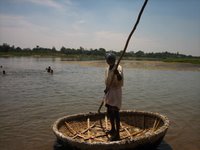
s/o. Devarasanayaka
Kaliyur, Narasipur Taluk
Mysore Dist.
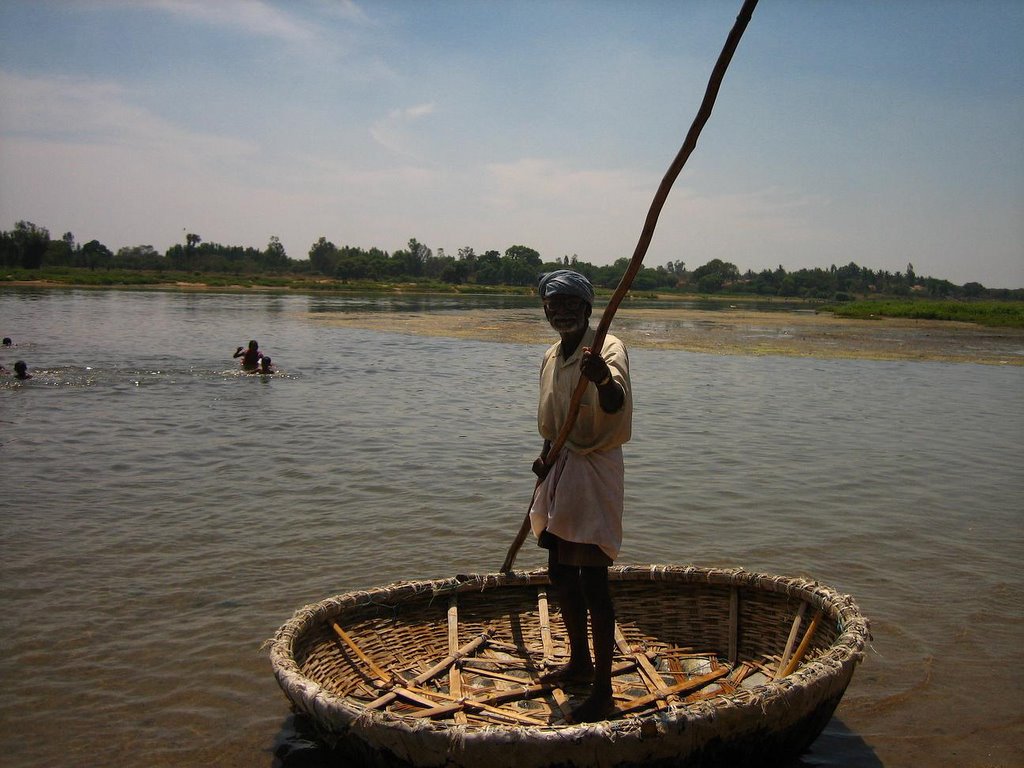
I guess everybody here knows English, given the fact its a tourist spot. The place is Talakadu, about 140 Km. from bangalore. We had just taken a ride in his "theppa" (a disc shaped boat) across to the opposite bank of Kavery and back. I also made him pose for a photograph.
The plan was to go to a place called "Shivanasamudra", a place with scenic beauty and some water falls on saturday Feb 25th 2006 so that I can attend a concert on Sunday eve (Shivaratri). But the trip got deferred to Sunday. We started off in a qualis, and after having our breakfast at a town called "Bididhi", famous for its huge idli called "thatte idli", we reached there after nearly 3 hours, not to mention the absence of a tar-road. Yet it was surreal sight watching people on top of private busses going to almost unreachable place of the same country of which Bangalore was once a part.

While travelling, I happened to see a hill to my left and a temple gopuram appeared on top of it. The driver informed us that its a nice Shiva temple. We took a detour and he parked near the base of the hill. On top of this hill called Somashaila presides Lord Mallikarjuna. Seemingly very old architecture, we had a nice bit of climb, given the fact that "Bangaloreans" tire easily.
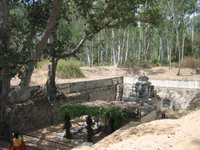 After that, we went to the Kavery river bank, and driver made it a point to repeat that all this water goes to Tamil Nadu. Perhaps he was expecting some comment from us... Anyway, we found a lot more sand than we were expecting. One can see how Kavery's course changed over the millenia. Someone told us about a few ancient recently discovered monuments and temples here. No time was lost-- up we went to the other side of the undulating land with sand top. The first monument we sighted was the Pataleshwara temple.
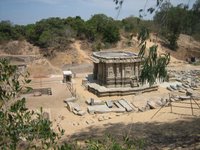 Further on, we came across a huge circular valley with a very ancient construction amidst. A guide was heard telling some interested telugu people that this was one of the pancha Narayanas established by Ramanuja. This was recently discovered and was in a bad shape before they dis-assembled it and put it back. A bigger temple also exists here, still in the dis-assembled state. Efforts are on to number the stone-blocks used and arrange them back.
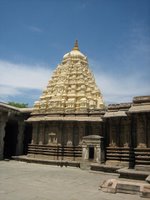
Very close by is the Vaidyeshwara temple. If the other two were old, this must be much older. With that amazing architecture in sight and no one to stop us from capturing it on camera, we cut loose with our weapons. The statue of the deity had an imposing and commanding presence, given the rather large and relatively dark hall, giving it an hoary appeal.
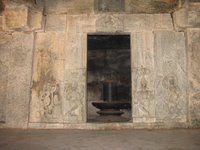
One of the places in that temple that caught my attention was the five lingas in the rooms at the back of the temple. The Linga shown here is the centre most and most imposing one. It reminds me of Egyptian Architecture. And inside lives, verily, Pharaoh of the Worlds! From here on, we went to the Kavery bank. After Swimming (I cant, so I didnt), Theppa rides and water melons , we came back here for lunch. There is a very small mess just in front of the temple declaring that it is a "brahmin tiffin and mess". What more to be needed from life?? We had our fill there alright!
All said and done, this was my best Shivaratri ever when I visited three Temples of Shiva-- one on top of a hill, one below ground and one on level ground. Lord of the Three Worlds! Icing on the cake: I cannot forget the coincidence that the boat man's name was Mahadevayya, who helped us cross the river (of our life?) on that holy day. Alas! A symbolist's predicament! Looking too much into everything!
Then we went to the water falls about an hour from there( which might need another post...)
Kedar.
I fought hard to restrain from showing any signs of amazement. Only a smile and a sideways shake of head.
"Ok. Send this picture to my address". He removed his wallet and showed his address:
D.Mahadevayya (Community Health Guide/ Boat Man)
s/o. Devarasanayaka
Kaliyur, Narasipur Taluk
Mysore Dist.
I guess everybody here knows English, given the fact its a tourist spot. The place is Talakadu, about 140 Km. from bangalore. We had just taken a ride in his "theppa" (a disc shaped boat) across to the opposite bank of Kavery and back. I also made him pose for a photograph.
The plan was to go to a place called "Shivanasamudra", a place with scenic beauty and some water falls on saturday Feb 25th 2006 so that I can attend a concert on Sunday eve (Shivaratri). But the trip got deferred to Sunday. We started off in a qualis, and after having our breakfast at a town called "Bididhi", famous for its huge idli called "thatte idli", we reached there after nearly 3 hours, not to mention the absence of a tar-road. Yet it was surreal sight watching people on top of private busses going to almost unreachable place of the same country of which Bangalore was once a part.
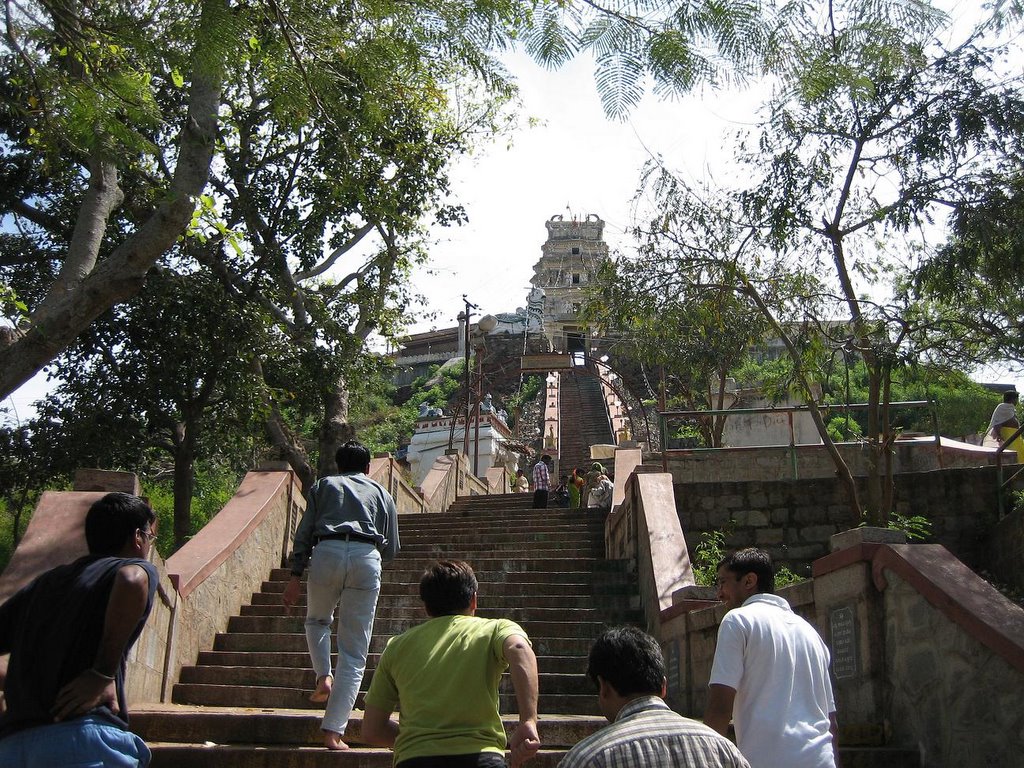
While travelling, I happened to see a hill to my left and a temple gopuram appeared on top of it. The driver informed us that its a nice Shiva temple. We took a detour and he parked near the base of the hill. On top of this hill called Somashaila presides Lord Mallikarjuna. Seemingly very old architecture, we had a nice bit of climb, given the fact that "Bangaloreans" tire easily.
 After that, we went to the Kavery river bank, and driver made it a point to repeat that all this water goes to Tamil Nadu. Perhaps he was expecting some comment from us... Anyway, we found a lot more sand than we were expecting. One can see how Kavery's course changed over the millenia. Someone told us about a few ancient recently discovered monuments and temples here. No time was lost-- up we went to the other side of the undulating land with sand top. The first monument we sighted was the Pataleshwara temple.
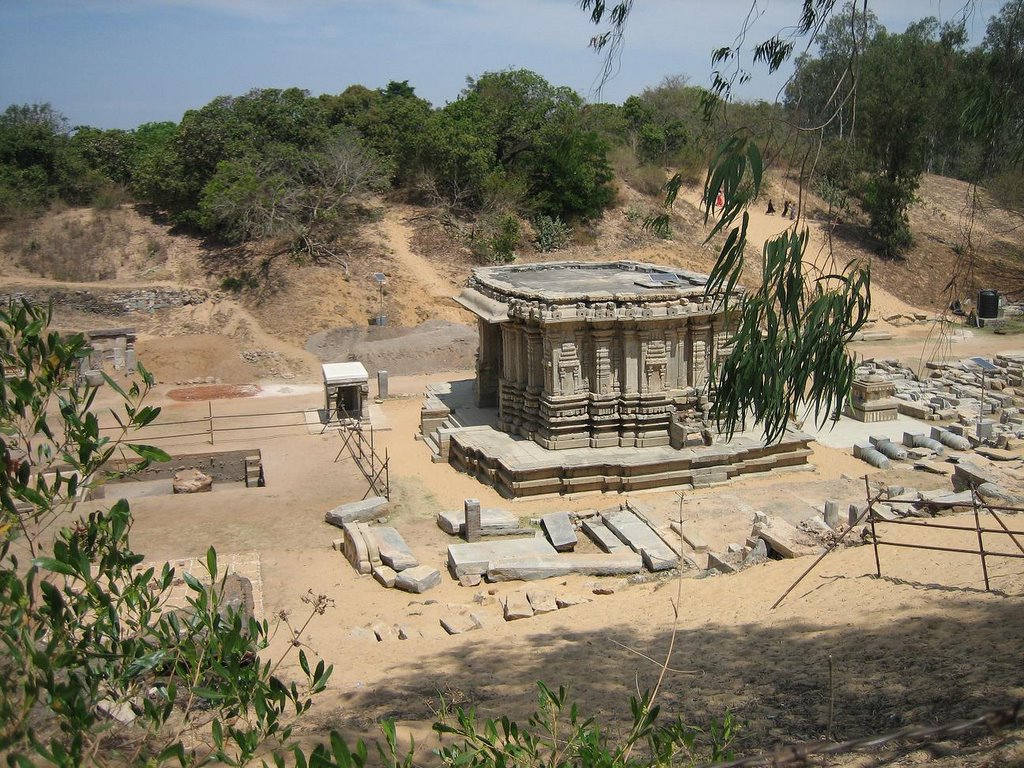 Further on, we came across a huge circular valley with a very ancient construction amidst. A guide was heard telling some interested telugu people that this was one of the pancha Narayanas established by Ramanuja. This was recently discovered and was in a bad shape before they dis-assembled it and put it back. A bigger temple also exists here, still in the dis-assembled state. Efforts are on to number the stone-blocks used and arrange them back.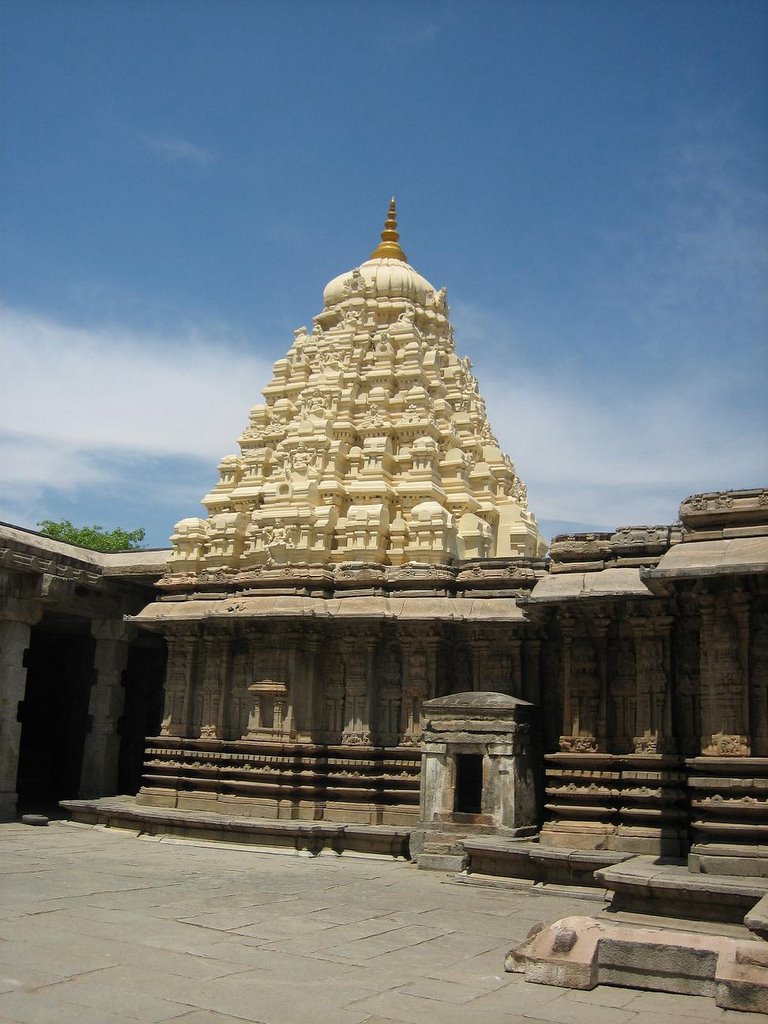
Very close by is the Vaidyeshwara temple. If the other two were old, this must be much older. With that amazing architecture in sight and no one to stop us from capturing it on camera, we cut loose with our weapons. The statue of the deity had an imposing and commanding presence, given the rather large and relatively dark hall, giving it an hoary appeal.
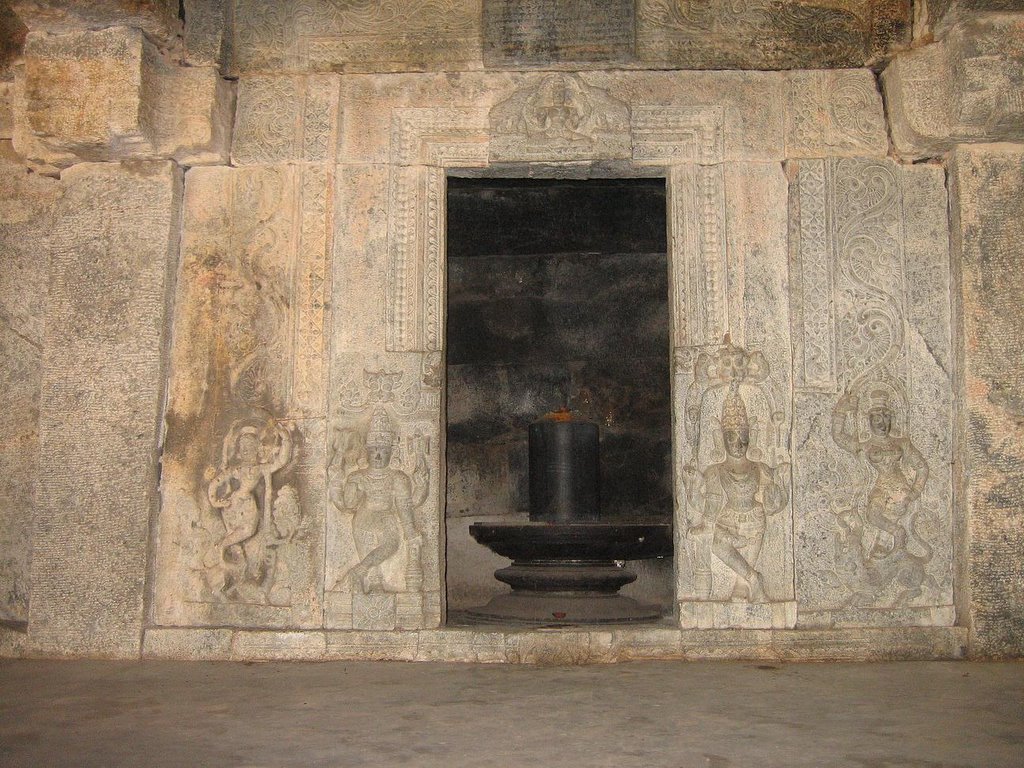
One of the places in that temple that caught my attention was the five lingas in the rooms at the back of the temple. The Linga shown here is the centre most and most imposing one. It reminds me of Egyptian Architecture. And inside lives, verily, Pharaoh of the Worlds! From here on, we went to the Kavery bank. After Swimming (I cant, so I didnt), Theppa rides and water melons , we came back here for lunch. There is a very small mess just in front of the temple declaring that it is a "brahmin tiffin and mess". What more to be needed from life?? We had our fill there alright!
All said and done, this was my best Shivaratri ever when I visited three Temples of Shiva-- one on top of a hill, one below ground and one on level ground. Lord of the Three Worlds! Icing on the cake: I cannot forget the coincidence that the boat man's name was Mahadevayya, who helped us cross the river (of our life?) on that holy day. Alas! A symbolist's predicament! Looking too much into everything!
Then we went to the water falls about an hour from there( which might need another post...)
Kedar.
Saturday, February 25, 2006
Thought process
I: O look! See the amount of cement being spent in the city. I bet, in a few years, we will run out of cement reserves.
Me: Stupid ass! Long before the reserves run out, cement will become so costly that only a few will be able to afford it.
Myself: Idiots! Long before that happens, there will be no land to build on, in the first place!!
Me: Stupid ass! Long before the reserves run out, cement will become so costly that only a few will be able to afford it.
Myself: Idiots! Long before that happens, there will be no land to build on, in the first place!!
Wednesday, February 22, 2006
A plea to save natural habitat
Long ago, I had a minor revelation about bangalore. Now, lets look at a different scene.
Magrath Road is supposed to be a posh locality. It is home to a couple of very high-class hotels in the hub of the city--in close proximity of Brigade Road, Residency Road and MG Road (every city has one, if you dont know the rule). Other than the everlasting road construction work and narrow one-way street, a very curious phenomenon is the presence of a pack of a species called "Stray dogs".
My own meditations on the presence of this species in this area told me that this is not very surprising-- a one-way street (did I mention "narrow"?) with a dead-end has very low traffic. If that street has a restaurant, then naturally it will have a lot of trash. This is a perfect place for dogs. If someone asks me what is Magrath Road most useful for, my answer will be-- to breed Stray dogs.
The only problem is a species called "Homo sapiens". What if someday, the road opens to free-flowing traffic? Or what if the authorities decide to clean-up the road? Or what if some American guy (a species very close to Indian guy, but is higher up the heirarchical ladder of economy-chain-- while he makes or breaks the economy of the world, his Indian counterpart can only get chained) finally decides to take action against stray-dogs, given the fact that there is a heavy interspecies competetion between the species of American guy and Stray dog, both competing for the same resources.
Given the jeopardy Stray dog is in, will someone not come to the aid of this mute being?
Magrath Road is supposed to be a posh locality. It is home to a couple of very high-class hotels in the hub of the city--in close proximity of Brigade Road, Residency Road and MG Road (every city has one, if you dont know the rule). Other than the everlasting road construction work and narrow one-way street, a very curious phenomenon is the presence of a pack of a species called "Stray dogs".
My own meditations on the presence of this species in this area told me that this is not very surprising-- a one-way street (did I mention "narrow"?) with a dead-end has very low traffic. If that street has a restaurant, then naturally it will have a lot of trash. This is a perfect place for dogs. If someone asks me what is Magrath Road most useful for, my answer will be-- to breed Stray dogs.
The only problem is a species called "Homo sapiens". What if someday, the road opens to free-flowing traffic? Or what if the authorities decide to clean-up the road? Or what if some American guy (a species very close to Indian guy, but is higher up the heirarchical ladder of economy-chain-- while he makes or breaks the economy of the world, his Indian counterpart can only get chained) finally decides to take action against stray-dogs, given the fact that there is a heavy interspecies competetion between the species of American guy and Stray dog, both competing for the same resources.
Given the jeopardy Stray dog is in, will someone not come to the aid of this mute being?
Monday, January 23, 2006
Identify the following compound
This is a test of your "hyderabadiness" (of course, N.A. if you are either not from Hyd or you dont claim to be from there!).
Identify the following compound "XXX":
"A panacea for several ailments which can be used both internally and externally.
DIRECTIONS FOR USE
Internal use:
COUGH COLD AND CORYZA Rub 4 drops of XXX on the neck, nose and also chest twice a day, morning and evening. It will also help if 4 drops are added to betel leaves or tea or coffee and consumed.
THROAT TROUBLE: Such as Tonsilitis, Hard Breathing and difficulty in swallowing--Add 2 drops of XXX in two to three glasses of boiling water and inhale vapour through mouth. Also paint the inside throat with swab dipped in XXX mixed with 1 oz. water
STOMACH TROUBLES: (Indigestion, Constipation, Flatulence, Loud Eructations, Bilious Retching and Loose Motions) Take 8 drops of XXX mixed with 1 oz. of water.
DYSENTERY Mix 8 drops of XXX with 10 grammes of butter or 50 grammes of curd and take twice, morning and evening on empty stomach till motions stop. Diet with barley water.
MALARIA: Fever followed by shivering-- Mix 8 drops of XXX with 1 oz. of water and take three times a day.
CHOLERA: Mix 8 drops of XXX with plain or soda water and take every 15 minutes till relief. During treatment take only Ganji or sabudana.
BREATHING TROUBLE OF CHILDREN: Mix 2 drops of XXX with mother's milk and feed the child. Also rub the chest of the child with 6 drops and foment with warm cloth. Repeat till relief. The above dosage is for children below 3 years.
External use:
HEADACHE: Rub on the forehead, 6 drops of XXX. If necessary repeat after two hours.
TOOTHACHE: Apply cotton swab soaked in XXX to the affected part ofthe gum every two hours till pain subsides.
EAR TROUBLE: Wash the affected ear with warm water and put 4 drops of XXX mixed with LUKEWARM coconut oil and plug with cotton.
PAINS: In any part of the body viz. Hands, feet, Back, Knees, etc.-- Rub on the affected part and foment with warm cloth. If the pain is chronic, mix XXX with equal quantity of kerosene oil and rub slowly twice a day morning and evening, foment with warm cloth and bandage.
SCORPION STING: Rub 4 drops of XXX on the part stung and apply heat from embers. Repeat till relief.
NOTE: XXX can be used during pregnancy also.
Identify the following compound "XXX":
"A panacea for several ailments which can be used both internally and externally.
DIRECTIONS FOR USE
Internal use:
COUGH COLD AND CORYZA Rub 4 drops of XXX on the neck, nose and also chest twice a day, morning and evening. It will also help if 4 drops are added to betel leaves or tea or coffee and consumed.
THROAT TROUBLE: Such as Tonsilitis, Hard Breathing and difficulty in swallowing--Add 2 drops of XXX in two to three glasses of boiling water and inhale vapour through mouth. Also paint the inside throat with swab dipped in XXX mixed with 1 oz. water
STOMACH TROUBLES: (Indigestion, Constipation, Flatulence, Loud Eructations, Bilious Retching and Loose Motions) Take 8 drops of XXX mixed with 1 oz. of water.
DYSENTERY Mix 8 drops of XXX with 10 grammes of butter or 50 grammes of curd and take twice, morning and evening on empty stomach till motions stop. Diet with barley water.
MALARIA: Fever followed by shivering-- Mix 8 drops of XXX with 1 oz. of water and take three times a day.
CHOLERA: Mix 8 drops of XXX with plain or soda water and take every 15 minutes till relief. During treatment take only Ganji or sabudana.
BREATHING TROUBLE OF CHILDREN: Mix 2 drops of XXX with mother's milk and feed the child. Also rub the chest of the child with 6 drops and foment with warm cloth. Repeat till relief. The above dosage is for children below 3 years.
External use:
HEADACHE: Rub on the forehead, 6 drops of XXX. If necessary repeat after two hours.
TOOTHACHE: Apply cotton swab soaked in XXX to the affected part ofthe gum every two hours till pain subsides.
EAR TROUBLE: Wash the affected ear with warm water and put 4 drops of XXX mixed with LUKEWARM coconut oil and plug with cotton.
PAINS: In any part of the body viz. Hands, feet, Back, Knees, etc.-- Rub on the affected part and foment with warm cloth. If the pain is chronic, mix XXX with equal quantity of kerosene oil and rub slowly twice a day morning and evening, foment with warm cloth and bandage.
SCORPION STING: Rub 4 drops of XXX on the part stung and apply heat from embers. Repeat till relief.
NOTE: XXX can be used during pregnancy also.
Wednesday, December 21, 2005
Arda Vs. Aryavartha
Arda Vs. Aryavartha
The juxtaposition of Indian Mythology with Tolkien's Mythology produces some very interesting parallels. However, I strongly suggest that they remain only those-- parallels, and I urge the readers against riding the current band-wagon of "everything is Indian".
It is interesting that Tolkien's literature doesnt have the words "God" or "Divine". His world (called the Arda, of which "Middle-Earth" forms a part) is a quite natural , matter-of-fact one where "magic", or "divine intervention" as Jules puts it in "Pulp Fiction", are as present as they are absent. The people depend on their own selves for protection and expect no miracle from any deity. But then there are Miracles and unexplained incidents. As for Elves, that which Samwise calls magic, is what they call skill-- the same skill that wrought the Silmarils, rings of power and the cloaks of the Fellowship.
Tolkein, as is said by himself, wanted to create a mythology for England because it had none of its own. The central theme of Ainulindale and Valaquenta, the first two chapters of Silmarillion is the concept of One God, Angels, and a fallen Angel who turns people away from Good-- the premises of Christianity. But along the way, because of the robustness of the starting idea and the fecund imagination of Tolkien, the mythology departed from its starting point and took on a unique form of itself. It is a kown fact that Tolkien, a professor of Old English and a Historian, included also the elements of the Nordic mythology into his world-- the Elven language of Quenya is supposed to be derived from Finnish. Yet, the ancient pre-abrahamic nature-worshipping mythologies of the world are so connected that we can already see parallels emerging thereof between the two aforementioned in the title.
It is worthwhile to note that the powers of the world, collectively called the Valar (plural of Vala), are much more than just Angels of the Abrahamic religions--
Manwe, the King of Valar, is the lord of winds,
Varda (who in middle-earth is called Elbereth), Manwe's consort is the giver of light-- she made the stars and the ancient lamps that shone in Arda,
Aule is lord of all the Arda's crust-- Mountains, plains, etc,
Yavanna, Aule's consort holds dominion on all things that green and growing,
Ulmo is the lord of waters, and so on...
In a single sentence, they are powers of nature, the equivalent of the 33 deities of Rig Veda suggesting a polytheistic nature resembling those of Greeco-Roman or Nordic Mythos.
Yet, there is a deeper similarity than this: Silmarillion begins (I think) with:
"In the beginning there was Eru, the One, who in Arda is called Illuvatar". Illuvatar is of course the name for "God" in Tolkien's Myth and then the story continues saying that He created the Ainur, of who, the Valar are the more powerful ones. This should immediately lead us to the concept of "Henotheism"-- the Vedic religion, and the Indian religion right now, demanded a seperate kind of term to describe them-- They are polytheistic on the outer side, but the concept of "One" forms the underlying matrix for all theories that emanate out of them. Also, note that the conept of "One" is absent from Greeco-Roman and Nordic Mythologies.
Secondly, Ainulindale-- "The Music of the Ainur" is said to have made the world. The One gave them a theme to sing and when they sang it, the world materialised out of their song. This, as Indians, we can relate to the concept of "aadi naada"-- the eternal anaahata (meaning that which doesnt make a "sound") rhythm that existed before eternity.
And lastly, if you look at the map of Arda in the First Age (which resembles a real-world map), you will find that the land of Hildorien, where Men woke up first i.e., created, lies exactly where India is. Well, well...Ahem! No comments.
well, actually 2 final comments:
1) Alas that people talk of "the others" in the same breath as Tolkien!
2) Since I am not a scholar, I dont have to bother about copyrights (or copylefts) of this very important article.
The juxtaposition of Indian Mythology with Tolkien's Mythology produces some very interesting parallels. However, I strongly suggest that they remain only those-- parallels, and I urge the readers against riding the current band-wagon of "everything is Indian".
It is interesting that Tolkien's literature doesnt have the words "God" or "Divine". His world (called the Arda, of which "Middle-Earth" forms a part) is a quite natural , matter-of-fact one where "magic", or "divine intervention" as Jules puts it in "Pulp Fiction", are as present as they are absent. The people depend on their own selves for protection and expect no miracle from any deity. But then there are Miracles and unexplained incidents. As for Elves, that which Samwise calls magic, is what they call skill-- the same skill that wrought the Silmarils, rings of power and the cloaks of the Fellowship.
Tolkein, as is said by himself, wanted to create a mythology for England because it had none of its own. The central theme of Ainulindale and Valaquenta, the first two chapters of Silmarillion is the concept of One God, Angels, and a fallen Angel who turns people away from Good-- the premises of Christianity. But along the way, because of the robustness of the starting idea and the fecund imagination of Tolkien, the mythology departed from its starting point and took on a unique form of itself. It is a kown fact that Tolkien, a professor of Old English and a Historian, included also the elements of the Nordic mythology into his world-- the Elven language of Quenya is supposed to be derived from Finnish. Yet, the ancient pre-abrahamic nature-worshipping mythologies of the world are so connected that we can already see parallels emerging thereof between the two aforementioned in the title.
It is worthwhile to note that the powers of the world, collectively called the Valar (plural of Vala), are much more than just Angels of the Abrahamic religions--
Manwe, the King of Valar, is the lord of winds,
Varda (who in middle-earth is called Elbereth), Manwe's consort is the giver of light-- she made the stars and the ancient lamps that shone in Arda,
Aule is lord of all the Arda's crust-- Mountains, plains, etc,
Yavanna, Aule's consort holds dominion on all things that green and growing,
Ulmo is the lord of waters, and so on...
In a single sentence, they are powers of nature, the equivalent of the 33 deities of Rig Veda suggesting a polytheistic nature resembling those of Greeco-Roman or Nordic Mythos.
Yet, there is a deeper similarity than this: Silmarillion begins (I think) with:
"In the beginning there was Eru, the One, who in Arda is called Illuvatar". Illuvatar is of course the name for "God" in Tolkien's Myth and then the story continues saying that He created the Ainur, of who, the Valar are the more powerful ones. This should immediately lead us to the concept of "Henotheism"-- the Vedic religion, and the Indian religion right now, demanded a seperate kind of term to describe them-- They are polytheistic on the outer side, but the concept of "One" forms the underlying matrix for all theories that emanate out of them. Also, note that the conept of "One" is absent from Greeco-Roman and Nordic Mythologies.
Secondly, Ainulindale-- "The Music of the Ainur" is said to have made the world. The One gave them a theme to sing and when they sang it, the world materialised out of their song. This, as Indians, we can relate to the concept of "aadi naada"-- the eternal anaahata (meaning that which doesnt make a "sound") rhythm that existed before eternity.
And lastly, if you look at the map of Arda in the First Age (which resembles a real-world map), you will find that the land of Hildorien, where Men woke up first i.e., created, lies exactly where India is. Well, well...Ahem! No comments.
well, actually 2 final comments:
1) Alas that people talk of "the others" in the same breath as Tolkien!
2) Since I am not a scholar, I dont have to bother about copyrights (or copylefts) of this very important article.
Monday, December 19, 2005
Of Caradhras and Tom Bambadil
All the characters in LOTR are divided into two camps-- powers of light and justice symbolising the good and powers of darnkess symbolising the bad. One one level, this seems very much like the wars of Aryas and Dasyus and Devas and Asuras highlighted in Rig Veda, though it might take a different kind of post to delve into the similarities between Tolkienian world called "middle earth" and the world described in the Rig Veda.
Only two characters of LOTR are mysterious in their aspect of siding with no one-- they serve no master and they have none to do them homage.
One of them is Tom Bombadil and the other, Mount Caradhras. In the movie, Tom is of course conspicuous by his absence but Caradhras by himself is shown powerless -- Saruman is shown chanting curses from the top of the Orthanc tower to cause the snowfall on Caradhras. In the book, Caradhras has his own personality and it is told that he does not like humans (men) climbing him, so he causes snowfall on his own. Yet, he is not in league with Sauron. He simply doesnt want any man to cross him, and he doesnt care about the tidings of the world. This actually makes sense because He was there even before Morgoth, the master of Sauron corrupted the earth, and He knows He will be there even after the dominion of Sauron, though Sauron were to regain the One and his rule lasted an eternity.
On the other hand, Tom is shown to be indifferent to the power of the One Ring, or rather, the One has no power over him. He is shown to be happy in his own place with his "goldberry" by his side and he is a gentle, humane, and good and he is said to be "the eldest" (curiously, the same title is conferred by Galadriel to Treebeard). Yet, he is not on the side of elves, dwarves or men though he will help those in his land at need.
Some feel that the inclusion of Tom Bombadil is the only weak link in the most robust "true fiction" produced in the twentieth century. The song and story of Tom Bombadil was written by Tolkien for kids before he began writing LOTR, and then, for some reason that either I dont know or dont remember, he included it in the story. When Frodo reaches Rivendel and the council of Elrond begins, Tolkien promptly covers his tracks by saying that its not wise to give Tom the responsibility of guarding the One Ring because he would be negligent and might throw it away simply because he is unaffected by it. Hmm... Convincing?
There are many theories about who Tom Bombadil is, the most popular being one that associates Tom with Aule and Goldberry with Yavanna, though that has been disproved by some.
Nevertheless, we do see that there are striking similarities between the way the two are dealt with-- showing that there are many other powers in the world that are either good or bad by nature, though it is not necessary that they be in league with the respective "eponymous" powers.
Only two characters of LOTR are mysterious in their aspect of siding with no one-- they serve no master and they have none to do them homage.
One of them is Tom Bombadil and the other, Mount Caradhras. In the movie, Tom is of course conspicuous by his absence but Caradhras by himself is shown powerless -- Saruman is shown chanting curses from the top of the Orthanc tower to cause the snowfall on Caradhras. In the book, Caradhras has his own personality and it is told that he does not like humans (men) climbing him, so he causes snowfall on his own. Yet, he is not in league with Sauron. He simply doesnt want any man to cross him, and he doesnt care about the tidings of the world. This actually makes sense because He was there even before Morgoth, the master of Sauron corrupted the earth, and He knows He will be there even after the dominion of Sauron, though Sauron were to regain the One and his rule lasted an eternity.
On the other hand, Tom is shown to be indifferent to the power of the One Ring, or rather, the One has no power over him. He is shown to be happy in his own place with his "goldberry" by his side and he is a gentle, humane, and good and he is said to be "the eldest" (curiously, the same title is conferred by Galadriel to Treebeard). Yet, he is not on the side of elves, dwarves or men though he will help those in his land at need.
Some feel that the inclusion of Tom Bombadil is the only weak link in the most robust "true fiction" produced in the twentieth century. The song and story of Tom Bombadil was written by Tolkien for kids before he began writing LOTR, and then, for some reason that either I dont know or dont remember, he included it in the story. When Frodo reaches Rivendel and the council of Elrond begins, Tolkien promptly covers his tracks by saying that its not wise to give Tom the responsibility of guarding the One Ring because he would be negligent and might throw it away simply because he is unaffected by it. Hmm... Convincing?
There are many theories about who Tom Bombadil is, the most popular being one that associates Tom with Aule and Goldberry with Yavanna, though that has been disproved by some.
Nevertheless, we do see that there are striking similarities between the way the two are dealt with-- showing that there are many other powers in the world that are either good or bad by nature, though it is not necessary that they be in league with the respective "eponymous" powers.
Monday, December 05, 2005
Vande Mataram
1) Vande Mataram Traditional, in Desh.
2) Vande Mataram rendition by Sudha Raghunathan,in traditional Desh tune (with her own spin).
3) Vande Mataram from Anand Math (1951) (I am afraid this is not the original song sung by Hemant Kumar et al).
4) Vande Mataram in Khambavati by a seemingly young Mogubai Kurdikar (Mother of Kishori Amonkar).. a very old recording-- 1947.
5) Vande Mataram in Brindavani Saranga by Vishnupant Phagnis.. this is older-- 1920s.
6) Vande Mataram in kafi by Omkarnath Thakur. Again, very old-- 1938-39.
7) Vande Mataram from "Vande Mataram" album by A.R.Rahman -- Traditional, in Desh with wonderful Saxophone by Chris "Snake" Davis.
2) Vande Mataram rendition by Sudha Raghunathan,in traditional Desh tune (with her own spin).
3) Vande Mataram from Anand Math (1951) (I am afraid this is not the original song sung by Hemant Kumar et al).
4) Vande Mataram in Khambavati by a seemingly young Mogubai Kurdikar (Mother of Kishori Amonkar).. a very old recording-- 1947.
5) Vande Mataram in Brindavani Saranga by Vishnupant Phagnis.. this is older-- 1920s.
6) Vande Mataram in kafi by Omkarnath Thakur. Again, very old-- 1938-39.
7) Vande Mataram from "Vande Mataram" album by A.R.Rahman -- Traditional, in Desh with wonderful Saxophone by Chris "Snake" Davis.
Wednesday, November 30, 2005
the other one...
this is the other one that is a bit interesting... A very old sketch, it had to pass through the seven seas (and the customs) more than once!
Tuesday, November 29, 2005
One of mine as well...
I left sketching long ago... here is one of those... I am not sure if any one recognises who she is supposed to be.
Friday, November 18, 2005
Osmania Biscuit XI-- Straange!!!
OK!
Before I reveal how Lingam Yadav and Obul Reddy finally come face to face, let me actually tell you some history of Lingam, which is of course completely irrelevant to the context. Nevertheless, I have decided to reveal this matter of complete secrecy, though I cant give any explanation of why would someone want to hide it or why would someone want to tell such a claptrap (synonyms: moonshine, gobbledygook, balderdash, hogwash, baloney).
Anyways, though most of the Yadavs of Saleemnagar Colony, Malakpet (Hyd-36) trace their origin from UP directly, the family of Lingam has had quite interesting tale in terms of the devious route it took...
When Krishna convinced peoople of Mathura that Mathura is no longer a safe refuge against the recurring invasions of the Mighty Emperor of Magadh- Jarasandha, many people joined him in that epic journey and they reached the Prabhasa Kshetra in Gujarat and established the city of Dwaraka. Now, as time flew, people began to settle more and more inwards and southwards. The Yadavs in question migrated after many centuries to the south of the Vindhya mountains, and settled in the country there along with many others.
Those were tumultous times...
Clearly the people of Dwaraka were excellent in cattle management-- the quality of milk, the species of buffalo and cow, and the kind of grass the fed to the cattle were all mysteriously wonderful. Through marine trade, the people of Dwaraka actually succeeded in bringing the best grass of south american grasslands (which, actually, scientists later found out to be "alfa-alfa" from the Pampas). So, very soon, they began to grow very rich and be held in high esteem.
Now the Rashtrakuta King (Rashtrakutas were a dynasty that ruled over Maharashtra in ancient times) was very wise, though meek, and his general was constantly plotting to pull off a coup and become the King. But the Yadavs (who had now risen to become the royal advisors ) saw through this plot and were ever eager to alert the King of the general's evil intentions. So you see, the Yadavs incurred the wrath of the general.
One night, after a celebration of cow festival, when everyone thought peace reigned supreme in the land, the general finally executed his long-planned plan, and of course, his planning was very well planned as well.
After taking control of the army, he slew the King's personal guard, went into the royal chamber and murdered the King. Hence, to the history, he is well-known (notoriously) as Dhondoba Et-tu-bruté.
The Yadavs were not spared as well... many of their folk were put to death. Lingam's ancestor (known only as "Bongu") had only a single child, and the couple were chased throughout the village and they fled into the graveyard, where the killers didnt dare come because of the undertaker Sepulkar, who was believed to be a master of black magic. Presently, Sepulkar was busy dealing with own enemy, the short-tempered and "hot"headed Thermal Jain, who had insulted him 17 years ago. Though Thermal Jain was a good natured Marwadi, he was short-tempered and that caused his downfall.
So, Sepulkar didnt budge from his crusade and so the couple had to run elsewhere for help. Luckily, they found the good natured prostitute hukkar and her pimp-cum-boyfriend fakkar. They knew the importance of tte Yadav dynasty and the help it would render to the coming Indian generations. Also, they wanted to do the right thing once in their life of sin. So, exchanged clothes with the Yadav couple and ran in the direction of the killers, succesfully diverting their attention (some attribute the origin of STDs in Maharashtra to this moment in History).
Thus escaping, the Yadav couple made their way down south, in a city where people from different regions and languages co-existed. They came to a house which was shared by three bachelors-- Smelly-onian from the Tamil land, feno-menon from "geraLa" and piss-in-the-paati from Andhra. Thus the Yadav dynasty was secured and they began to live a decent life in that area (A lot of stories are woven around these three bachelors-- about their earlier witty exploits, and later about their comicly succesfull efforts to save "the Bongu's Heir" but this is not the time). Lingam's great grandfather (titled Bongu-IV) moved to Naizaam during World War II, and settled in a village near the then Hyderabad called "theegalaguda". Later, the very same area is known as Saleem Nagar.
Note : This history is recorded in the journals of the japanese monk EkO naaraayaanaa when he visited India.
Before I reveal how Lingam Yadav and Obul Reddy finally come face to face, let me actually tell you some history of Lingam, which is of course completely irrelevant to the context. Nevertheless, I have decided to reveal this matter of complete secrecy, though I cant give any explanation of why would someone want to hide it or why would someone want to tell such a claptrap (synonyms: moonshine, gobbledygook, balderdash, hogwash, baloney).
Anyways, though most of the Yadavs of Saleemnagar Colony, Malakpet (Hyd-36) trace their origin from UP directly, the family of Lingam has had quite interesting tale in terms of the devious route it took...
When Krishna convinced peoople of Mathura that Mathura is no longer a safe refuge against the recurring invasions of the Mighty Emperor of Magadh- Jarasandha, many people joined him in that epic journey and they reached the Prabhasa Kshetra in Gujarat and established the city of Dwaraka. Now, as time flew, people began to settle more and more inwards and southwards. The Yadavs in question migrated after many centuries to the south of the Vindhya mountains, and settled in the country there along with many others.
Those were tumultous times...
Clearly the people of Dwaraka were excellent in cattle management-- the quality of milk, the species of buffalo and cow, and the kind of grass the fed to the cattle were all mysteriously wonderful. Through marine trade, the people of Dwaraka actually succeeded in bringing the best grass of south american grasslands (which, actually, scientists later found out to be "alfa-alfa" from the Pampas). So, very soon, they began to grow very rich and be held in high esteem.
Now the Rashtrakuta King (Rashtrakutas were a dynasty that ruled over Maharashtra in ancient times) was very wise, though meek, and his general was constantly plotting to pull off a coup and become the King. But the Yadavs (who had now risen to become the royal advisors ) saw through this plot and were ever eager to alert the King of the general's evil intentions. So you see, the Yadavs incurred the wrath of the general.
One night, after a celebration of cow festival, when everyone thought peace reigned supreme in the land, the general finally executed his long-planned plan, and of course, his planning was very well planned as well.
After taking control of the army, he slew the King's personal guard, went into the royal chamber and murdered the King. Hence, to the history, he is well-known (notoriously) as Dhondoba Et-tu-bruté.
The Yadavs were not spared as well... many of their folk were put to death. Lingam's ancestor (known only as "Bongu") had only a single child, and the couple were chased throughout the village and they fled into the graveyard, where the killers didnt dare come because of the undertaker Sepulkar, who was believed to be a master of black magic. Presently, Sepulkar was busy dealing with own enemy, the short-tempered and "hot"headed Thermal Jain, who had insulted him 17 years ago. Though Thermal Jain was a good natured Marwadi, he was short-tempered and that caused his downfall.
So, Sepulkar didnt budge from his crusade and so the couple had to run elsewhere for help. Luckily, they found the good natured prostitute hukkar and her pimp-cum-boyfriend fakkar. They knew the importance of tte Yadav dynasty and the help it would render to the coming Indian generations. Also, they wanted to do the right thing once in their life of sin. So, exchanged clothes with the Yadav couple and ran in the direction of the killers, succesfully diverting their attention (some attribute the origin of STDs in Maharashtra to this moment in History).
Thus escaping, the Yadav couple made their way down south, in a city where people from different regions and languages co-existed. They came to a house which was shared by three bachelors-- Smelly-onian from the Tamil land, feno-menon from "geraLa" and piss-in-the-paati from Andhra. Thus the Yadav dynasty was secured and they began to live a decent life in that area (A lot of stories are woven around these three bachelors-- about their earlier witty exploits, and later about their comicly succesfull efforts to save "the Bongu's Heir" but this is not the time). Lingam's great grandfather (titled Bongu-IV) moved to Naizaam during World War II, and settled in a village near the then Hyderabad called "theegalaguda". Later, the very same area is known as Saleem Nagar.
Note : This history is recorded in the journals of the japanese monk EkO naaraayaanaa when he visited India.
Subscribe to:
Posts (Atom)